 By st20113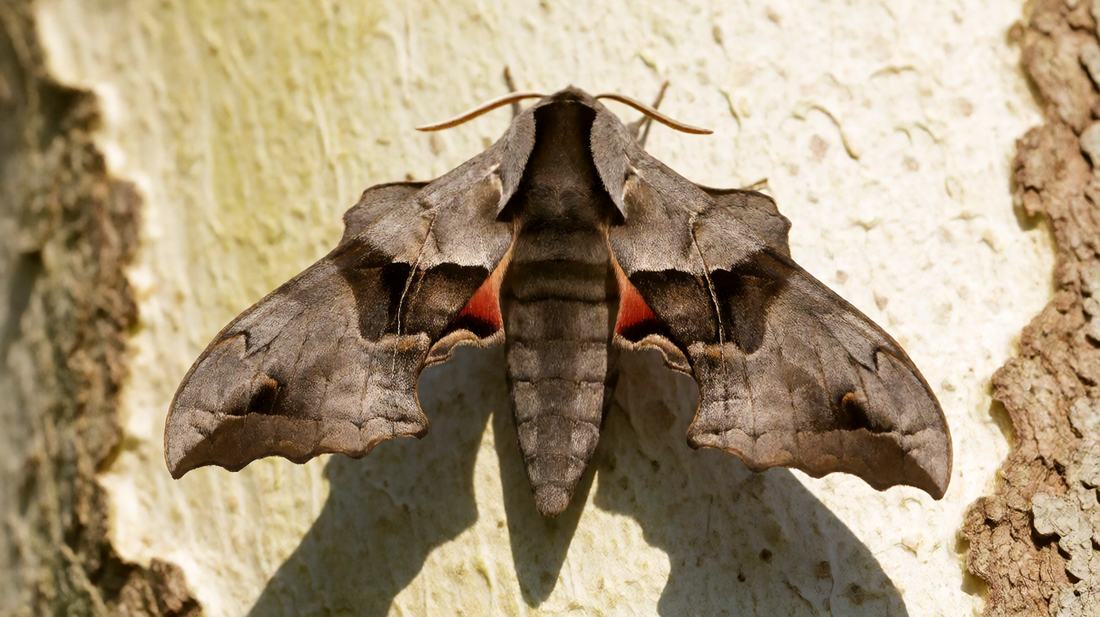
Laothoe populi | Poplar Hawk-moth
Species Profile · Sphingidae
Poplar Hawk-moth
The hawk-moth that refuses to look like a hawk-moth: it rests flat against the bark like a torn leaf — and the adult cannot feed at all.
IUCN: Not Evaluated
Range
Wingspan
Eggs
Larva
Broods
The moth that looks like a leaf
One of Europe’s largest, and one of the commonest
The poplar hawk-moth is one of the largest moths in Europe. It is also one of the commonest, and one of the strangest to look at. Most hawk-moths rest with their wings folded over the back like a tent. This one holds its wings flat and swept back. The smaller hindwings are pushed forward under the forewings. The abdomen curls up at the tip.
The resting insect looks like a torn, crumpled dead leaf. The pattern is mottled grey-brown or red-brown. The wing edges are scalloped. Against bark or dry foliage the moth is almost invisible. It flies at night and comes well to light. In a garden with poplars and willows it is often the largest thing in the trap.
The adults cannot feed at all. Their mouthparts are reduced to small stubs. The weeks of life left to them are paid for out of the food they ate as caterpillars. The species is widespread and common across Europe and temperate Asia. It lives in most of Britain, including parks, gardens and city centres. It reaches even those places where its food plants have been planted.
Family tree
Laothoe, hawk-moths with reduced mouths
The poplar hawk-moth sits in the family Sphingidae, the hawk-moths. It belongs to the subfamily Smerinthinae. That group has reduced mouthparts and a special resting posture. Linnaeus described the species in 1758 as Sphinx populi. It was later moved to the genus Laothoe. That genus holds a few species across the temperate north. The species name populi refers to the poplar, the caterpillar’s food plant.
The classification has been stable for a long time. The moth sits in the tribe Smerinthini, with the eyed hawk-moth and the lime hawk-moth. That group is well defined by anatomy, pheromone chemistry and DNA. Its closest relative in European gardens is the privet hawk-moth. The two share a family but not their habits. Beginners often confuse them, and the difference is useful. The privet hawk-moth rests with its wings folded over its back.
Its hindwings carry bright pink and black bands. The poplar hawk-moth lies flat against the surface. Its hindwings point forward and show only a small rust-orange patch. Within its genus it is the most widespread and abundant member. It is the species most often seen by people who never set out to look for moths.
Flat wings, curled abdomen
How to identify one
The poplar hawk-moth is a heavy-bodied insect. Its wingspan is 65 to 100 mm. That puts it among the largest moths in European gardens. The forewings vary a lot from one individual to the next. They range from pale grey through buff and red-brown to dark chocolate brown. Each wing carries darker bands. The outer edge is scalloped and carries a small white crescent mark. The hindwings are smaller and usually hidden. Each carries a patch of fox-red or orange-brown at its base.
The body is thick and furry and matches the wings. At rest the abdomen curls upwards at the tip. The underside is paler and more even. The resting posture is the species’ most distinctive feature. The hindwings fan forwards, in front of the leading edge of the forewings. That breaks the straight line of the wing margin. The insect then looks like a piece of broken leaf. The abdomen curls up behind. The disguise is so good that a moth on a fence post goes unseen at arm’s length.
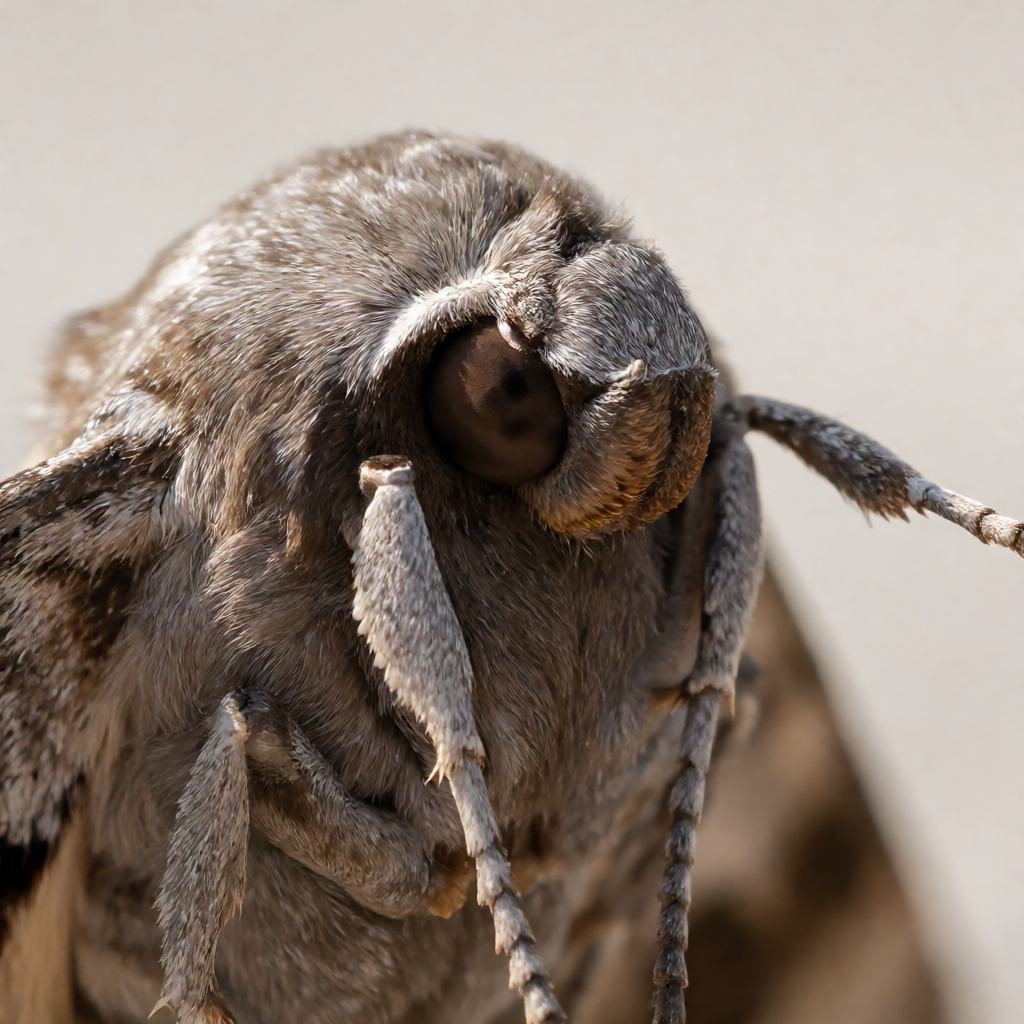
If the moth is disturbed it drops the disguise. It flashes the orange-brown patches on its hindwings. That startle display makes a bird hesitate for a moment. The antennae are short and pale. In most hawk-moths the mouthparts form a long proboscis for drinking nectar. Here they are reduced to small stubs. That one detail governs the adult’s whole way of life.
1
2
3
Wherever poplars grow
Where it lives
The poplar hawk-moth lives wherever its caterpillar’s food plants grow. In practice that means poplars, aspens and willows. It is found in woodland and woodland edges, hedgerows, scrub, carr and fen. It also uses riverbanks, moorland with sallow, parks and large gardens. It even uses city streets where poplars were planted as street trees. The species is widespread and common across most of Europe. Its range runs east through temperate Asia. It is one of the commonest hawk-moths in Britain. It is recorded in the great majority of the country’s 10 km squares.
It is missing only from the far north and from parts of the Scottish islands. The adults are nocturnal. They spend the day hidden on bark, on fence posts, among foliage or on the ground. They rely on camouflage rather than on flight. They are strongly drawn to artificial light at night. That is why they turn up in moth traps and on lit windows so often. In most of Britain the species has a single generation each year. Adults fly from late April to July and peak from late May to late July. In the warmer south a second generation can appear in August and September.
That happens mostly in good summers. The caterpillars of that second brood feed through late summer and autumn. The caterpillar lives openly on the food plants. It feeds on the leaves from June to early October. When fully grown it drops to the ground and burrows into the soil to pupate. The pupa is dark red-brown and spends the winter underground. That stage, not the egg or the adult, carries the species through the cold months.
The adult cannot feed
What it eats
The adult poplar hawk-moth does not feed. That is not a simplification. The mouthparts of the adults are reduced and cannot work. The insect cannot take in nectar, water or anything else after it leaves the pupa. The adult lives for several weeks. It must survive on the fat and glycogen it stored as a caterpillar. That is why the caterpillar feeds so heavily and grows so large. The caterpillar is a specialist leaf eater. Its main food plants are poplars, above all the aspen, Populus tremula.
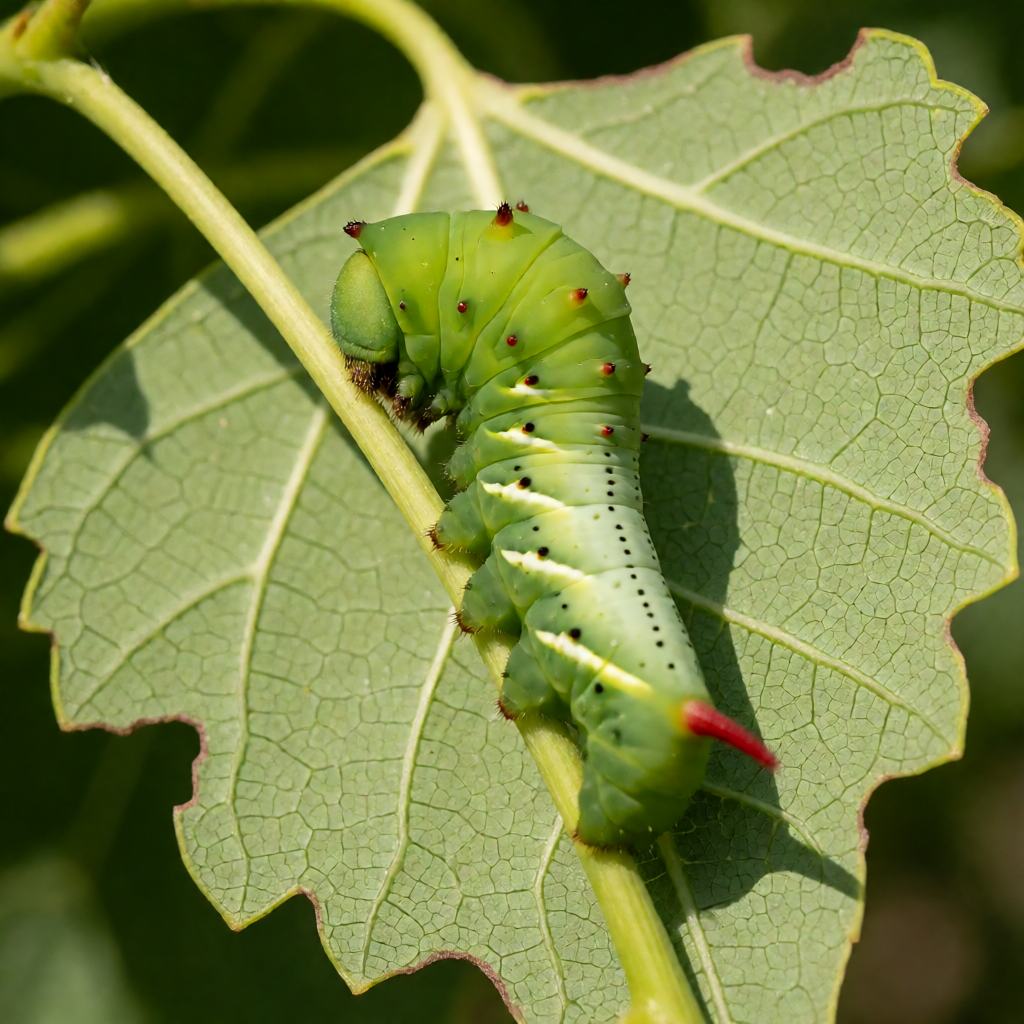
It also uses willows and sallows, plus planted poplar species and their hybrids. It feeds openly on the foliage. When not eating it rests along the midrib of a leaf or on a stem. Its colour is bright green. A series of diagonal yellow or pale stripes crosses each pair of segments. That breaks up its outline against the leaves. Some individuals carry small red spots. All of them have a horn at the tail end. It is a pointed green projection with a red or purple tip.
It looks threatening but is harmless and cannot sting or bite. Fully grown caterpillars reach 75 to 85 mm and are noticeably stout. Females lay their eggs singly rather than in batches. They place each one on the underside of a leaf. A single female can lay up to 200 eggs. The young larvae hatch after about 2 weeks and start feeding at once. A heavy brood can strip a small tree or a group of sallows quite bare by late summer. The plants usually recover the next year.
200 eggs, one at a time
The breeding cycle
The poplar hawk-moth finds a mate by scent rather than sight. A female that has left her pupa releases a pheromone from a gland at the tip of the abdomen. Males pick it up with their large, feathery antennae. They fly upwind to find her, often from a long way off. Both sexes are nocturnal. Pairing happens at night, often in the early hours. The female then lays her eggs singly. She glues each one to the underside of a leaf of the food plant. She lays up to 200 over several days.
The eggs are pale green and hatch in about 2 weeks, depending on the temperature. The caterpillar passes through 5 larval stages. It feeds hard on poplar or willow leaves. In a few weeks it grows from a few millimetres to 75 or 85 mm. When it is fully fed it stops eating and darkens. It descends from the food plant to the ground and burrows down. There it forms a cell in the soil and turns into a pupa. That takes several days. The pupa lies buried below the surface with no cocoon to protect it.
In most of the range it stays in the soil until the following spring. In the warmer south some pupae develop quickly. They produce a second generation in the same year and emerge in August and September. The adults that emerge do not feed. They live only a few weeks, long enough to mate and to lay. The species cannot build up reserves as an adult. So its whole output depends on how well the caterpillar fed. A poor summer for the food plants shows up in the moths of the next season.
Not Evaluated, not at risk
Conservation
The poplar hawk-moth has not been assessed for the global IUCN Red List. It is therefore listed as Not Evaluated. It is not a species of concern. National and regional lists in Britain and in Flanders class it as Least Concern. It is described as common and widespread. It is not thought to be under threat in any significant part of its range. The reasons are simple.
Its caterpillars can use several widespread and often weedy food plants, including planted poplars. The adults need no food at all. So the species does not depend on flower-rich habitats in the way that most butterflies do. It also tolerates a very wide range of habitats, from fen and moorland to city streets. It disperses well enough to colonise new plantings of poplar and willow quickly. Local pressures are real but limited. The removal of mature poplars and willows for safety reasons takes away food.
So does the drainage of fens and carr woodland, and the loss of wet woodland. Moth trapping surveys show that the species is still abundant over most of its range. It is one of the standard species seen in light traps across Europe. Where poplars and willows are planted in the landscape, the moth’s fortunes follow the planting. It can be helped simply by keeping willows and poplars rather than felling them. A gardener who plants sallow or aspen can expect caterpillars within a few seasons.
Quick hits
Five things to remember
- The adults cannot feed at all and live on reserves stored as caterpillars.
- It rests with its wings flat and swept back, so it looks like a dead leaf.
- Disturbed moths flash patches of fox-red on the hindwings to startle predators.
- A single female can lay up to 200 eggs, one at a time on a leaf.
- The caterpillar reaches 75 or 85 mm and carries a harmless horn at the tail.