 By st20113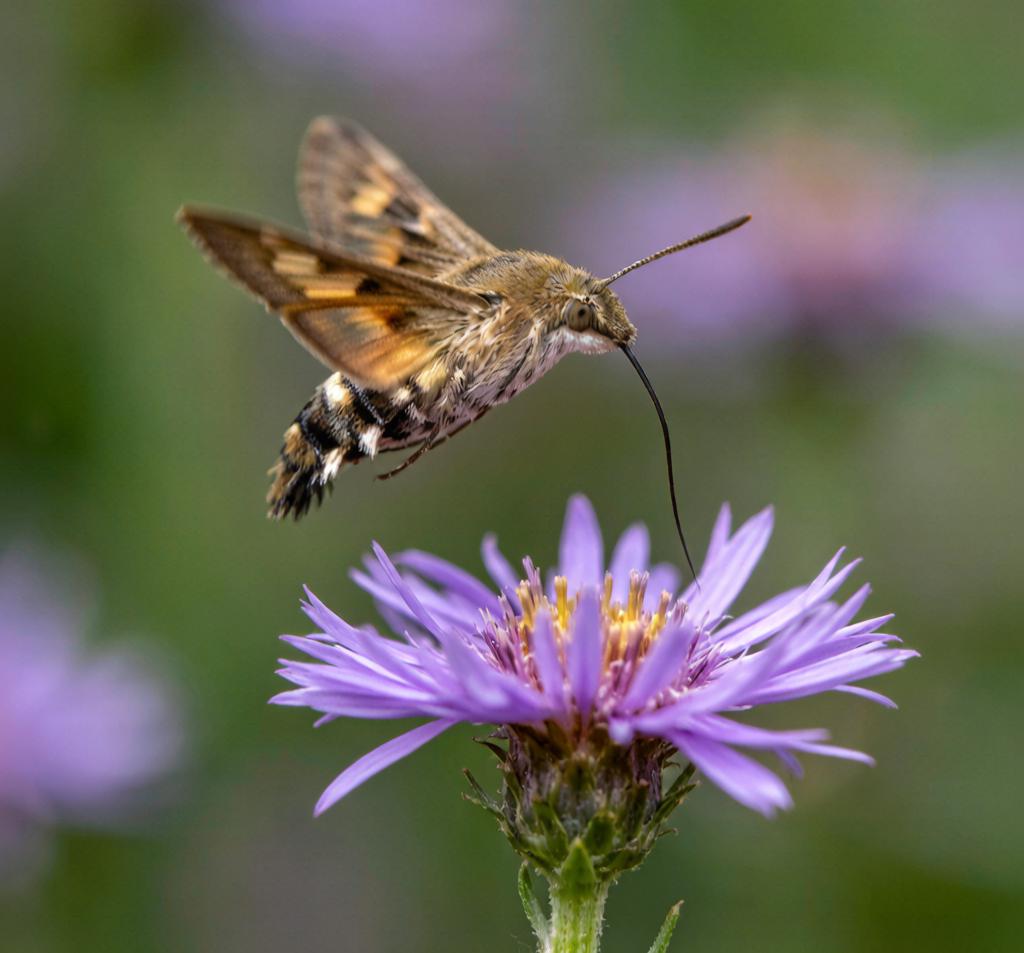
Introduction
The hummingbird hawk-moth is one of the most astonishing insects in Europe, named for its uncanny resemblance to a small hummingbird as it hovers at flowers with wings a blur.
Found from the British Isles and Scandinavia south to North Africa and east to Japan, it is a strong migratory flyer capable of colonizing new areas each summer.
Unlike most moths, it is fully day-flying, visiting gardens, meadows, and cliff faces where its preferred food plants and larval bedstraw grow.
Its larvae feed on various bedstraw species, and the species overwinters as an adult in mild regions or as a pupa in cooler climates.
Its cosmopolitan range and approachable nature have made it a favourite subject for nature photographers and garden naturalists worldwide.
Taxonomy
The hummingbird hawk-moth belongs to the family Sphingidae, a global family of more than 1,400 species of large, rapid-flying moths with long proboscis adapted for hovering nectar feeding.
Its genus Macroglossum, meaning long tongue, contains approximately 100 species distributed across every continent except Antarctica.
Macroglossum stellatarum was described by Linnaeus in 1758, making it one of the earliest formally named Sphingidae species.
The species is considered monotypic, with no recognized subspecies despite its vast range from the Atlantic Islands to Japan.
Physical Characteristics
The hummingbird hawk-moth is a medium-large moth with a wingspan of 45 to 62 millimetres and a body length of 20 to 28 millimetres.
The forewings are greyish-brown with subtle dark transverse lines providing camouflage against bark and stone when at rest.
The hindwings are orange-russet, visible as a flash of colour when the moth hovers, and the abdomen is stout and tapered.
The head bears large compound eyes with a metallic green or bronze sheen and a remarkable long, slender proboscis that can exceed 28 millimetres in length.
Habitat
The hummingbird hawk-moth occupies a vast range of open habitats including Mediterranean scrubland, wildflower meadows, alpine meadows, parklands, and gardens.
It is highly adaptable to urban environments and is a frequent garden visitor in Europe, hovering at honeysuckle, petunia, verbena, and a wide range of ornamental flowers.
Its strong flying ability allows it to colonize isolated islands and high mountain valleys far from permanent populations.
Migration brings individuals north into Scandinavia and the British Isles each summer, where they breed in pockets of suitable habitat before returning south in autumn.
Diet
The hummingbird hawk-moth is a specialized nectarivore, with a long, slender proboscis perfectly adapted for reaching deep into tubular flowers that most other insects cannot access.
Preferred nectar sources include honeysuckle, jasmine, phlox, petunia, buddleia, and a wide range of garden ornamental plants.
Unlike honeybees and bumblebees, the species is not flower-constant and visits a wide range of flower shapes and colours as they become available.
Larvae feed almost exclusively on various species of bedstraw, a large genus of herbaceous plants found in meadows, woodland clearings, and hedgerows.
Reproduction
Two to three generations are produced annually in southern parts of the range, with a single generation in northern regions.
Males locate females by following pheromone plumes, and mating at flowers or resting sites lasts 30 to 90 minutes.
Females lay 150 to 200 small, pale green eggs of approximately 1.5 millimetres singly on bedstraw leaves and stems.
The larval stage lasts 20 to 30 days through five instars, with final-instar larvae growing to approximately 50 millimetres before pupating in soil or dense vegetation.
Conservation
The hummingbird hawk-moth is assessed as Least Concern globally, with a vast range and population that appears stable and may be expanding in northern regions.
Primary threats include habitat loss through agricultural intensification, the use of neonicotinoid insecticides that reduce insect prey availability, and wildflower habitat conversion.
Climate change appears to be benefiting the species by extending its northern breeding range and allowing multiple generations where only one was historically possible.
Maintaining wildflower-rich gardens, reducing pesticide use, and preserving natural meadows all support healthy populations of this charismatic garden visitor.
Fun Facts
Individuals have been tagged in southern England and recovered thousands of kilometres away in the Mediterranean basin, demonstrating exceptional migratory range for a moth.
In cold weather, the moth raises its thoracic temperature by vibrating its wings before takeoff, foraging in conditions that would ground most other flying insects.
Its remarkable resemblance to hummingbirds is an evolved adaptation to exploit the same ecological niche of hovering nectar feeding, one of the most spectacular cases of convergent evolution on Earth.
The peacock butterfly shares garden habitats with the hummingbird hawk-moth, both day-flying insects attracted to the same nectar flowers.
The red admiral butterfly is a frequent garden companion of the hummingbird hawk-moth, with both migrating north each summer.
The seven-spot ladybird is a common garden insect found alongside the hummingbird hawk-moth in flower-rich habitats across Europe.
[…] of the genus Sphinx within the family Sphingidae, the hawk-moths. It is a close cousin of the Hummingbird Hawk-moth, though that species hovers by day while the privet hawk-moth flies at night. The family also […]