 By st20113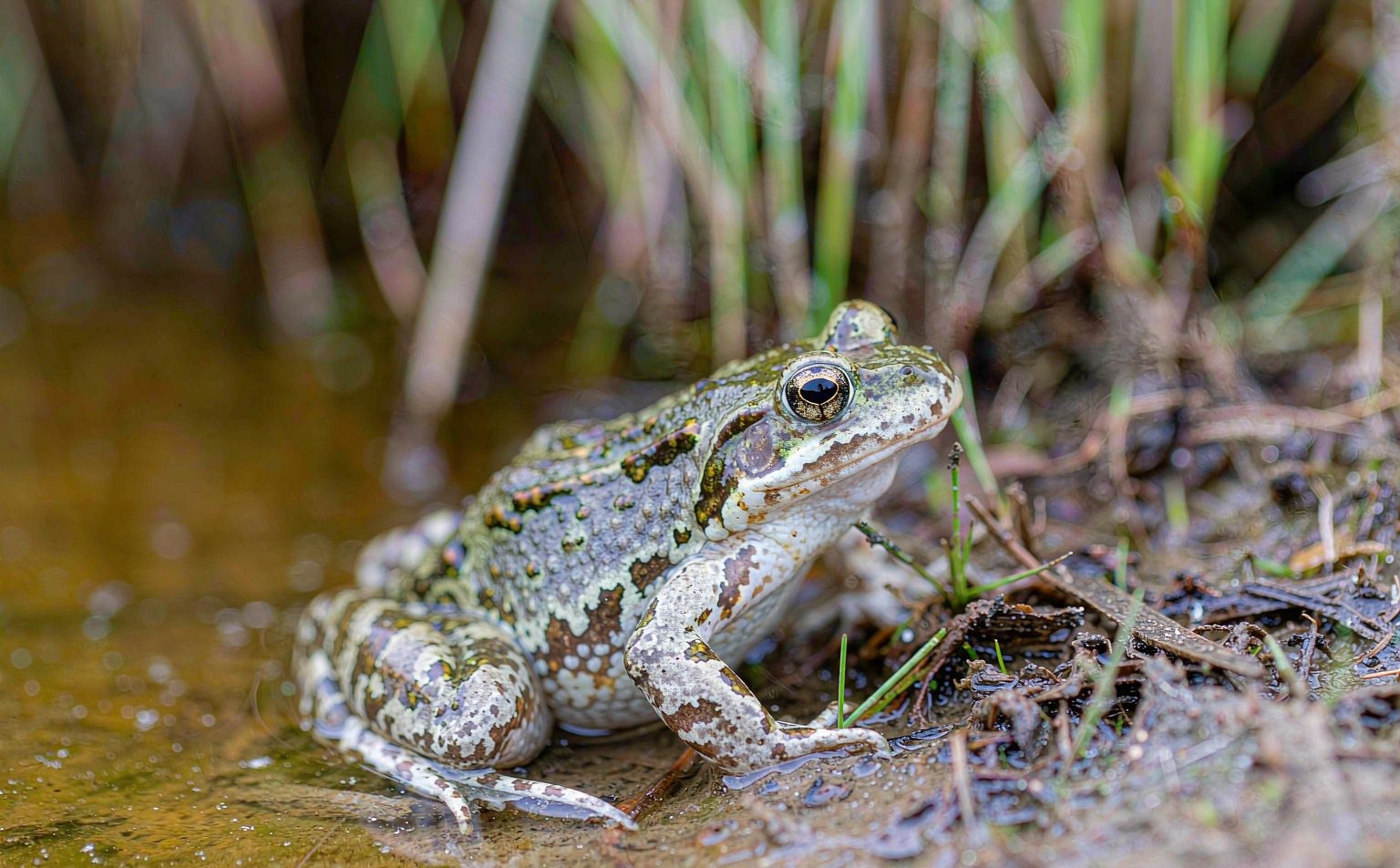
Discoglossus pictus | Painted Frog
Introduction
The Painted Frog (Discoglossus pictus) is a small, secretive amphibian native to the wetlands of North Africa and the islands of Malta and Sicily, with established introduced populations in southern France and south-west Spain. Unlike the smooth-skinned frogs of northern Europe, it belongs to the archaic family Alytidae, the “painted frogs” and midwife toads, a group that has changed little in body plan for tens of millions of years. Its common name comes from the intricate pattern of dark blotches and a pale, often yellow-edged stripe along the back that gives each individual a hand-painted look. Active mostly at dusk and after rain, the Painted Frog is a familiar voice in Mediterranean reed beds, where its short, explosive call carries across still water.
Taxonomy
Discoglossus pictus was first described by the Italian naturalist Oronzio Gabriele Costa in 1837 and remains the type species of the genus Discoglossus. The genus sits within Alytidae, a family it shares with the well-known Common Tree Frog‘s more distant relatives and with other fragmented-backed frogs. Close relatives include Pelophylax cambiensis and the broader European ranid frogs such as Rana temporaria and Rana dalmatina, though those belong to separate families and are not direct kin. Two subspecies are generally recognised, the nominate D. p. pictus of Tunisia and D. p. auritus of Algeria, the latter bearing a more prominent ridge behind the eye.
Physical Characteristics
An adult Painted Frog measures 4.5 to 8 centimetres from snout to vent, with females noticeably larger than males. The body is compact and broad-headed, and the eyes sit high on the skull with vertical, cat-like pupils—a feature shared with its alytid relatives and unusual among typical frogs. The skin is finely granular. Coloration is highly variable: the upper surfaces range from olive, grey-brown or reddish to almost black, overlaid with an irregular net of darker marbling and a pale mid-dorsal line that may be cream, yellow or orange. The underside is pale, often mottled with grey. The hind limbs are relatively short for a frog, and the toes are only weakly webbed, reflecting a lifestyle that is as much on land among damp vegetation as in the water. A fold of skin runs from the eye to the shoulder, and the tympanum (eardrum) is hidden or barely visible.
Habitat
Painted Frogs occupy a broad band of Mediterranean and sub-Mediterranean wetland habitats: permanent and temporary ponds, slow canals, coastal lagoons, freshwater marshes, and the margins of rivers and reservoirs. They are tolerant of slightly brackish water and are often found in disturbed ground such as rice paddies, garden pools and irrigation ditches. In their introduced French and Spanish range they have colonised similar lowland wetlands and even urban parks. During the heat of summer they retreat into cool, shaded refuges under stones, roots and dense grass, emerging when humidity rises. They are essentially lowland animals, rarely found above a few hundred metres.
Diet
Like most frogs, the Painted Frog is a generalist carnivore that feeds on whatever small invertebrate prey it can overpower. The diet is dominated by ants, beetles, flies, mosquitoes and other aquatic and terrestrial insects, together with worms, spiders and small crustaceans when available. Hunting is chiefly ambush-based: the frog waits motionless and flicks out its sticky tongue to capture passing prey. Tadpoles are differently equipped, grazing on algae and detritus on the pond bottom and filtering fine organic particles from the water column.
Reproduction
Breeding begins with the autumn rains and can extend through winter into spring in milder parts of the range. Males call from shallow water, often hidden among vegetation, producing a short, dry “breck” repeated at intervals. Females lay eggs singly or in small loose clusters attached to submerged plant stems and debris, rather than in the large gelatinous rafts typical of many frogs. A single female may deposit several hundred eggs across a season. The tadpoles are unusual in the family for being free-swimming and bottom-dwelling, developing over roughly two to three months depending on water temperature. Metamorphosis produces tiny froglets that disperse into the surrounding damp vegetation.
Conservation
Within its native North African and Sicilian-Maltese range the Painted Frog is still common and is not considered globally threatened, though local drainage of wetlands and pesticide use in agriculture reduce some populations. The species has been assessed as of Least Concern by the IUCN. Its introduced populations in France and Spain, however, have prompted ecological concern: in the Camargue and neighbouring wetlands it can occur at very high density and may compete with native amphibians. Because of this, management in parts of its introduced range monitors its spread. Habitat protection of Mediterranean ponds and responsible control of invasive spread both contribute to the species’ long-term outlook.
Fun Facts
- The Painted Frog’s vertical pupils close to thin slits in bright light, a trait more typical of toads than of smooth frogs.
- Each individual’s back pattern is unique, making the “painted” name literally true for every frog.
- It belongs to one of the most ancient frog lineages on Earth, little changed since the time of the dinosaurs.
- In Malta the species is a celebrated native amphibian and appears on local conservation materials.
- The tadpoles breathe partly through external gills early on, then through lungs, like miniature underwater metamorphosing dragons.