 By st20113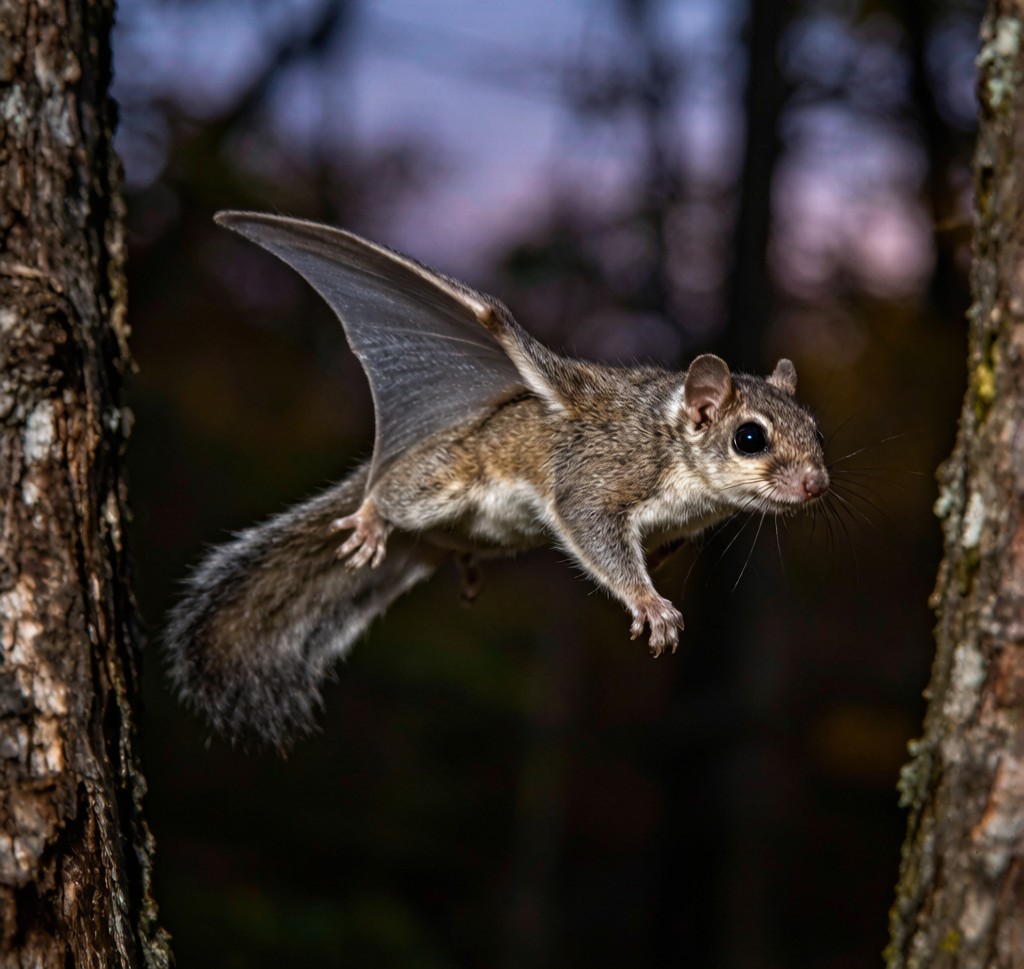
Overview
The Southern Flying Squirrel (Glaucomys volans) is one of the most extraordinary mammals in the forests of eastern North America – a small, nocturnal creature that appears to fly through the forest at night, gliding from tree to tree with astonishing grace and precision. Despite the name, flying squirrels do not actually fly: they glide, using a unique membrane of skin called a patagium that stretches between the wrist and ankle on each side of the body. When the squirrel leaps from a tree and extends its limbs, the patagium opens out like a square parachute, generating lift and allowing the animal to glide gracefully through the air for distances of up to 30 meters or more. The Southern Flying Squirrel is the most common of the three species of flying squirrel in North America, and one of the most frequently observed – despite its nocturnal habits – thanks to its habit of visiting bird feeders at night.
The Southern Flying Squirrel is a small mammal – one of the smallest tree squirrels in North America – with a body length of approximately 12 to 15 centimeters and a weight of 55 to 85 grams. Its fur is soft and silky, grey-brown on the upperparts and white or cream on the belly, and its large, prominent eyes – each over 1 centimeter in diameter – are perfectly adapted for nocturnal vision. The species’ tail is flattened and broad, functioning as a rudder during glides to steer and control the direction of flight. Despite its gliding abilities, the Southern Flying Squirrel is largely arboreal, rarely descending to the ground except to cross small gaps or retrieve fallen food items.
Habitat and Distribution
The Southern Flying Squirrel occurs throughout the deciduous and mixed forests of eastern North America – from southern Canada (Ontario, Quebec, and Nova Scotia) south through the eastern United States to Florida and Texas, and into Mexico, Guatemala, and Honduras. Within this broad range, the species is associated primarily with mature deciduous and mixed forest containing tree species that produce acorns, hickory nuts, and other hard mast – the primary food sources on which the squirrel depends throughout the year. The species is most abundant in forest with a well-developed canopy, abundant dead standing trees (which provide nesting cavities), and diverse tree species that ensure a reliable supply of food across the seasons.
Southern Flying Squirrels are highly dependent on tree cavities for nesting – they rarely if ever build the leafy nests (dreys) constructed by other tree squirrels. They nest in natural tree cavities (typically old woodpecker holes), nesting boxes, and occasionally in the abandoned nests of other animals. In the northern parts of their range, Southern Flying Squirrels are known to form communal nests during the winter – clusters of up to 20 or more individuals huddling together in a tree cavity to conserve heat. These communal winter nests are a remarkable example of social behavior in a typically solitary small mammal and are critical for survival in the cold northern winters.
Gliding and Navigation
The Southern Flying Squirrel’s gliding ability is one of the most impressive examples of aerial locomotion in the animal kingdom. To initiate a glide, the squirrel climbs to a high point on a tree and launches itself outward, spreading its limbs to deploy the patagium. During the glide – which typically lasts 1 to 3 seconds – the squirrel can adjust the shape and angle of the patagium to control the glide angle and direction, making mid-air adjustments that allow it to navigate around obstacles and land precisely on a target tree. The flattened tail provides additional directional control, acting as a rudder and stabilizer. Glides of 30 meters or more are common in good conditions, and the squirrel lands on the tree trunk feet-first, using its claws to grip the bark and prevent a fall.
Southern Flying Squirrels are nocturnal and do almost all of their gliding at night – a behavior that is thought to reduce the risk of predation by diurnal birds of prey. Their large eyes give them excellent night vision, and they are also able to navigate using their sense of smell and tactile cues. The squirrels are highly territorial during the breeding season but maintain overlapping home ranges at other times of year. Their diet is dominated by nuts, seeds, and tree buds, supplemented by fungi, berries, insects, and bird eggs. They store food – particularly nuts and seeds – in caches during the autumn, which they retrieve and eat during the winter.
Conservation
The Southern Flying Squirrel is listed as Least Concern on the IUCN Red List, reflecting its relatively large population and broad range. However, the species faces localized conservation challenges in parts of its range. The fragmentation and loss of mature deciduous forest in the eastern United States has reduced the availability of the old-growth habitat with large, cavity-bearing trees that Southern Flying Squirrels require for nesting. The introduction of the competitively superior Northern Flying Squirrel (Glaucomys sabrinus) in parts of the northeastern U.S. has also caused local Southern Flying Squirrel populations to decline.
In the Appalachian Mountains, Southern Flying Squirrels are the primary prey of the Endangered Northern Spotted Owl and the Endangered Cooper’s Hawk, making them a critical component of the food web in Appalachian forests. The species also serves as a major disperser of the seeds of hardwood trees including oaks and hickories, contributing to forest regeneration. Conservation efforts focus on protecting and maintaining mature forest habitat, preserving dead standing trees that provide nesting cavities, and installing nesting boxes in areas where natural cavities are scarce. Encouraging forest owners to maintain old-growth characteristics on their land is increasingly recognized as important for maintaining Southern Flying Squirrel populations.