 By st20113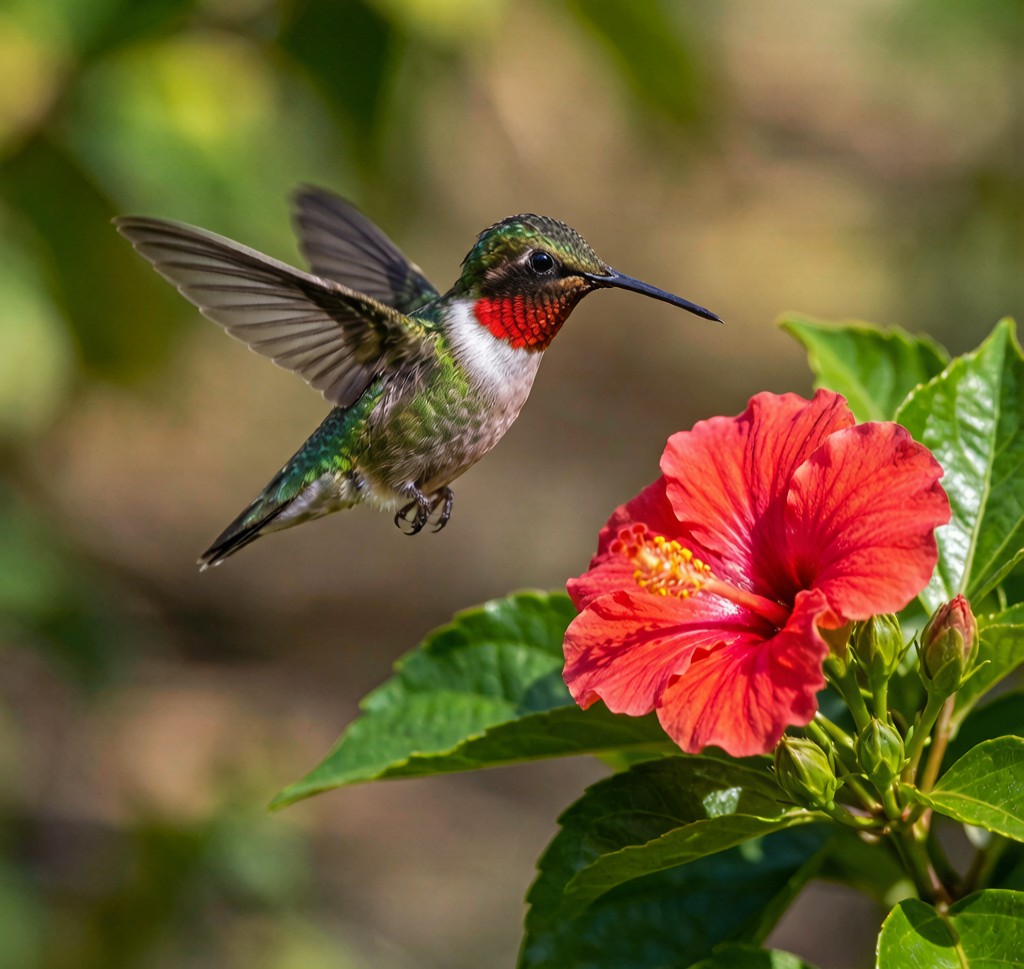
Overview
The Ruby-throated Hummingbird (Archilochus colubris) is one of the most beloved and magical birds in North America – a tiny, jewel-like creature that seems to defy the laws of physics as it hovers motionless in front of flowers, flies backward, and darts through the air at speeds of up to 50 kilometers per hour. Weighing just 3 to 4 grams – less than a U.S. penny – the Ruby-throated Hummingbird is one of the smallest birds in the world, measuring only 7 to 9 centimeters in length with a wingspan of 8 to 11 centimeters. The male is instantly recognizable in good light: its throat (gorget) glows an intense, luminous ruby red that appears to shift through the spectrum from orange to purple as the light catches the iridescent feathers at different angles.
Hummingbirds are found exclusively in the Americas, from Alaska to Tierra del Fuego, and are one of the most specialized and successful groups of birds on the continent. Their most remarkable feature is their flight capability: hummingbirds are the only group of birds capable of true hovering – sustained, stationary flight in which the wings beat in a figure-eight pattern at approximately 50 to 80 beats per second, generating enough lift to cancel out the bird’s weight. This extraordinary flight ability allows hummingbirds to feed while hovering in front of flowers, a feeding strategy that has driven the coevolution of hundreds of plant and hummingbird species throughout the Americas.
Metabolism and Energy
The Ruby-throated Hummingbird’s most remarkable characteristic is its extraordinarily high metabolism. Relative to body size, the hummingbird has the highest metabolic rate of any vertebrate – approximately 10 times that of a human and 2 times that of a racehorse. To sustain this metabolism, a Ruby-throated Hummingbird must consume approximately half its body weight in sugar every day, visiting hundreds of flowers and consuming up to 2,000 flower visits in a single day. The hummingbird’s diet consists almost entirely of flower nectar – a sugar-rich liquid produced by plants to attract pollinators – supplemented by small insects and spiders that provide essential protein and nutrients not available from nectar.
To survive the night when it cannot feed, the Ruby-throated Hummingbird enters a state of torpor – a hibernation-like condition in which its metabolic rate, heart rate, and body temperature drop dramatically to conserve energy. During torpor, a hummingbird’s heart rate may fall from approximately 1,200 beats per minute to just 50 to 180 beats per minute, and its body temperature may drop by 50 percent or more. This daily energy-saving strategy is essential for survival: without torpor, a hummingbird would starve to death overnight. The hummingbird’s ability to enter and exit torpor rapidly – within minutes – is one of the most remarkable physiological adaptations in the animal kingdom.
Pollination and Coevolution
The relationship between hummingbirds and the flowers they pollinate is one of the most celebrated examples of coevolution in nature. Over millions of years, the flowers preferred by hummingbirds have evolved a suite of traits – including tubular red or orange flowers, abundant nectar, and no landing platform – that are specifically adapted to the hummingbird’s morphology and behavior. In turn, hummingbirds have evolved long, slender bills and tongues that can reach nectar deep within tubular flowers, and specialized flight capabilities that allow them to hover and feed efficiently.
The Ruby-throated Hummingbird is an important pollinator of many wildflowers in eastern North American forests, including columbine, cardinal flower, bee balm, and trumpet vine. The species also visits garden flowers including petunias, impatiens, and honeysuckle. While feeding, the hummingbird’s head contacts the flower’s reproductive structures, picking up pollen from the anthers and depositing it on the stigma of the next flower visited – a highly efficient pollination mechanism. The ruby-throated hummingbird’s remarkable migration – each fall, most individuals fly non-stop across the Gulf of Mexico from the U.S. Gulf Coast to the Yucatan Peninsula, a journey of approximately 800 kilometers that takes 18 to 22 hours – is one of the most demanding migratory flights of any bird, requiring enormous energy reserves built up over several weeks of intensive feeding.
Conservation
The Ruby-throated Hummingbird is listed as Least Concern on the IUCN Red List, reflecting its large and apparently stable population – estimated at approximately 34 million individuals – and its broad breeding and wintering range. However, the species faces a number of conservation threats, particularly during migration and on its wintering grounds in Central America. The conversion of tropical forest to agriculture and pasture in Mexico and Central America has reduced the availability of winter habitat and food resources, and the use of pesticides in gardens eliminates the insect prey that hummingbirds need for protein. Climate change may also affect the timing of plant flowering and the availability of nectar resources during migration.
Conservation efforts for the Ruby-throated Hummingbird focus on protecting and restoring tropical forest habitat in Central America, reducing pesticide use in gardens and agricultural settings, and providing supplementary food through hummingbird feeders – which, while not a substitute for natural habitat, can provide crucial energy for migrating individuals. Providing hummingbird feeders and native plant gardens in North American cities and suburbs has helped support urban populations and may contribute to population connectivity. The extraordinary popularity of hummingbirds among birdwatchers and nature enthusiasts has also generated significant public support for conservation of their habitats throughout the Americas.