 By st20113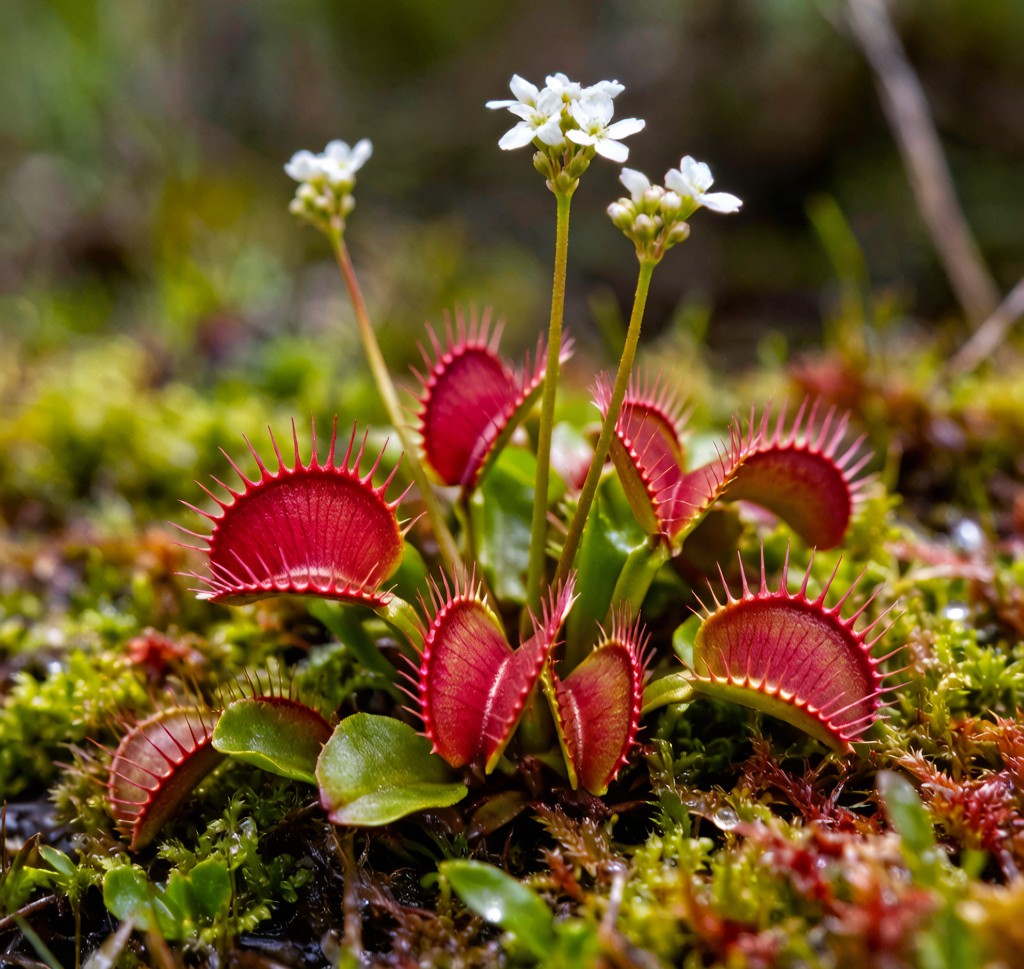
Overview
The Venus Flytrap (Dionaea muscipula) is perhaps the most famous plant in the world – a carnivorous plant that moves with startling speed to trap and digest insects, capturing the popular imagination like almost no other plant. Found in the wild only in a tiny area of coastal North and South Carolina – within approximately 100 kilometers of Wilmington, North Carolina – the Venus Flytrap is one of the most geographically restricted flowering plants on Earth and one of the most unusual. Its leaves are modified into highly specialized traps – hinged, jaw-like structures with interlocking teeth fringing the edges and trigger hairs lining the interior – that snap shut on any insect unlucky enough to trigger them.
The Venus Flytrap’s trap mechanism is one of the fastest plant movements known to science. When an insect touches one of the trigger hairs inside the trap twice within approximately 20 seconds, or touches two different trigger hairs in quick succession, the trap snaps shut in a fraction of a second – approximately 100 milliseconds – one of the fastest movements of any plant. The trap does not close completely initially; the interlocking teeth form a cage that allows small insects to escape while trapping larger ones. If the trapped item is not food (a leaf fragment, a stone, or an insect too small to be worth digesting), the trap will reopen after approximately 12 hours. If it is a suitable prey item, the trap seals completely and begins digesting, a process that takes 5 to 12 days.
Habitat and Distribution
The Venus Flytrap occurs naturally in only a tiny area of the southeastern United States – the coastal plain of North and South Carolina, primarily within approximately 75 kilometers of Wilmington, North Carolina. Within this limited range, the species is restricted to specific, highly specialized habitat: wet, nutrient-poor, acidic, sandy and peaty soils in fire-maintained longleaf pine savannas and wetlands, where lightning fires prevent the growth of competing vegetation and maintain the open, low-competition conditions that the Venus Flytrap requires. The species’ dependence on fire-maintained habitats makes it extremely vulnerable to fire suppression and habitat alteration.
The soils in which Venus Flytraps grow are among the most inhospitable to plants: nutrient-poor, waterlogged, and highly acidic, with nitrogen and phosphorus availability so low that few plants can survive. These conditions have driven the evolution of carnivory in Venus Flytraps and the other carnivorous plants – including sundews, bladderworts, and pitcher plants – that share its habitat. The Venus Flytrap’s carnivorous strategy – catching and digesting insects – provides the nitrogen and phosphorus that are unavailable from the soil, allowing the plant to thrive in conditions where competing plants cannot survive.
Carnivory Mechanism
The Venus Flytrap’s carnivorous mechanism is one of the most sophisticated in the plant kingdom and involves a remarkable combination of mechanical, electrical, and biochemical processes. The trigger hairs inside the trap are sensory structures that detect the movement of prey through fine mechanical displacement. When triggered, they generate an electrical signal – an action potential similar to the nerve impulses in animals – that travels through the trap tissue and triggers the rapid opening-to-closing response. This electrical signaling mechanism was first demonstrated in the 19th century by Charles Darwin, who described the Venus Flytrap as “one of the most wonderful in the world.”
Once closed, the trap seals and begins producing digestive enzymes – including proteases, phosphatases, and esterases – that break down the soft tissues of the prey into a nutrient-rich soup that the trap can absorb. Digestion typically takes 5 to 12 days, after which the trap reopens, the remains of the prey (typically just the dry exoskeleton) fall out or are washed away, and the trap is ready to function again. Each trap can cycle through this process only approximately 3 to 5 times before it loses its ability to close and turns black – a lifespan of approximately 2 to 3 months. The Venus Flytrap compensates for this relatively short trap lifespan by continuously producing new traps from its underground rhizome.
Conservation
The Venus Flytrap is listed as Vulnerable on the IUCN Red List and is listed under Appendix II of CITES, reflecting serious concerns about its long-term survival in the wild. The species has undergone dramatic population declines over the past several decades, with estimates suggesting that fewer than 300,000 individuals remain in the wild compared to an estimated 4.5 million in the 1970s – a decline of approximately 93 percent. The primary threats are habitat loss due to development, forestry, and agriculture; fire suppression (which allows competing vegetation to outcompete Venus Flytraps); and illegal collection for the horticultural trade. Poaching Venus Flytraps from public and private land is a serious and ongoing problem.
Despite its precarious wild status, the Venus Flytrap is one of the most widely cultivated plants in the world, with millions of cultivated specimens produced annually for the horticultural trade. Commercial cultivation is generally considered the most important factor in preventing the species from becoming extinct: as long as cultivated populations are maintained, the species will survive even if wild populations are lost. Conservation efforts in the wild focus on protecting remaining populations within state and federal conservation areas, implementing prescribed burning programs to maintain open habitat, and enforcing laws against illegal collection.