 By st20113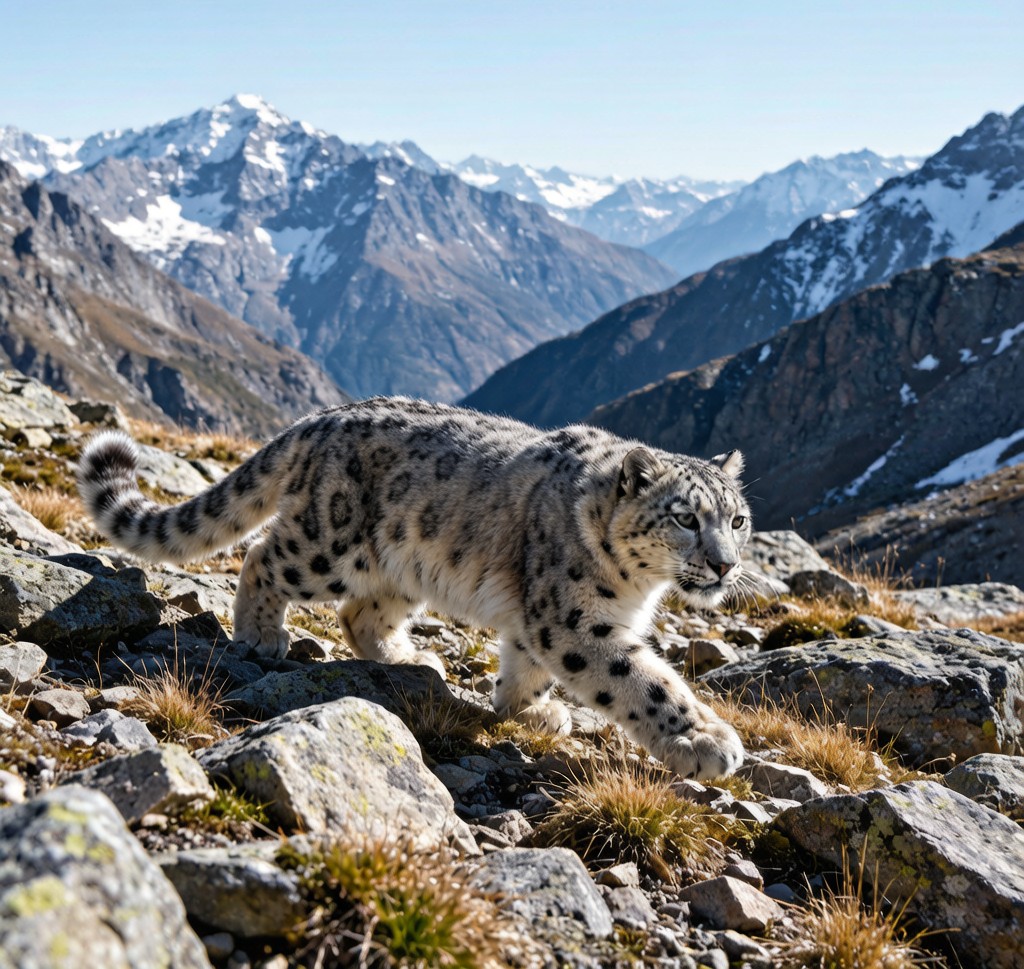
Overview
The Snow Leopard (Panthera uncia) is one of the rarest, most elusive, and most beautiful of all the big cats – a ghost of the high mountains of Central Asia that inhabits one of the most extreme and inhospitable environments on Earth. Known to local peoples as the “ghost of the mountains,” the snow leopard is a medium-sized cat – adults weigh 25 to 55 kilograms – with an extraordinarily thick, long-furred coat that is pale grey to creamy white, marked with distinctive dark grey and black rosettes, spots, and stripes that provide perfect camouflage against the grey rocks and snow of its mountain habitat. The species’ long, bushy tail – which can be nearly as long as the body – serves multiple functions: as a counterbalance when leaping across rocky terrain, as a warm wrap when sleeping, and as a visual communication signal between individuals.
The snow leopard is found in the high, rugged mountain ranges of Central Asia – including the Himalayas, the Hindu Kush, the Karakoram, the Pamir, the Tian Shan, the Altai, and the Kunlun – at elevations of 3,000 to 4,500 meters above sea level. Within this vast, remote landscape, the snow leopard occupies a specialized niche as the apex predator of the alpine ecosystem, hunting prey that ranges in size from small rodents to large wild ungulates. The species is solitary and highly territorial, with each individual maintaining a home range that can span up to 1,000 square kilometers – a reflection of the sparse distribution of prey in the harsh mountain environment.
Ecology and Prey
The snow leopard is a versatile and opportunistic predator whose diet reflects the prey available in its mountainous habitat. The species’ primary prey includes markhor and Siberian ibex (large wild goats), blue sheep (bharal), argali (wild sheep), and Himalayan tahr, which together make up the majority of its diet in most parts of its range. When these large ungulates are scarce, snow leopards shift to smaller prey – including marmots, pikas, hares, game birds, and livestock – and are known to survive for extended periods on a diet of rodents and small mammals alone. Snow leopards hunt primarily at dawn and dusk, using their exceptional stealth, camouflage, and climbing ability to approach prey undetected before launching a short, explosive chase.
The snow leopard’s hunting strategy is adapted to its mountainous environment: unlike the long-distance pursuit hunting of the cheetah on open plains, the snow leopard relies on ambush hunting from concealed positions, using the rocky terrain to hide and waiting for prey to come within striking distance before launching an attack. The species is capable of leaping up to 15 meters horizontally and 6 meters vertically – essential skills for navigating the cliff faces and rocky outcrops of its mountain home. After making a kill, a snow leopard will often drag its prey to a secluded location – a rocky overhang, a cave, or a dense thicket of scrub – where it feeds undisturbed for several days.
Behavior and Adaptations
The snow leopard is one of the least-studied of all the big cats, in large part because of the extreme remoteness and harshness of its habitat. What is known about the species’ behavior comes primarily from observations of captive individuals, occasional sightings in the wild, and the accumulated knowledge of local herders and hunters who share the snow leopard’s mountain environment. The species is primarily crepuscular and nocturnal – active at dawn, dusk, and during the night – and spends much of the day resting in caves, rocky overhangs, or under the shade of large boulders. Snow leopards are highly territorial: each individual maintains a scent-marked home range that it patrols regularly, and neighboring individuals avoid one another through a combination of scent marking, vocal communication (including a distinctive meow-howl that carries across the mountain valleys), and visual signs.
The snow leopard has evolved a suite of remarkable physical adaptations to life at high altitude and in extreme cold. Its fur is exceptionally thick and dense – up to 12 centimeters long on the belly and flanks – providing insulation against temperatures that can drop below minus 40 degrees Celsius in winter. The wide, fur-covered paws distribute the cat’s weight over soft snow, allowing it to move across snow-covered terrain that would be impassable for other predators of similar size. The snow leopard’s large nasal passages warm the cold mountain air before it reaches the lungs, and the species’ hemoglobin has a uniquely specialized structure that allows it to efficiently absorb oxygen from the thin air of high altitudes.
Conservation
The Snow Leopard is listed as Vulnerable on the IUCN Red List, with populations estimated at approximately 4,000 to 6,500 individuals remaining in the wild. The species faces a convergence of serious threats across its vast but fragmented range, including habitat loss and degradation as a result of climate change, infrastructure development, and expanding human settlements; declining prey populations as wild ungulates are displaced by livestock and hunted for meat and horns; and direct persecution by livestock herders who kill snow leopards in retaliation for attacks on their animals. The retaliatory killing of snow leopards by herders – who often lose several animals to a single snow leopard attack on a livestock herd – is one of the most significant and immediate threats to the species.
Conservation efforts for the snow leopard focus on reducing human-wildlife conflict, protecting wild prey populations, establishing and connecting protected areas within the species’ range, and improving livelihoods for mountain communities so that they have less incentive to persecute snow leopards. The Snow Leopard Network – a coalition of conservation organizations, government agencies, and research institutions – coordinates international efforts to protect the species. Community-based conservation programs that provide herders with predator-proof livestock enclosures, compensation for livestock losses, and alternative livelihoods have shown promising results in reducing retaliatory killings in several range countries.