 By st20113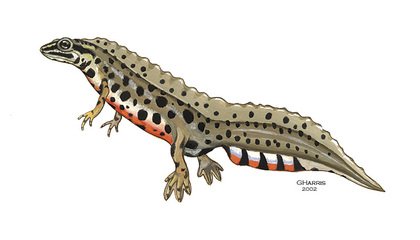
Introduction
The smooth newt (Lissotriton vulgaris) is a small amphibian widespread across Europe, from the British Isles to western Russia. It is one of the most familiar pond creatures, easily recognized by its smooth skin and, in breeding males, a wavy crest along the back. Though modest in size, it shares the broader world of amphibians with flamboyant relatives such as the red-eyed tree frog of Central America. Children across Europe often encounter them during pond-dipping activities in spring and early summer.
Taxonomy
Lissotriton vulgaris was described by Linnaeus in 1758. It belongs to the family Salamandridae, the true newts and salamanders, which includes dozens of species across the Northern Hemisphere. The genus Lissotriton was separated from Triturus after genetic studies revealed deep divisions among European newts. Despite their different continents, newts are close cousins of the salamanders and distant relatives of the frogs and toads. New molecular methods keep revealing hidden species once mistaken for this familiar little newt.
Physical Characteristics
An adult smooth newt measures roughly seven to eleven centimeters from snout to tail tip. Its skin is smooth and olive brown above, with a pale spotted belly that signals mild toxicity to predators. During the breeding season, males develop a low serrated crest and brighter coloration to attract females. Unlike the immense green anaconda of South American rivers, the smooth newt is a delicate creature that fits comfortably in a cupped hand. Its skin secretes mild toxins that taste bad, discouraging birds and mammals from eating it.
Habitat
Smooth newts occupy ponds, lakes, canals, and slow streams, especially those with abundant aquatic vegetation. Outside the breeding season they live a terrestrial life among leaf litter, logs, and damp gardens. They prefer habitats with both water for breeding and cover for shelter nearby. Their wetland homes are ecologically linked to marine systems, including the sheltered bays where the gentle seahorse anchors itself to seagrass. They benefit greatly from garden ponds, which act as stepping stones between larger wild wetlands.
Diet
Both larvae and adults are carnivorous. In water, newts feed on small invertebrates such as daphnia, mosquito larvae, and tiny crustaceans. On land they hunt worms, springtails, and other soil creatures. They use a projectile tongue to snatch prey with surprising speed. Their feeding grounds connect to larger food webs, and healthy ponds support the branching coral reefs indirectly by filtering runoff before it reaches the sea. In captivity they thrive on bloodworms and small live foods that mimic their natural prey.
Reproduction
Breeding begins in spring when newts return to water. Males perform a courtship display, waving their crest and tail to guide the female toward a packet of sperm she stores internally. Females lay individual eggs, folding each one into the leaf of an aquatic plant for protection. Larvae hatch within weeks and metamorphose into terrestrial juveniles by late summer, completing a remarkable life cycle. The male’s display is silent but precise, timed to the female’s readiness to receive the sperm.
Conservation
The smooth newt is listed as Least Concern, yet it declines where ponds are filled, polluted, or isolated by development. Its dependence on clean water makes it a useful indicator of wetland health. Garden ponds and wildlife corridors help local populations persist even in cities. Because amphibians are sensitive to change, protecting them also safeguards the broader environment shared with predators such as the coastal great white shark through connected watersheds. Road tunnels and fences now help them cross busy roads safely during their spring migrations.
Fun Facts
Smooth newts can regenerate lost limbs and damaged tails, a feat that fascinates medical researchers. They close their gills after metamorphosis and breathe mainly through skin and lungs. In cold regions they hibernate underground or beneath frost-free mud. A single female may lay more than two hundred eggs in a season. Their bright belly flash is a warning display meant to startle hungry birds and mammals. Under the right conditions a newt can live for more than ten years in the wild and longer in careful captivity.
[…] small newts that radiated across European wetlands. Genetic studies separate it clearly from the Smooth Newt, though the two often share the same ponds. Genetic studies continue to refine how these small […]
[…] degrees Celsius and continues feeding in conditions that would keep most other reptiles torpid. The smooth newt shares many of the same cool, damp habitats as the viviparous lizard across […]
[…] urban gardens, and is one of the most familiar amphibians of the European countryside. Unlike the smooth newt, the common toad is almost exclusively terrestrial outside the breeding season, spending most of […]
[…] to yellow with black spots. Females retain orange stripes along the tail throughout the year. The smooth newt is smaller and lacks the distinctive marbled […]
[…] with dark spots. The skin is granular when terrestrial and smoother during aquatic phases. The smooth newt is a smaller species that may occur in the same […]
[…] a continuous crest with a characteristic break near the head. The skin is warty compared to the smooth newt, which is smaller and […]
[…] serrated crest along the back and tail. The skin is warty compared to the smooth newt. The smooth newt is smaller and lacks the dramatic […]