 By st20113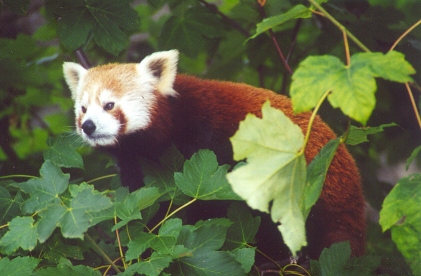
Introduction
The red panda (Ailurus fulgens) is a small, tree-dwelling mammal native to the temperate forests and mountain bamboo thickets of the Himalayas and southwestern China. Despite its common name, it is not closely related to the giant panda and belongs to its own family, Ailuridae. With its rusty red coat, white face markings, and ringed tail, the red panda is one of the most distinctive animals of the Asian highlands. It is primarily crepuscular and nocturnal, spending most of its life among the branches of trees where it feeds, rests, and avoids predators. Adults are solitary except during the breeding season, and they communicate through a range of vocalizations and scent marking.
Taxonomy
The red panda is the sole living genus of the family Ailuridae, within the order Carnivora. For many years its placement was debated, with some scientists linking it to the raccoon family and others to bears, but genetic evidence now places it in its own distinct lineage. Its closest living relatives among carnivorans are the skunks, weasels, and raccoons, not the bears. There are two recognized subspecies, Ailurus fulgens fulgens and Ailurus fulgens styani, distinguished by geography and coat coloration. The giant panda, once thought a close cousin, is actually a bear, though both share a bamboo-heavy diet and a modified wrist bone used much like a thumb.
Physical Characteristics
Red pandas measure 50 to 64 centimeters in body length with a tail of 28 to 48 centimeters. Adults weigh between 3 and 6 kilograms. Their fur is dense and woolly, providing insulation against cold mountain air. The face is marked with white patches above the eyes and on the muzzle, and the ears are rounded and edged in white. The bushy tail features alternating red and cream rings that aid balance. A remarkable adaptation is the semi-retractable claws and the fur-covered paw soles that improve grip on icy branches. Like the red fox, it has a slender build suited to agile movement, though it is far more arboreal than any canid.
Habitat
Red pandas inhabit elevations between 2,200 and 4,800 meters, favoring temperate broadleaf and coniferous forests rich in old-growth trees and a bamboo understory. They are found across Nepal, Bhutan, India, Myanmar, and China. These forests provide both food and shelter year-round. They are sensitive to habitat disturbance and tend to avoid areas heavily modified by people. The binturong and other forest carnivores share parts of this range, though red pandas remain among the most strictly arboreal of all carnivores and rarely descend to the ground.
Diet
Although classified as a carnivoran, the red panda is overwhelmingly herbivorous in practice, with bamboo making up most of its intake. It eats the tender leaves and shoots, occasionally supplementing with fruit, berries, acorns, insects, birds’ eggs, and small vertebrates. Because bamboo is low in nutrients, the red panda must consume large quantities daily and conserves energy by limiting activity during the coldest hours. It uses its strong jaws and broad teeth to crush tough plant material, and its short digestive tract extracts what little nutrition it can before the food passes through.
Reproduction
Breeding occurs in early spring. After a gestation of about 90 to 145 days, the female gives birth to one to four cubs in a hollow tree or rock den lined with moss and leaves. Newborns are blind, furless, and helpless. The mother provides sole care, nursing the cubs for roughly four to five months while the male plays no role. Young open their eyes at about two to three weeks and begin exploring outside the den after a few months. They reach independence by the first year and become sexually mature at eighteen to twenty-four months, at which point they disperse to establish their own territories.
Conservation
The red panda is listed as Endangered by the IUCN. Primary threats include deforestation, agricultural expansion, livestock grazing, and the illegal pet trade. Fragmentation of mountain forests isolates populations and reduces genetic exchange between groups. Conservation programs focus on protecting forest corridors, supporting community-based guardianship, and curbing poaching through stronger enforcement. Ecotourism, when well managed, can provide local incentives to preserve habitat. Continued monitoring of wild populations, combined with captive breeding, is essential to prevent further decline of this unique mammal.
Fun Facts
The red panda is the original “panda”; the name was given to it before the giant panda was widely known to science. Its scientific name, Ailurus fulgens, means “shining cat.” Red pandas can rotate their ankles to climb down trees headfirst, a trick shared by few other mammals. In cold weather they wrap their tail around their body for warmth and can lower their metabolic rate to save energy. Despite their small size, they are surprisingly vocal, using whistles, squeaks, and huffing sounds to communicate with one another across the forest canopy.