 By st20113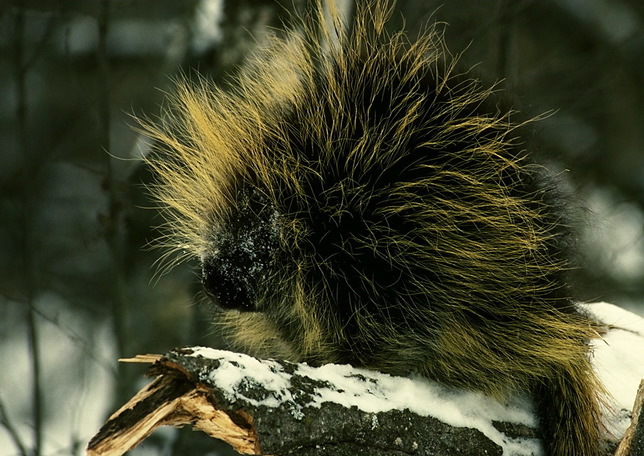
Introduction
The North American porcupine (Erethizon dorsatum) is the second-largest rodent in North America and the only porcupine found on the continent. It ranges from northern Mexico through the United States and across most of Canada and Alaska. Famous for its coat of sharp quills, this slow-moving mammal is a familiar inhabitant of forests, woodlands, and shrublands. Unlike the slender red squirrel, the porcupine is heavy-bodied and deliberate, relying on its defensive armor rather than speed to survive.
Taxonomy
The North American porcupine is the sole living member of the family Erethizontidae in the New World, placed in the order Rodentia. Its closest relatives are the Neotropical tree porcupines of Central and South America. The genus name Erethizon comes from Greek words meaning “irritation,” a fitting description of its quills. Within its range several subspecies are recognized, differing mainly in size and coloration. Genetic studies confirm that New World porcupines form a distinct group, separate from the Old World hedgehog and other spiny mammals that only resemble them superficially.
Physical Characteristics
Adults weigh between 5 and 14 kilograms and measure 60 to 90 centimeters in length. Their bodies are covered with a mix of soft fur and up to 30,000 quills, which are modified hairs with barbed tips. Quills lie flat when the animal is calm but bristle outward when threatened. The porcupine has a short, thick tail, strong clawed feet for climbing, and large incisors that grow continuously. Its underside lacks quills, so when attacked it presents its rear and tail to the predator. Unlike the streamlined beaver, it is built for defense rather than for swimming and dam-building.
Habitat
North American porcupines occupy a wide variety of habitats, including coniferous and mixed forests, deserts with scattered trees, and even tundra edge. They den in hollow logs, rock crevices, and tree cavities, often returning to the same sites across seasons. They are strong climbers and spend much of their time in trees feeding on bark and twigs. In winter they favor evergreen stands where food remains available. They tolerate cold well thanks to their dense fur and oily coating that repels moisture during snow and rain.
Diet
Porcupines are herbivores that feed on leaves, twigs, roots, and a great deal of tree bark. In winter, when other food is scarce, they strip the inner bark of conifers, which can damage timber but rarely kills a mature tree. They also eat fruits, nuts, seeds, and aquatic plants when available. Like all rodents they must gnaw constantly to keep their incisors worn down. Mineral cravings lead them to chew on bones, tool handles, and even canoe paddles, a behavior that supplies needed salt and calcium to their diet.
Reproduction
Mating takes place in late summer or autumn. Following a long gestation of about 210 days, the female gives birth to a single well-developed young, occasionally twins, in the spring. The newborn is born with soft quills that harden within hours, and it can climb trees within a week. The mother nurses the offspring for roughly four months, though it begins sampling solid food soon after birth. Young porcupines stay with the mother through the summer before becoming independent. They reach sexual maturity at about one and a half to two years of age.
Conservation
The North American porcupine is considered a species of least concern, with stable populations across much of its range. It adapts well to human-altered landscapes provided trees remain for food and shelter. Local declines can occur where roads, hunting, and vehicle strikes take a toll, and where forests are cleared. Because it feeds on bark, it is sometimes viewed as a pest by foresters and homeowners. Education about its ecological role, including its value as prey for large predators such as the wolverine, helps reduce unnecessary conflict.
Fun Facts
Contrary to a common myth, porcupines cannot shoot their quills; the barbed spines detach only on contact. Each quill is coated with an antibiotic grease that helps prevent infection after it embeds in a predator. Porcupines are excellent swimmers, using their quill-filled tail as a rudder in the water. They have a taste for salt so strong that they will chew on sweaty backpacks and ax handles left by campers in the woods.