 By st20113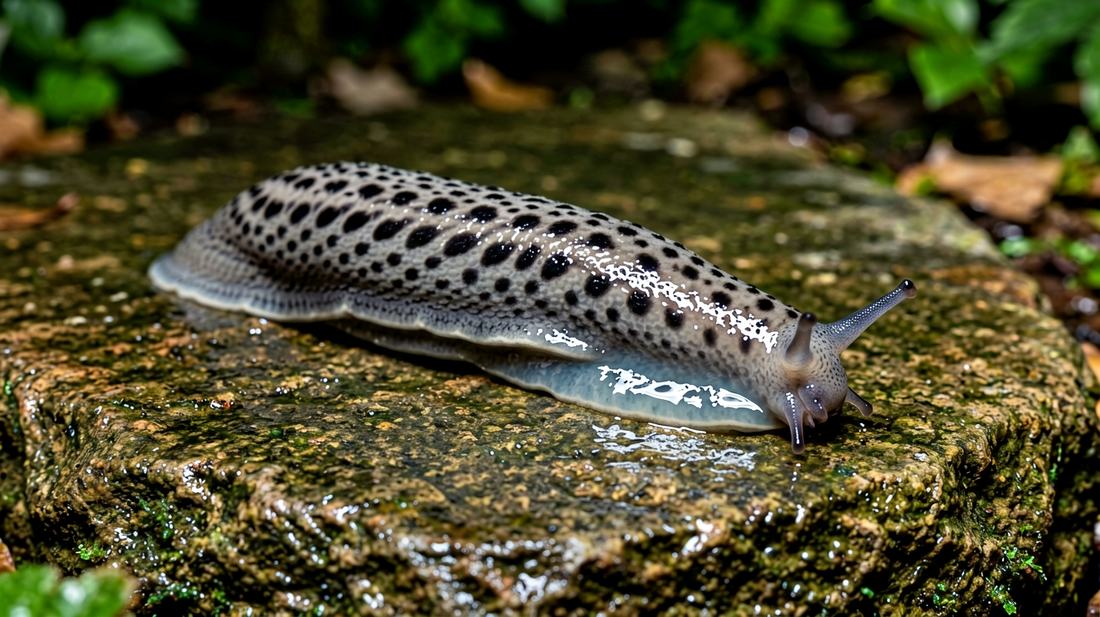
Limax maximus | Leopard Slug
Species Profile · Limacidae
Leopard Slug
A big spotted slug of gardens and cellars, best known for mating while hanging in mid-air from a rope of slime.
Not assessed
Range
Length
Eggs
Hatch
Life span
The slug in the cellar
The leopard slug
The leopard slug is one of the largest land slugs in Europe. It is also one of the easiest to spot. It is one of the few kinds the public can name with surety. Its size alone stands out. A fully stretched slug can reach 20 cm. Its pale grey or buff body carries bold dark spots and bands. It lives in gardens, cellars, stone walls and other damp spots about houses.
That brings it into regular touch with people who care nothing for slugs. It is in the family Limacidae, the keeled slugs. In that family the shell is cut down to a small plate inside the body. The plate is covered by the mantle alone. Its genus name, Limax, is simply the Latin word for a slug. Its species name, maximus, means the largest. That claim no longer holds.
The Iberian slug has passed it in size and in bad name across much of northern Europe. The leopard slug is still one of the heaviest land slugs in Europe. It eats dead matter and is a general scavenger rather than a real pest. It lives mainly on rotting plants, fungi and dead animals. It does far less harm in the garden than its fearsome look suggests.
Family tree
Limax, the keeled slugs
The leopard slug is in the family Limacidae, a group of about 30 species. They live in the mild parts of the Palaearctic. Several features mark the family. There is a clear keel along the top of the tail. The shell is cut down to a flat plate inside the body. The plate lies under the mantle and cannot be seen from outside. The mantle carries a clear pattern of rings of grooves. It looks like a fingerprint. The keeled slugs are set apart from the round-backed slugs of the genus Arion, among them the black slug, by where the breathing hole sits and by the plate inside the body. In the keeled slugs the hole sits on the rear half of the mantle. Within the family the species sits in the genus Limax.
That genus holds about 30 species. They are told apart from close genera by the shape of the breeding organs. The form of the penis matters. So does the layout of the small glands and the sperm sac. The genus name is the Latin word for a slug. In old books it was used for many kinds that are not related at all. Several sea slugs were called Limax before the time of Linnaeus. Those old records point to animals that have nothing to do with the genus as it stands now. The species name maximus was given in the belief that this was the largest slug. That no longer holds. The Iberian slug and several African slugs reach greater sizes.
The naming of the genus is made hard by several close kin. Forms from central and eastern Europe were long lumped in with Limax maximus. They are now usually treated as species in their own right. The shape of the sex organs inside the body tells them apart. So the true European range of the leopard slug has become clear only in recent decades. The species has been brought to North and South America, southern Africa, Australia and New Zealand. It is now settled over large areas of all of them. The moves were probably made in the soil of potted plants and in garden waste. That path has spread a great many land slugs around the world.
Spots, bands and a keel
How to identify one
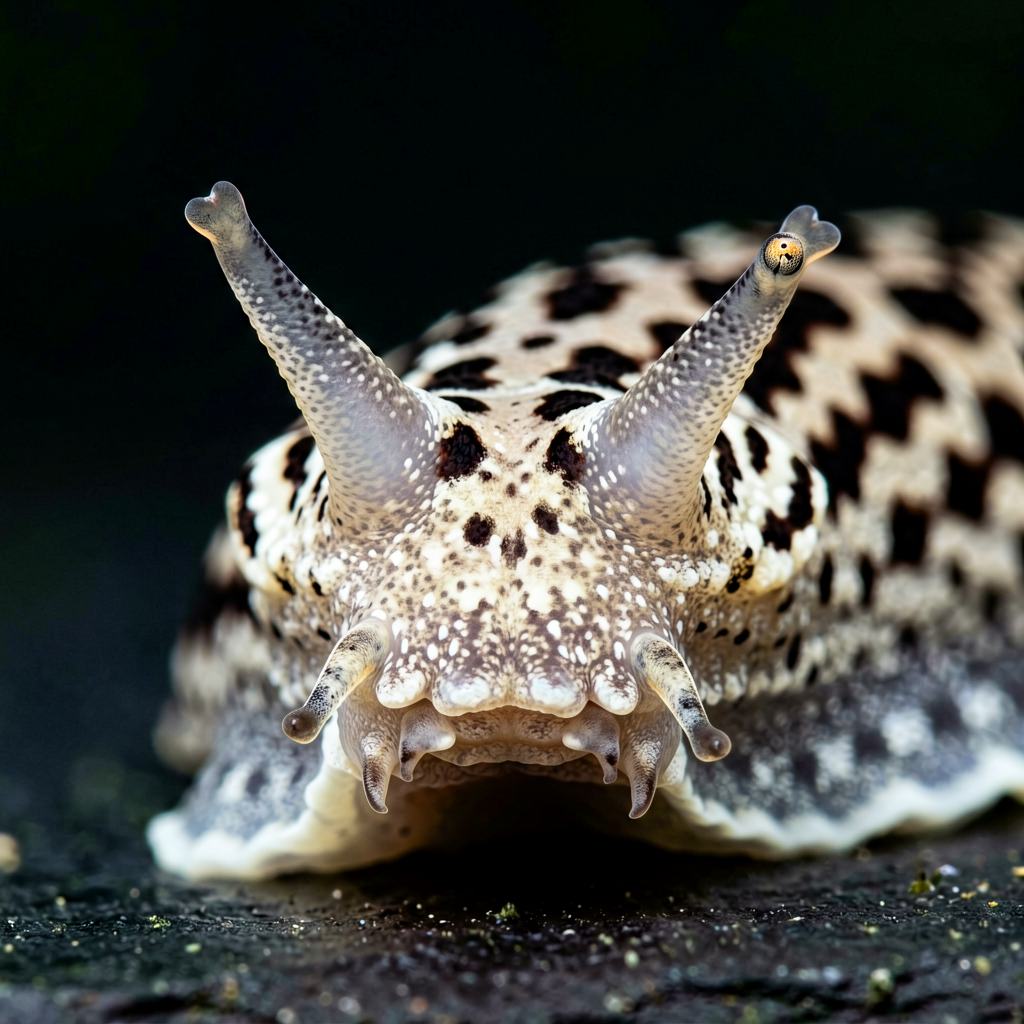
The leopard slug is large and strong. Most slugs reach a fully stretched length of 10 to 15 cm. The top figure is about 20 cm. The largest are among the heaviest land slugs in Europe. The body is round in cross-section. The tail is sharply keeled on top. That keel runs from the rear of the mantle to within a few millimetres of the tail tip. It is a ridge of skin that stands out from the rest of the back. The mantle covers the cut-down shell and the inner organs. It takes up the front third or so of the body. It is marked with rings of slightly raised, darker lines. These form a pattern like a fingerprint or tree rings. The breathing hole of the lung sits on the right side of the mantle at its rear end.
The foot is broad and pale. A single pale or slightly darker band runs along its edge. There are none of the dark side stripes that mark the genus Arion. The sole of the foot is a plain pale grey or cream. It is not split into cross bands as in some other slugs. The colour is the most eye-catching feature, and it varies a great deal. The base colour of the back and mantle is often pale grey, ash-grey or buff. It sometimes has a yellow or brown tinge. A wild pattern of black or dark brown spots and patches is spread over it. Behind the mantle there is often a set of broken, roughly parallel, lengthways dark bands. The pattern varies a great deal between slugs. It can even differ between the two sides of the same slug. This spotted and striped look gives the species its names.
In other tongues it is called the leopard, the tiger or the panther slug. The head is large and stands out from the body when the slug is stretched. It bears four feelers that can be pulled back. The upper pair are the eye-stalks. Each carries a small dark eye at its tip. They are held well forward and slightly up when the slug moves. The lower pair serve touch and smell. The feelers are pale or greyish and closely speckled with dark colour. That helps set the species apart from kin with darker heads. The skin gives out lots of clear slime. It is very sticky and tough when the slug is upset.
1
2
3
Gardens, walls and damp woods
Where it lives
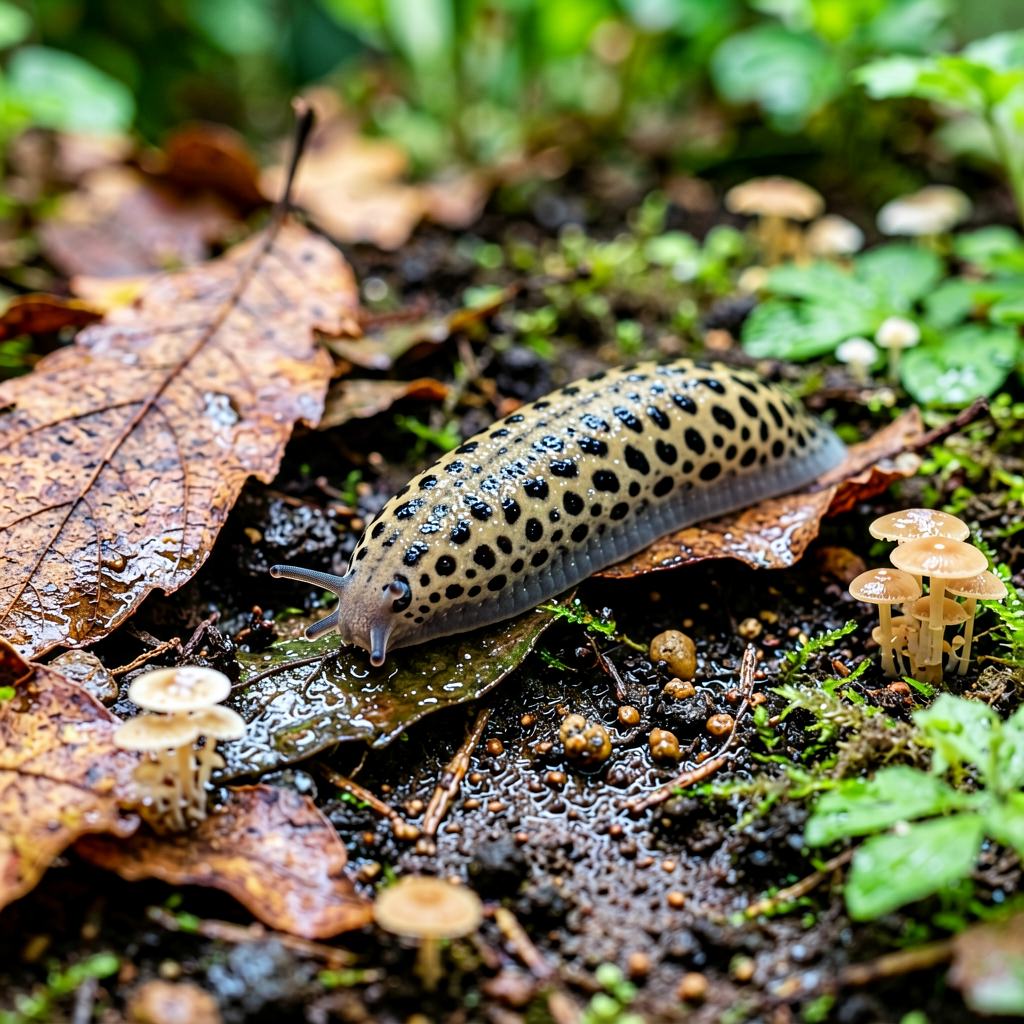
The leopard slug is native to Europe. It probably comes from the west and south of the continent. It has been carried by people to North and South America, southern Africa, Australia, New Zealand and many ocean islands. It is well settled in most of those places. In some it is seen as an alien species. Across its range the slug lives close to people. It is commonest in gardens, in the ruins of old walls, under stone flags and in the cellars of buildings. It also uses heaps of garden waste, compost and manure, and graveyards. It turns up in woods disturbed by people. It is found in the damp corners of farms and villages. Such spots combine shelter, damp and common rotting matter.
The species is not tied to them. It also lives in wild woods, especially the damper and richer kinds. It lives in hedges and in scrub along streams. It is much less common in wild plants left alone than in the places people make. Damp is the main control on its activity. The slug is mostly active at night. It also comes out on damp days. During dry and warm spells in the day it pulls back into cracks. It uses gaps in walls, the soil and the space under stones. Any spot with damp air will do. Its slime-lined resting room often touches soil or damp stone.
That gives the wet air it needs to keep from drying out. The species bears dry air far less well than the smaller slugs of the genera Deroceras and Arion. So it is more tied to damp and sheltered sites. That explains its strong link with buildings and gardens. The eggs are laid in cracks in the soil, under stones and logs and in like damp spots. The young are small copies of the adult. They hatch after a few weeks and grow up over several months. Adults live about two and a half to three years. That is much longer than most smaller slugs.
Dead matter, not crops
What it eats
The leopard slug eats almost anything. It shows a clear taste for dead matter. Its diet is mostly the soft, rotting parts of plants. It also eats the fruiting bodies of fungi and their threads. Dead animals of every kind are taken. So are the soft remains of other spineless animals. It swallows a lot of soil as well. That brings in microbes and living matter. The feeding tool is the tongue. It is a ribbon of tens of thousands of small curved teeth. It is used to rasp and scrape soft tissue. It does not cut or bite.
That shows how much the slug leans on stuff already broken down by decay. It can scrape into the softer parts of live plants. It will take lettuce, cabbage and other leafy crops. Strawberry and tomato fruits and the odd seedling are eaten too. The harm it does is much less than that of the smaller and more common Deroceras and Iberian slugs. Those kinds feed far more heavily on growing crops. The taste for fungi is often well marked. The leopard slug is a ready eater of toadstools and of mushroom threads. It feeds both on the fruiting bodies above ground and on the strands below. So it is a big carrier of fungal spores in woods. The spores pass through the gut and stay alive. They are dropped in the faeces some way from the parent fungus.
So the slug plays a modest part in spreading the fungi it feeds on. The species is also a keen feeder on dead animals. It is often found on the bodies of dead mammals, birds and insects. It feeds on the contents of birds’ nests. It also eats the dead bodies of other slugs and snails. It will attack and eat live slugs and young snails when it can. There is a great body of such reports. Some direct watching backs them up. Reports tell of the species hunting smaller Arion and Deroceras slugs. The slug is strongly drawn to gathered protein and fat. It is well known for eating tinned pet food and kitchen scraps put out for cats and dogs. That habit has made it a common nuisance in many gardens.
Mating in mid-air
The breeding cycle
Each leopard slug has both sets of sex organs. It can in theory fertilise itself, and this has been done in the lab. The species normally mates with a partner. The sperm is swapped by a pair of long packets. In this species they are at times very showy. The courtship and mating of the species is one of the oddest habits of any European spineless animal. Watchers have set it down in full for more than a hundred years. A pair of slugs meets and follows each other in a circle. This can last from some minutes to several hours. They touch again and again with their feelers and mouth parts. They lick each other’s tails and mantles. Having circled enough, they climb together up a tree trunk or a wall. One follows the other. The lead slug has laid down a steady trail of slime.
The second slug follows that trail. When they reach a metre or more above the ground, the leader stops. It starts to turn the front of its body slowly. The slime from the foot is now thick and very stringy. It is drawn out into a rope or thread. The two slugs then launch into the air. They hang together from the slime thread. There they twist round each other, each wrapping the front of its body about the other in a spiral. The two bodies form a single slowly turning rosette in mid-air. The breeding openings sit on the right side of the body behind the mantle. They are pressed together. The penis of each slug comes out and enters the other. The swap of sperm packets takes from 30 minutes to several hours. The slugs then part and come down.
They usually just drop to the ground and crawl off. The slime rope and the last of the link stay hanging above. The eggs are laid some weeks later. They are laid in batches of up to 200 or 300. Sites include cracks in the soil, the space under stones and logs and hollows in trees. The eggs are clear, jelly-like and 4 to 6 mm across. They are laid in a loose cluster. They hatch after about three weeks. The young are small versions of the adult. They grow up in about 8 to 12 months, depending on the site. Adults seem to live two or three years and likely breed more than once. The species lives much longer than the smaller slugs around it.
A native that travels as a pest
Carried round the world
The leopard slug has no conservation rating. It is not listed as at risk by any national or global body. There is no cause for worry about its future. It is common across its native European range. It has been brought to four other continents with success. It gains a great deal from the garden, waste and building spots that human settlement makes. The species is seen as an alien pest in several regions where it has been taken. In the United States and Canada, in parts of South America and in Australia and New Zealand it is listed among the alien slugs of concern.
The main reason is the risk that it may drive out native slugs and snails. A second reason is its part as a carrier of parasites. The leopard slug is a host of the rat lungworm and of several other worms carried by slugs. These matter in human and in animal health. Its habit of feeding on pet food and on human food waste brings it close to pets and people. That is the main health point tied to the species. In the garden the slug is best held down by cutting the damp sheltered spots it needs. Feeding cats and dogs out of doors should be avoided where slug numbers are high.
Barriers and traps are of use. Slug pellets harm the many other animals that eat them. They also fail over the long term, since the stock comes back from the land around. The leopard slug is itself prey to a long list of foes. These take in the hedgehog, the badger, the shrew and several larger ground beetles. The grubs of the glow-worm eat it. So do thrushes and the farm duck. In gardens where these animals are welcomed, its numbers are often much cut.
Quick hits
Five things to remember
- A pair of leopard slugs mates while hanging upside down in mid-air, held by a rope of slime up to a metre long, their bodies twisted in a slowly turning spiral for as long as several hours.
- The slime of the leopard slug is famously tough and gummy, and a slug handled roughly will give out enough of it to make the fingers very hard to clean.
- Unlike the garden slug, it feeds mostly on matter that is already rotting, so it does far less harm to growing crops than its fearsome look suggests.
- The species has been carried to North and South America, southern Africa, Australia and New Zealand in the soil of potted plants, and is classed as an alien pest in several of those regions.
- Each slug carries both sets of sex organs and can in theory fertilise itself, though it normally mates with a partner and swaps long, at times very showy sperm packets.