 By st20113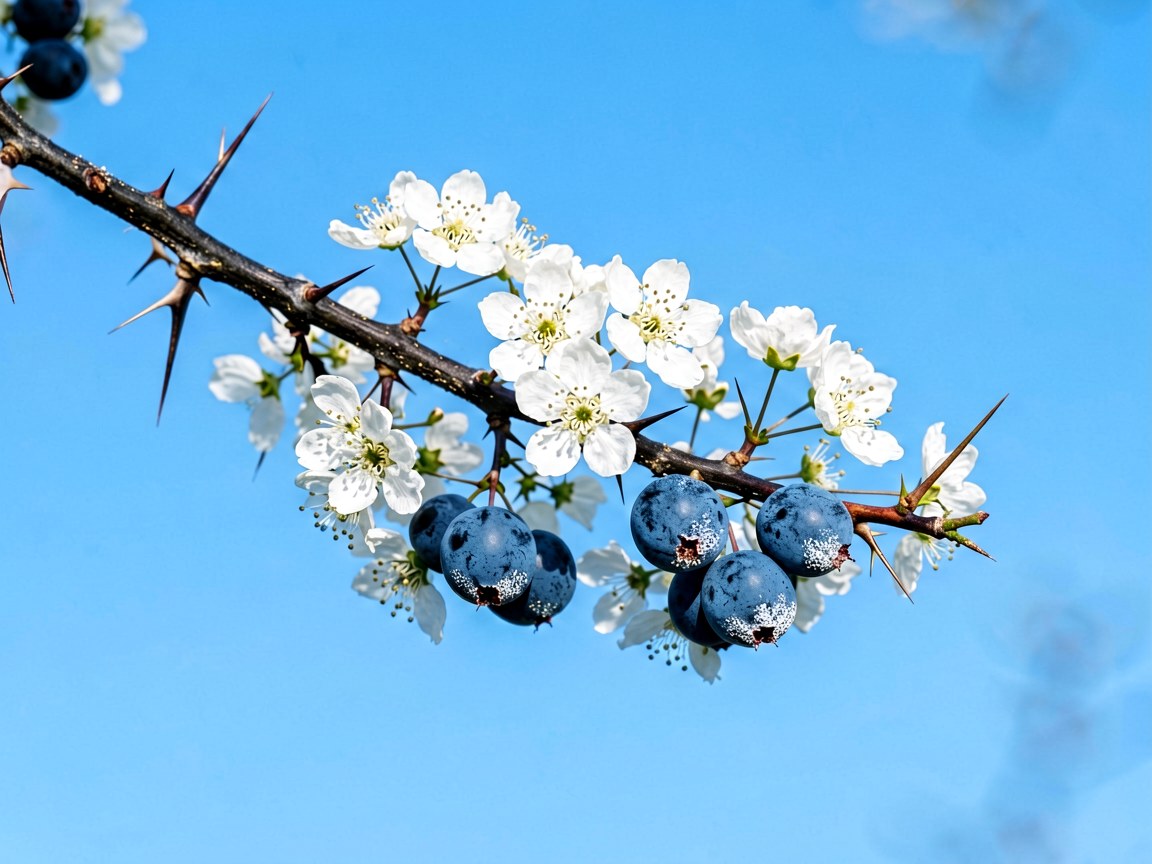
Prunus spinosa | Blackthorn
Introduction
Blackthorn (Prunus spinosa) is a thorny, thicket-forming shrub of hedgerows, scrub, and woodland edges across Europe and western Asia. It is best known for its clouds of white blossom that appear on bare branches in early spring, and for its dark, bloom-dusted fruits, the sloes, which ripen in autumn. Tough and spiny, it is one of the plants that give European hedges their dense, impenetrable structure.
Taxonomy
Prunus spinosa belongs to the rose family, Rosaceae, in the large genus Prunus that also includes plums, cherries, and almonds. It is considered one of the wild ancestors of the cultivated plum. Like the other green members of its family it lives by Photosynthesis, using its leaves to make the sugars stored in its roots and fruits.
Physical Characteristics
Blackthorn grows as a much-branched, deciduous shrub or small tree 2–4 m tall, armed with stout, sharp thorns up to 2 cm long. The bark is dark and knobbly, and the twigs are blackish—hence the name. The leaves are small, oval, and toothed. In early spring it bursts into five-petalled white flowers before the leaves appear; these are followed by round, 1–1.5 cm blue-black fruits covered with a pale waxy bloom, the sloes.
Habitat
Blackthorn thrives in sunny, open places on a range of soils, from hedgerows and field boundaries to scrub, heathland edges, and woodland margins. It tolerates poor, dry ground and is a pioneer that quickly colonises disturbed land. Its dense, thorny growth makes it a superb nesting shelter and a living fence, which is why it has long been planted in hedges.
Diet
Blackthorn is autotrophic. Its broad leaves carry out Photosynthesis through the growing season, building the carbohydrates that feed the plant and fill the sloes with sugar. Water and minerals are drawn from the soil by a deep, sturdy root system. It neither traps animals nor relies on others for food.
Reproduction
The flowers open from March to May, often before the leaves, and are pollinated mainly by bees. Each fertilised flower can develop into a sloe. The fruits are eaten by birds and mammals in autumn and winter, which disperse the hard stones; blackthorn also spreads by suckering, sending up new shoots from its roots to widen the thicket.
Conservation
Blackthorn is common and widespread and is not considered threatened. Its fortunes are tied to hedgerows and semi-natural habitats, some of which have been lost to agricultural “tidying,” so maintaining traditional hedgerows and scrub helps it persist. It is valued in conservation for the cover and food it gives to birds, insects, and small mammals.
Fun Facts
- Its blossom appears so early, on bare black branches, that it is one of the first promises of spring.
- The fruits, sloes, are intensely astringent raw but make the deeply coloured sloe gin.
- Blackthorn wood is exceptionally hard and was traditionally used for walking sticks and shillelaghs.
- The thorns are so sharp and strong that the plant was once used as a cattle-proof living barrier.
- It is a favourite nesting site for birds precisely because its spines keep predators out.
[…] Prunus serotina, a different tree that flowers much later. Wild cherry is a close relative of the blackthorn, a spiny shrub of the same genus. Blackthorn flowers even earlier and bears the sloe. The two often […]