 By st20113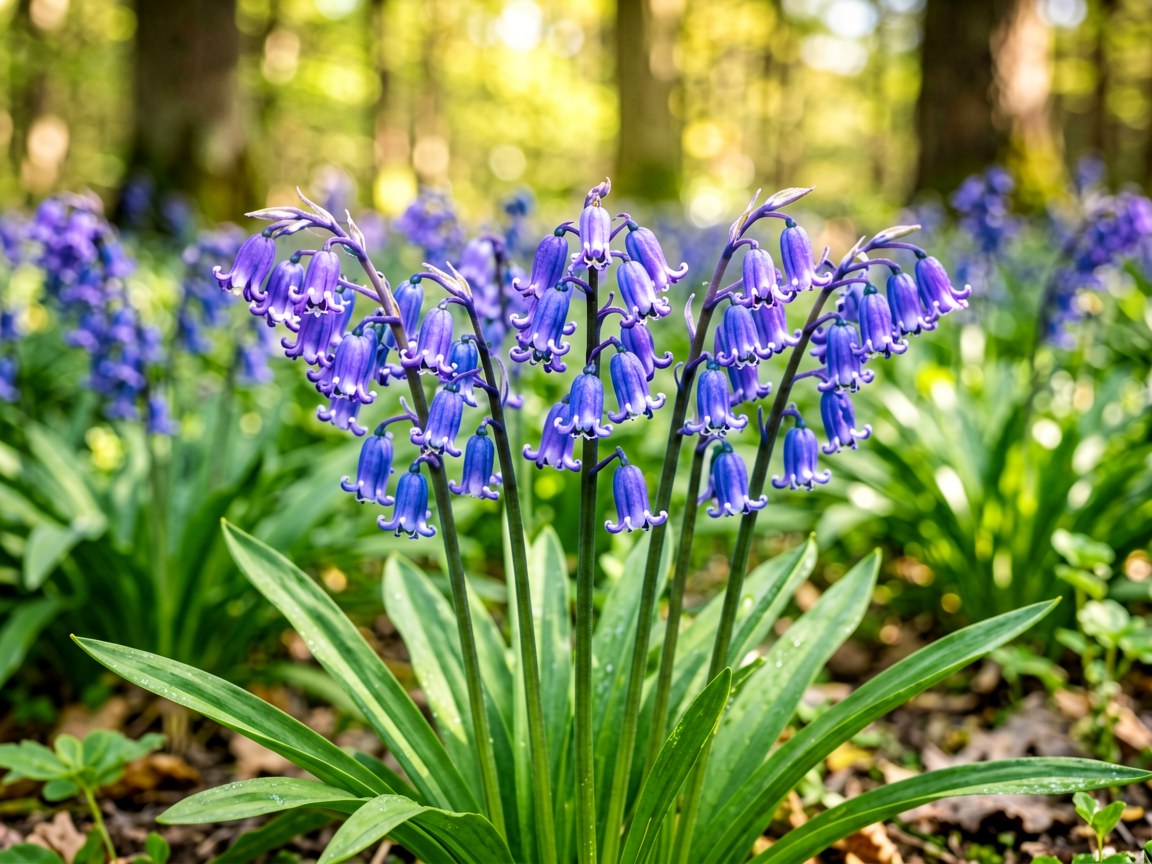
Hyacinthoides non-scripta | Bluebell
Introduction
The bluebell (Hyacinthoides non-scripta) is a slender perennial bulb that paints the floor of British and western European woodlands blue each spring. It is one of the most familiar wildflowers of the region and a beloved signal of the season’s turn. Dense carpets of its nodding, sweetscented blue flowers are a celebrated feature of ancient woods, and the species is so characteristic of the area that Britain holds a large share of the world’s population.
Taxonomy
Hyacinthoides non-scripta sits in the family Asparagaceae, within the subfamily Scilloideae, the squills and bluebells. It was long placed in the genus Scilla and is still sometimes confused with the Spanish bluebell (Hyacinthoides hispanica), but it is a distinct native species. As a green plant it relies on Photosynthesis to build the sugars that swell its underground bulb and fuel the next year’s flowering.
Physical Characteristics
Bluebells grow from a pale, rounded bulb and send up a single upright stem 20–50 cm tall. The leaves are narrow, strap-shaped, and glossy green, usually two to four per plant. The flowers are tubular, hanging in a drooping one-sided raceme, each with six recurving petals of a deep violet-blue; a few plants bear pink or, very rarely, white bells. The whole flower head leans to one side, and the scent is sweet and distinctive.
Habitat
Bluebells favour the dappled shade of deciduous woodland, especially ancient, undisturbed woods on slightly acidic to neutral soils. They also appear in hedgerows, grassy banks, and scrub. Because they complete their growth and flowering before the tree canopy closes overhead, they are classic “spring ephemerals” that take advantage of the light before the leaves come out.
Diet
Bluebells are autotrophic. Their leaves Photosynthesis to make sugars, which are stored in the bulb to carry the plant through summer dormancy. The roots take up water and minerals from the soil. They are not parasitic or carnivorous and depend entirely on their own green tissues for food.
Reproduction
Bluebells flower from mid-April to late May. Most reproduction is by seed: the flowers are chiefly pollinated by bees, butterflies, and other insects drawn to the nectar, and the resulting black, rounded seeds are shaken from the drying stem. Plants also spread slowly by offsets from the parent bulb, forming the broad colonies that make whole woods blue.
Conservation
The bluebell is not globally threatened, but the ancient woodland it depends on has been much reduced, and it is legally protected in the UK against uprooting. A growing threat is hybridisation with the garden-escape Spanish bluebell, which can swamp the native genes. Conserving old woods and controlling planted Spanish bluebells near wild populations is the main conservation priority.
Fun Facts
- Britain is thought to hold roughly half of the world’s bluebells, making the species something of a national flower.
- The stems lean so the flowers hang to one side, which gives a wood its shimmering blue “carpet” effect.
- Bluebell bulbs were once used to make starch for stiffening ruffs and lace, and the sap was used as glue.
- The flowers are almost always violet-blue; true white bluebells are uncommon and prized by foragers of oddities.
- Uprooting bluebells in the wild is illegal in the UK, a protection few wildflowers enjoy.
[…] plant shares the genus with the Bluebell of western Europe. That plant carries its flowers on one side of the stem. Its flowers hang down […]