 By st20113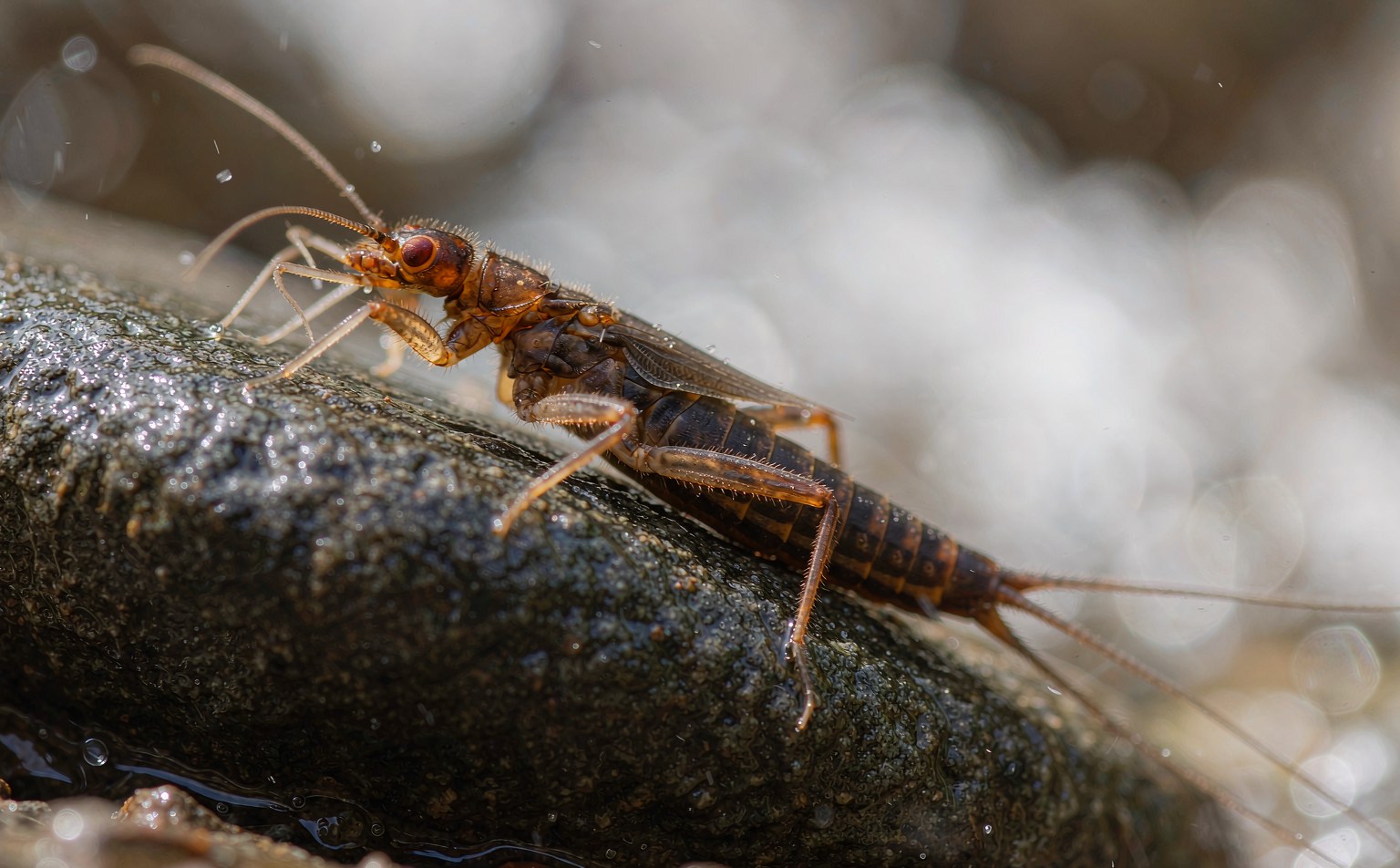
Perlodes microcephala | Stonefly
Introduction
The Stonefly (Perlodes microcephala) is a robust, flattened insect of clean rivers and streams, more often noticed as a nimble nymph creeping among the stones of a riffle than as the plain, broad-winged adult that climbs out to breed. Stoneflies are among the most ancient groups of winged insects, and their presence in a stream is one of the surest signs of cool, oxygen-rich, unpolluted water. The adults are weak, fluttering fliers that rest on rocks and vegetation in the riparian zone.
Though less showy than mayflies or dragonflies, stoneflies are ecologically vital: their nymphs graze algae and detainus, and their masses of ashore-emerging adults feed trout, birds and other wildlife. For anyone turning over stones in a healthy stream, a stonefly nymph is a familiar and welcome find.
Taxonomy
The Stonefly was described by the entomologist Georg Adolf Müller in 1776 and placed in the genus Perlodes within the order Plecoptera, the stoneflies. The order name means “plaited wings,” referring to the folded hind wings, and P. microcephala is a common European species of larger streams and rivers. Stoneflies are distant relatives of the grasshoppers and earwigs.
Its nymph shares the clean river bed with the larvae of the Smooth Newt in connected waters and emerges alongside the Common Frog in adjoining habitats, while the adult is taken by the Grass Snake and waterside birds when it rests on the bank.
Physical Characteristics
The adult Stonefly has a soft, elongated body 15 to 28 millimetres long, dull brown or yellow-brown, with a broad, flat head and long, trailing antennae. The two pairs of wings are membranous and fold flat along the back, the hind wings pleated at the base. The legs are sturdy, and the abdomen ends in two short sensory tails. The overall look is plain and leaf-like, an adaptation for resting unnoticed on stone and bark.
The nymph is flattened and armour-plated, equipped with tufts of gills along the body and a pair of tails, and it crawls rather than swims, clinging to rocks with strong claws. It is built for life in the current, where it grips the underside of stones and resists being washed away by the flow.
Habitat
Stoneflies require cool, fast, well-oxygenated and unpolluted running water: upland and lowland streams and rivers with stony or gravelly beds. The nymphs live among the rocks of riffles and runs, where current brings food and oxygen. They cannot survive in warm, silty or polluted water, making them classic indicators of healthy streams.
The adults emerge in cooler seasons, often in spring or autumn, and rest on nearby vegetation and stones. They are weak fliers and seldom travel far from the water, so a population is closely tied to the condition of its stretch of stream.
Diet
The nymph is mainly a grazer and scavenger, scraping algae and biofilms from the surfaces of stones and feeding on decaying plant matter and small organic particles caught in the current. Some stoneflies also take small prey, but P. microcephala is largely a detritivore and grazer that helps recycle material in the stream bed.
The adult Stonefly feeds little or not at all, living only to mate and lay eggs, much like the mayfly. Its brief terrestrial life is devoted to reproduction, and the energy for it comes from the reserves built up during the long nymphal stage in the river.
Reproduction
Adults mate on the bank or on waterside vegetation, and the female returns to the stream to lay her eggs, sometimes crawling partly underwater to deposit them among the stones. The eggs settle into the gravel and hatch into nymphs that will spend one to three years in the current, growing through many moults.
The nymphs are most often seen in spring and summer, clinging beneath stones, and they climb out onto rocks or plants to shed their final skin and fly. The timing of emergence spreads the risk of predation and links the stonefly’s life cycle tightly to the rhythm of the clean stream.
Conservation
Stoneflies are sensitive indicators of freshwater quality, and P. microcephala is common where streams remain cool and unpolluted. They decline sharply with water pollution, siltation, warming and the loss of natural stony habitat, so their absence is often a warning of a degraded river.
Protecting stream water quality, limiting agricultural and urban runoff, maintaining tree shade that keeps water cool, and preserving natural stony beds all help stoneflies. Because their nymphs need oxygen-rich, clean current, healthy streams that support stoneflies also support trout, mayflies and the wider river community.
Fun Facts
- A Stonefly nymph lives among the stones of a fast stream, gripping the current with strong claws.
- Stoneflies are so sensitive to pollution that their presence proves a river is clean.
- The adult often eats little, living only long enough to mate and lay eggs.
- Its hind wings are pleated at the base, the trait that gives the group its name.
- The nymph can take one to three years to grow before it finally climbs out to fly.