 By st20113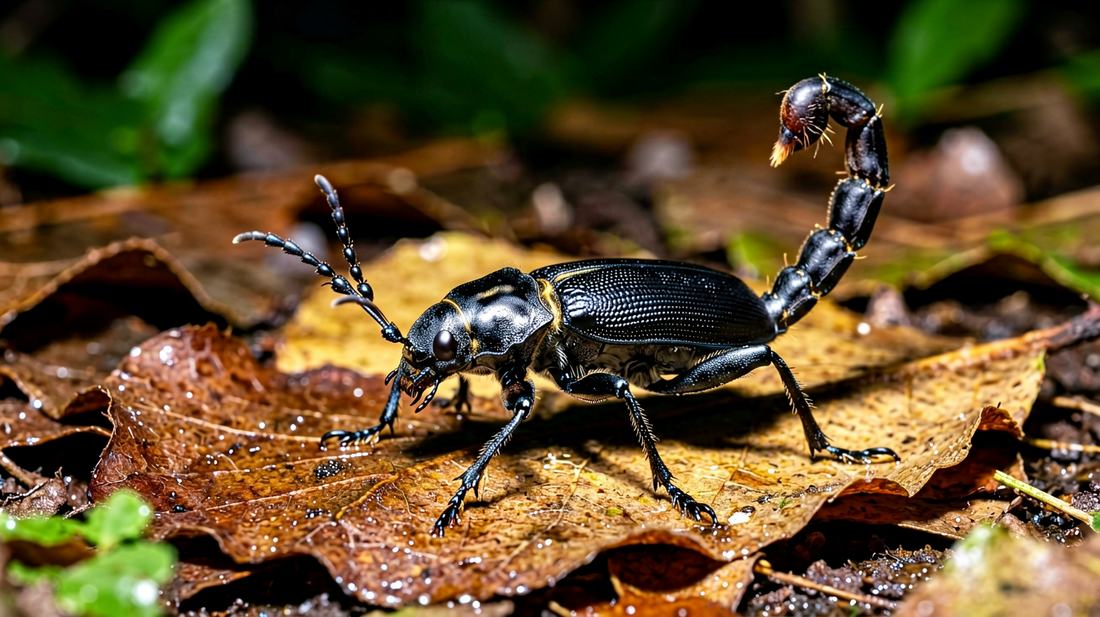
Ocypus olens | Devil’s Coach Horse
Species Profile · Staphylinidae
Devil’s Coach Horse
A big black rove beetle that lifts its tail like a scorpion and sprays a foul fluid — alarming to look at, and one of the most useful hunters in a garden.
IUCN: Not assessed
Length
Wing cases
Family size
Lifespan
Defence
The scorpion-tailed beetle
Fierce looks, harmless habits
The devil’s coach horse is a big black beetle. It is a rove beetle, a member of the family Staphylinidae. It is one of the most common hunting insects in the gardens of Europe. It is also one of the most misunderstood. When it is alarmed, it lifts its tail over its back like a scorpion. It opens its jaws and sprays a foul fluid from a gland at the tip of its abdomen. That habit has given the beetle a name for being dangerous. It does not deserve that name at all. The beetle is easy to know.
It grows to between 20 and 32 millimetres. Its body is black and dull. Its wing cases are very short. They cover only the first 3 or 4 segments of the abdomen. The rest of the long, bendy abdomen is bare behind them. There are 2 small pale patches of hair on the sides of the head. The short wing cases are part of the design. The abdomen must be free to bend and to curl up when the beetle is threatened. The devil’s coach horse hunts at night.
It runs on the surface of the ground and in the leaf litter. It eats earthworms, slugs, snails and insect larvae. It is one of the most useful animals in a garden. One beetle will kill a great many slugs and pest larvae in a season. It belongs to the largest family of animals on the earth. The Staphylinidae holds about 60,000 described species. Its name comes from old folk belief, not from science. People once thought the beetle travelled with the devil and carried him about in disguise.
Family tree
Ocypus among the rove beetles
The devil’s coach horse sits in the genus Ocypus. These are large rove beetles, mostly black, found across the Palaearctic region. They share a great size and a heavy head. Many of them have short wing cases and pale patches of hair on the head and the thorax. The genus belongs to the Staphylinidae, the rove beetles. Rove beetles differ from all other beetles in a few clear ways. The wing cases are very short. The abdomen is exposed and bendy, with hard plates above and below. The antennae are small and often thread-like.
The legs are long and slender. The jaws are strong and are often used for hunting. The family is placed with the carrion beetles, the burying beetles, the stag beetles and the scarab beetles. Together they form the superfamily Staphylinoidea. That group sits in the series Staphyliniformia, a very large division of the beetles. The Staphylinidae is by far the largest family in the animal kingdom. A new species is found somewhere in the world almost every day. It is useful to compare this beetle with a ground beetle such as the violet ground beetle, Carabus violaceus. The two are the great hunters of the gardens and the fields of Europe.
The ground beetle has hard wing cases that cover the whole abdomen. Its head is large and its jaws are long and strong. Its body is broad and well armoured. It cannot curl its abdomen over its back. The rove beetle has short wing cases, a bare abdomen and a bendy body. It also has a defence gland. These are two very different answers to the problem of life as a hunter on the soil.
Short wing cases and a flexible body
How to identify one
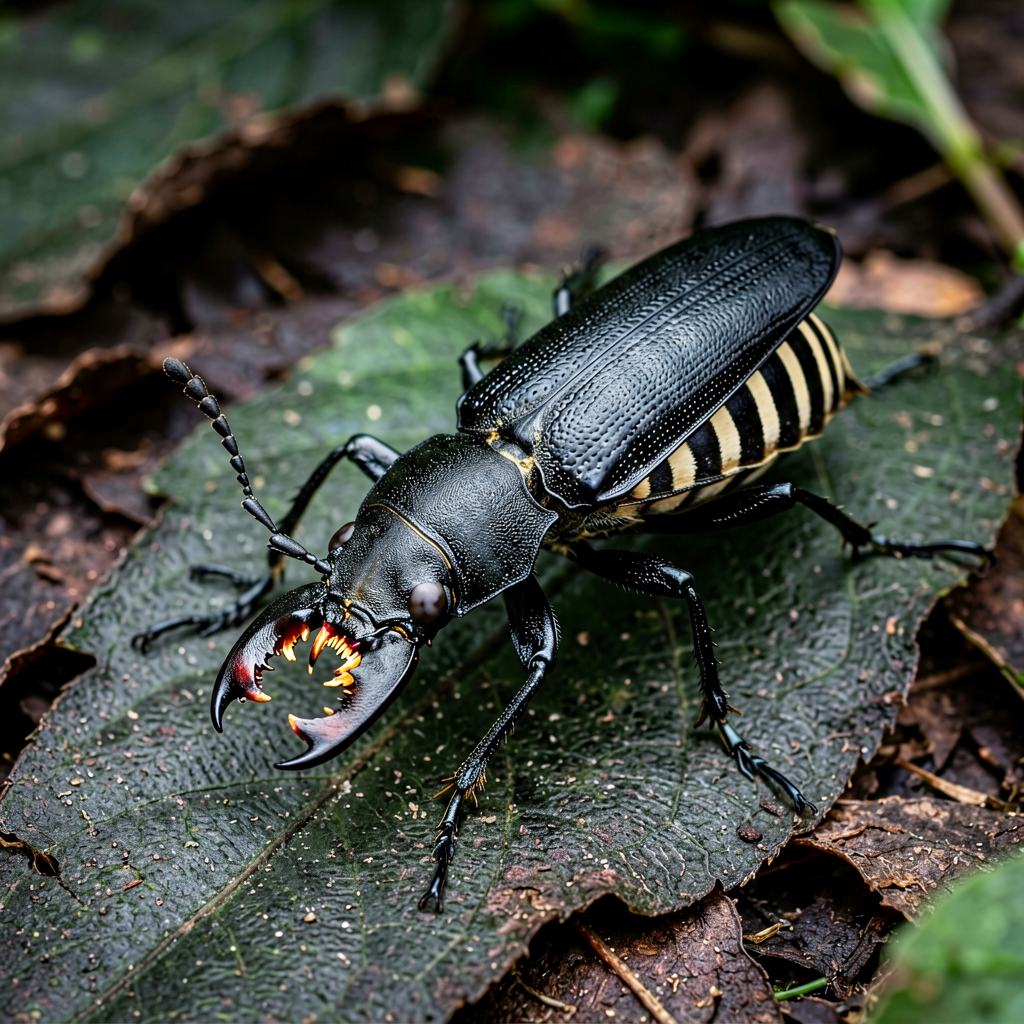
The devil’s coach horse is long, narrow and solidly built. It measures between 20 and 32 millimetres. Its body is all black, or very dark brown-black, and matt on the surface. The whole insect looks strong. That is unusual among the slimmer rove beetles. The head is large and roughly square at the front. It carries a pair of long, curved and sharp jaws. The beetle uses them to seize and to tear up prey. They can give a painful nip to a finger. There are 2 small patches of pale grey hair on the sides of the head, just behind the eyes. The antennae are short and thick. They have 11 segments and sit on top of the head, in front of the eyes.
The thorax is called the pronotum in beetles. It is broad and a little flat. It is about as wide as the head and dotted with small pits. The wing cases are very short. They reach only over the first 3 or 4 segments of the abdomen. They are hard, black and often a little wrinkled. Under them lies the folded second pair of wings. This membrane is fully formed, so the beetle can fly. Even so, it is nearly always seen walking and it flies only rarely. The abdomen is long and broad and flat beneath. It has well-formed plates above that overlap. At the tip are the defence glands.
They open on each side of the anus. They make a strong fluid of quinones and other compounds. The smell is heavy and unpleasant. The taste and the sting of it are enough to put off most predators. The legs are long and strong. The tarsi have 5 joints on all 3 pairs of legs. The whole insect is covered with fine spines and hairs. These give it a soft, velvety look. They also work as sense organs. The sexes look alike. The male is told apart by the shape of the abdomen and of the genitals.
1
2
3
Gardens, hedgerows and rough ground
Where it lives
The devil’s coach horse lives on the surface of the soil and in the litter. It likes open ground and ground with light shade. It is found in gardens, parks, churchyards, meadows and hedgerows. It also lives in field margins, roadside verges, waste ground and woodland rides. It is an insect of the lowlands and of the less farmed parts of the countryside. It is much rarer in the middle of a large arable field or in a dark plantation. It does best in the rough, untidy corners of farms and gardens.
There the litter layer is deep and the soil animals are plentiful. The species is found all through Europe, from the Mediterranean to southern Scandinavia. It also lives in North Africa and in western Asia. It has been brought to North America, to New Zealand and to parts of Australia. There it is now settled in gardens, parks and rough ground. Its habits are just the same as those of the European insect. The beetle is active at night and it hides by day.
It rests under stones, boards, logs, dead leaves and clods of soil. At night it comes out to hunt on the surface. Gardeners most often see it when they move a stone or a log. The raised tail and the open jaws are the result of being disturbed in its retreat. It hunts on the ground and it is not tied to dead wood, carrion or dung as many other rove beetles are. It is one of the insects that gains most from rough, undisturbed and litter-rich ground.
Slugs, worms and larvae
What it eats
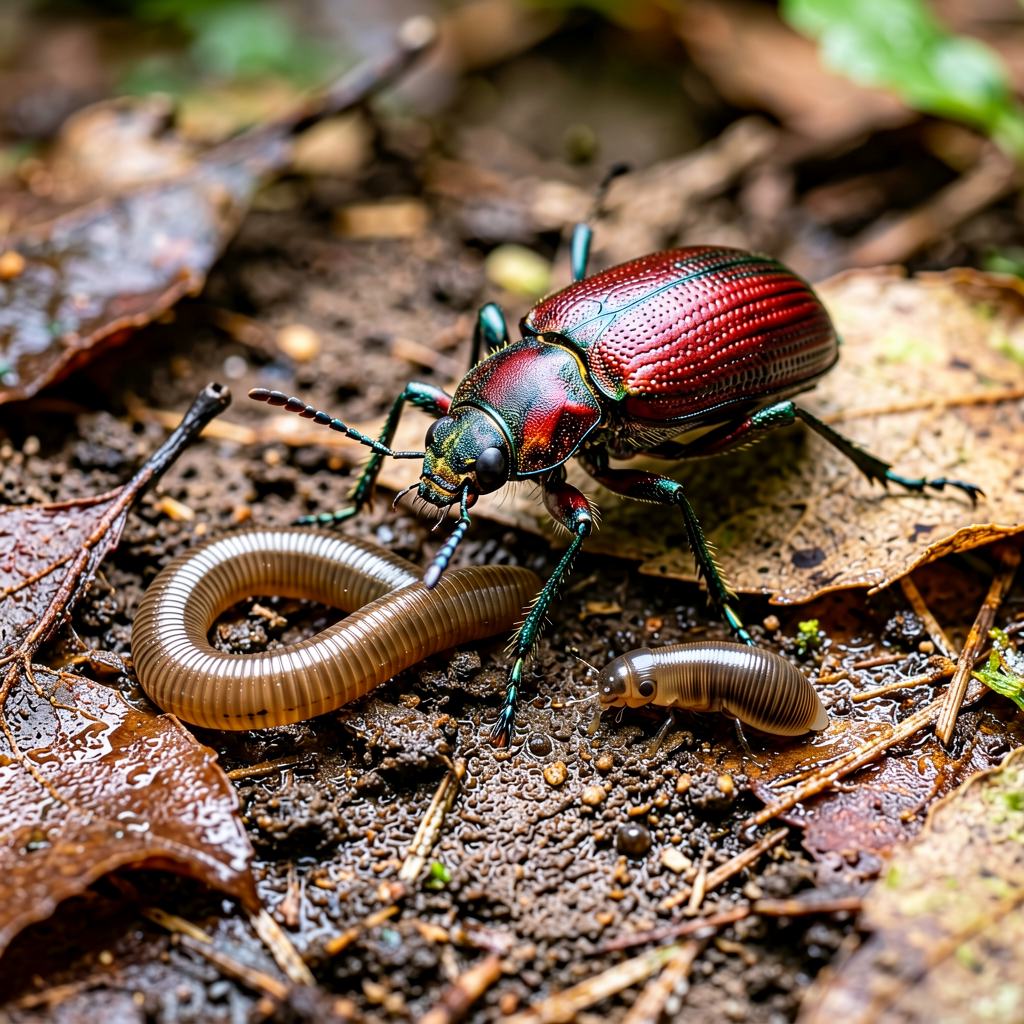
The devil’s coach horse is a general hunter. It takes a very wide range of animals from the soil and the litter. Its food includes earthworms, slugs and snails, and the smaller slugs of the garden. It also eats the larvae and pupae of beetles and moths, wireworms, leatherjackets, millipedes, centipedes, woodlice, harvestmen and spiders. It will take small adult beetles and other insects that it can catch on the ground. It also eats dead and dying invertebrates. It is said to take the caterpillars and the pupae of pest species in large numbers. The beetle hunts at night.
It finds its prey by touch and by smell. It runs quickly over the ground with its abdomen a little raised and its head low. It searches the soil and the litter with its short antennae. It seizes prey between the jaws. It chews the prey or holds it while it presses its mouthparts to the tissues. The long and bendy body lets it enter earthworm burrows and cracks in the soil. A broader and stiffer insect could not reach such prey. The larva also hunts.
It lives in the soil and takes small invertebrates with a strong pair of jaws. Both the larva and the adult can go several weeks without food. That matters for an insect that may lie still under a stone through cold or drought. Many gardeners see the species as a helpful insect. One beetle kills a great many slugs and pest larvae in a season. To kill it because it looks dangerous is a mistake that does the garden no good.
More than a year of life
The breeding cycle
The devil’s coach horse has a fairly long life cycle for an insect. Adults live for more than a year. Some survive for 2 years or a little more. The breeding season runs through the autumn and the early winter. In the warmer parts of its range it runs through the winter as well. The cycle is set so that the larvae grow through the winter and the spring. The adults that come out in summer and autumn breed in the next season. Mating takes place on the ground at night. It follows a period of courtship in which the two beetles touch with their antennae.
The male mounts the female from behind. The pair may stay joined for a long time. There is some evidence that the male stays near the female afterwards. The eggs are laid one at a time in the soil and the litter. This usually happens in the autumn. They hatch after some weeks into small larvae. These are pale, long and armoured. They live in the soil and the litter and hunt small invertebrates. The larva grows through 3 stages.
It then pupates in a chamber that it makes in the soil. The pupa is pale at first and darkens as it matures. The adult beetle comes out of the chamber some weeks later. New adults are soft and pale. They need some days for the cuticle to harden and to darken before they can hunt. Adults are long-lived and they can wait out a long spell of bad weather under cover. A female can lay a large number of eggs in one season. The details of her egg output and of the length of the immature stages are far less studied than those of pest species.
Common, useful and misunderstood
Conservation
The devil’s coach horse is not a species of concern. Over most of its very large range it is common and often seen. Its numbers are not known to be falling. It is on no international or national list of threatened species. Its main interest for conservation is the light it throws on the other animals of the soil and the litter. The numbers of those animals are almost certainly falling across Europe, and almost nobody is watching them. The species needs rough, undisturbed and litter-rich ground. It is killed by heavy digging of the soil and by the removal of the litter layer.
It is also destroyed in large numbers by insecticides. The broad-spectrum chemicals used on soil and turf are the worst. They kill the insect prey that the beetle needs. To manage a garden for the beetle you only have to do a few simple things. Leave a few stones and boards in place. Keep a rough, untidy corner or 2 with a deep litter layer. Stop using insecticide on the soil. Tolerate a hunter that looks alarming but does no harm.
The beetle is large and black, and it is common in gardens. Its habits are startling. That makes it one of the few insects that almost everyone in northern Europe has seen. Its name suggests that it is dangerous. The old belief that the beetle could be the devil in disguise was widespread in the British Isles and in mainland Europe. That belief is one of the most stubborn of the false ideas about invertebrates. Correcting it is a small but real gain for the public understanding of the animals that share the soil with the gardener.
Quick hits
Five things to remember
- When it is alarmed, the devil’s coach horse lifts its abdomen over its head like a scorpion. It opens its jaws and sprays a foul fluid from a gland at the tip of its tail.
- The wing cases cover only the first 3 or 4 segments of the abdomen. The rest of the long, bendy abdomen is bare. That is what lets the beetle curl its tail over its back.
- It is a hungry hunter of slugs, snails, earthworms and insect larvae. One beetle will destroy a great many garden pests in a single season.
- The fluid it sprays holds quinones and related compounds. It is strong enough to drive off most birds, mammals and other insects that might attack the beetle.
- It belongs to the Staphylinidae, the rove beetles. With about 60,000 described species, this is the largest family of animals on the earth.