 By st20113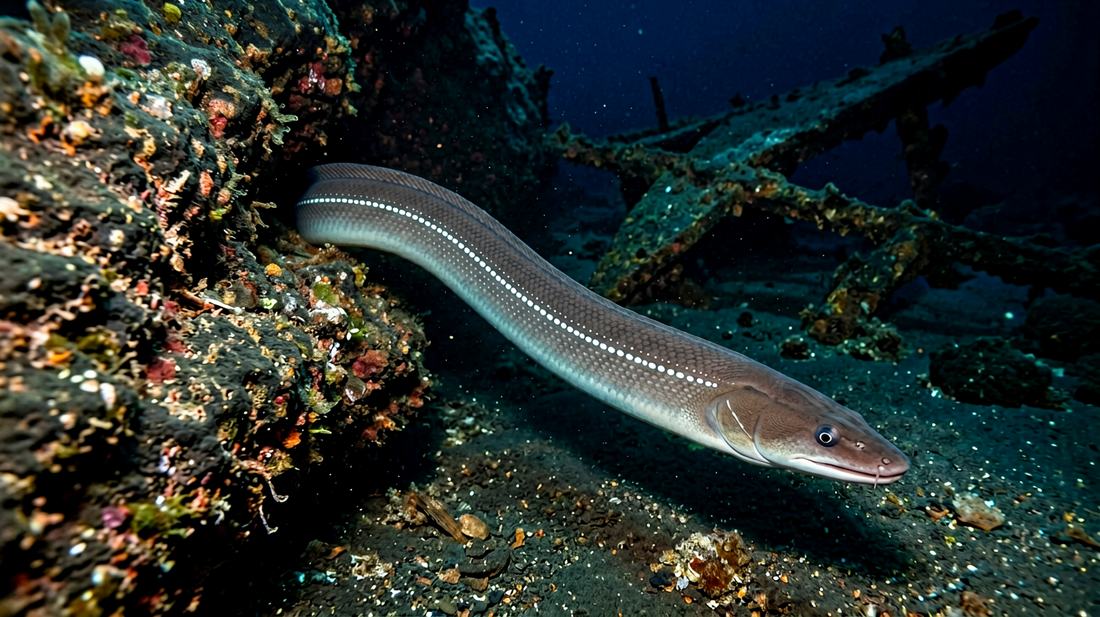
Conger conger | European Conger
Species Profile · Congridae
European Conger
The largest eel of the eastern Atlantic, up to 3 metres, which leaves the shelf to spawn in deep water while its larvae drift back across the ocean for a year or two.
IUCN: Not assessed
Range
Max length
Depth
Maturity
Spawning
The largest eel
A hunter of holes and wrecks
The European conger is the largest of all the eels of the eastern Atlantic and the Mediterranean. It is a strong, muscular, snakelike hunter. It lives on rocky ground, wrecks, harbour walls and deep reefs. It can reach a length of 3 metres and a weight of more than 100 kilograms. Most fish that people meet are far smaller. A specimen of 1.5 metres is already a good one. The body is long and round and it tapers towards the tail. The skin is smooth and has no scales. It is dark grey-brown or slate-grey on the back and paler on the belly. A light line of small white spots runs down the side. One fin forms a single fringe around the rear of the animal.
It joins the dorsal, the tail and the anal fins into one. The head is large and a little flat. The mouth is wide. It holds several rows of small, sharp teeth that point backwards. The fish has a pair of well-formed pectoral fins just behind the gill openings. That feature sets it apart at a glance from the true morays. The morays have no pectorals at all. The conger is mostly active at night. It eats fishes, octopuses, cuttlefishes and crustaceans, and it is ready to take whatever comes. It will also eat carrion of almost any kind. That is why it is so easy to catch on a baited line.
It is also why sea anglers in western Europe prize it. The fish takes shelter in a hole in a rock or in a wreck. It coils itself inside. So it is generally impossible to pull out once it has settled in such a place. The species is a valuable food fish in southern Europe. It is sold fresh for the table. Its biology holds one of the stranger life cycles of any European fish. The adults leave the shelf and the slope for the deep ocean to spawn. The larvae then drift back across the Atlantic for a year or more. At last they reach the coasts.
Family tree
Conger among the Anguilliformes
The European conger sits in the genus Conger. This is a group of about 14 species of large eels. They live in the temperate and the tropical seas of all the world’s oceans. The fish belongs to the family Congridae, the conger eels. That family joins the morays, the snake eels and the garden eels. Many other forms belong there too. The order is the Anguilliformes. That is a very large group of about 800 species of long fishes. In these fishes the body is snakelike. The scales are small or absent. The swim bladder is often lost, or joined to the gut. The gill openings are small.
The fins are soft-rayed, and in most families they run without a break around the tail. The congers are told apart from the morays by their pectoral fins. The place of the gill openings differs too. They are told apart from the freshwater eels by their much greater top size. Their mouth is larger as well. And they do not swim into fresh water to spawn. The European conger is close to the congers of the west Atlantic and of the Mediterranean. In the past the species was split into a number of forms. The dorsal fin origin and the number of vertebrae were the basis. The modern view is that it is one single species that varies a good deal. Its range covers the whole of the eastern Atlantic. It runs from the coast of Norway and Iceland to Senegal.
It also covers the whole of the Mediterranean and the waters next to it. Like all eels the conger has a life cycle that includes a larva called a leptocephalus. This is a clear, leaf-shaped, ribbon-like creature that looks nothing like the adult. The gap between the open-water larva and the bottom-living adult is huge. It is one of the most extreme cases of change of form among the bony fishes. The congers share this trait with the freshwater eels of the genus Anguilla. One of them is the European eel Anguilla anguilla. Its own long swim into the Sargasso Sea to spawn is remarkable. Its fall over the last 4 decades is worse. It is now one of the best-known cases of a European fish in trouble.
Pectorals, teeth and slime
How to identify one
The European conger has a long, heavy, almost round body. Its greatest depth sits in front of the dorsal fin origin. The body narrows to a point at the tail. Its top recorded length is about 3 metres. Its top weight is between 100 and 110 kilograms. Even so, a fish of 1 metre is already thought large. The species grows very slowly once it is past its first few years. The skin has no scales at all. It is smooth and covered with a thick layer of mucus. That layer gives the fish a slippery and rather unpleasant feel. A row of small white or pale spots marks the lateral line. Those spots stand out well against the dark back.
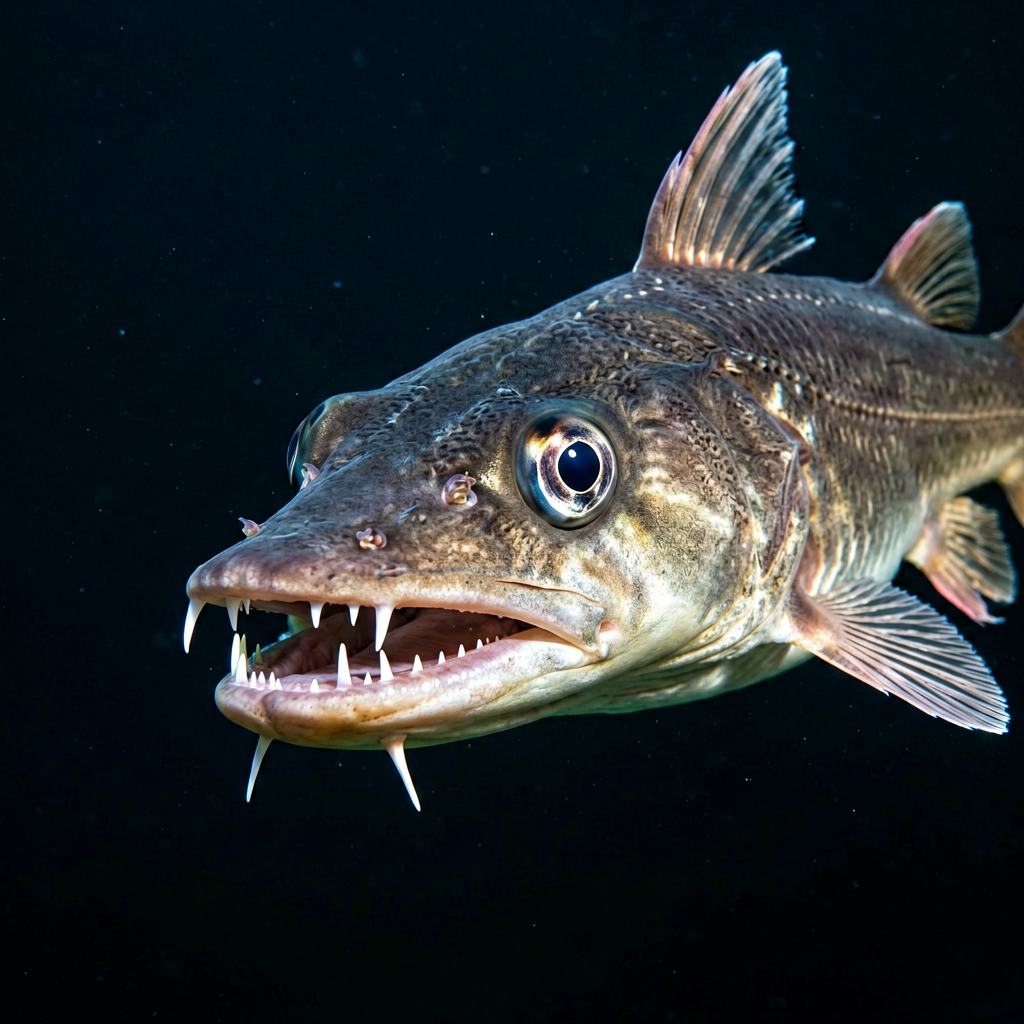
The dorsal fin starts above or just behind the base of the pectoral fins. It runs without a break around the tail and forward along the underside to the anus. So it forms a single fringe of about 300 or more rays. The pectorals are long, slender and rounded. The head is broad and a little flat. The mouth is large and reaches back past the eye. The lower jaw sticks out slightly in front of the upper one. Several rows of small, sharp teeth sit on both jaws. The teeth curve slightly backwards. More rows sit on the vomer. The eyes are small for the size of the head. The gill openings are small and set low.
The colour is a dark grey-brown or slate-grey. It turns lighter on the flanks and whitish on the belly. There is sometimes a bronze tint on the head. The sexes look alike. The female grows larger than the male. The females are the ones that reach the top lengths and weights. The young are a paler yellow-brown with darker marks. They are often found in rock pools, in crevices of the shore and in shallow weedy ground. As they grow they move into deeper water. So the smallest fish of the species live in water only a metre or 2 deep. The largest live in 200 metres or more.
1
2
3
Wrecks, reefs and harbour walls
Where it lives
The European conger is a fish of hard, rough and broken ground. It is found from the shallow shore down to depths of about 500 metres. The young and the smaller fish stay inshore among rocks, weed and boulders. Breakwaters, piers and the piles of harbours suit them too. The adults live in deeper water on rocky reefs and boulder fields. Coral and coralline formations suit them too. They also use wrecks and the sloping ground at the edge of the shelf. There the fish may sit in holes and crevices of a fair size. The species lives in the whole of the eastern Atlantic from Norway and Iceland to Senegal. It also lives in the whole of the Mediterranean.
It is found in the nearby parts of the Black Sea too. It is one of the most numerous large hunters of north-west Europe. It hunts the rocky inshore and the deeper zones. It occurs around the coasts of Britain and Ireland. Any place with a hard bottom and enough food will hold it. For most of the year the conger keeps to itself and holds a territory. It takes over a certain hole or a certain wreck and drives other congers away. So it is likely to be found in the same place year after year. The adults make a spawning migration. That trip takes them away from the coastal grounds.
It takes them out into the deeper water of the Atlantic. The biology of that trip is still not well known. It is thought that the fish of north-west Europe move south and west. They spawn in the deep water off the Atlantic coast of Iberia and north-west Africa. They may go as far as the Azores and the Canaries. The depths there are 3,000 metres or more. It is also thought that the adults die after spawning, as the freshwater eels do. The larvae drift with the currents for a year or 2. They change into small eels when they reach the coasts. By then they have crossed a large part of the Atlantic.
Fish, octopus and carrion
What it eats
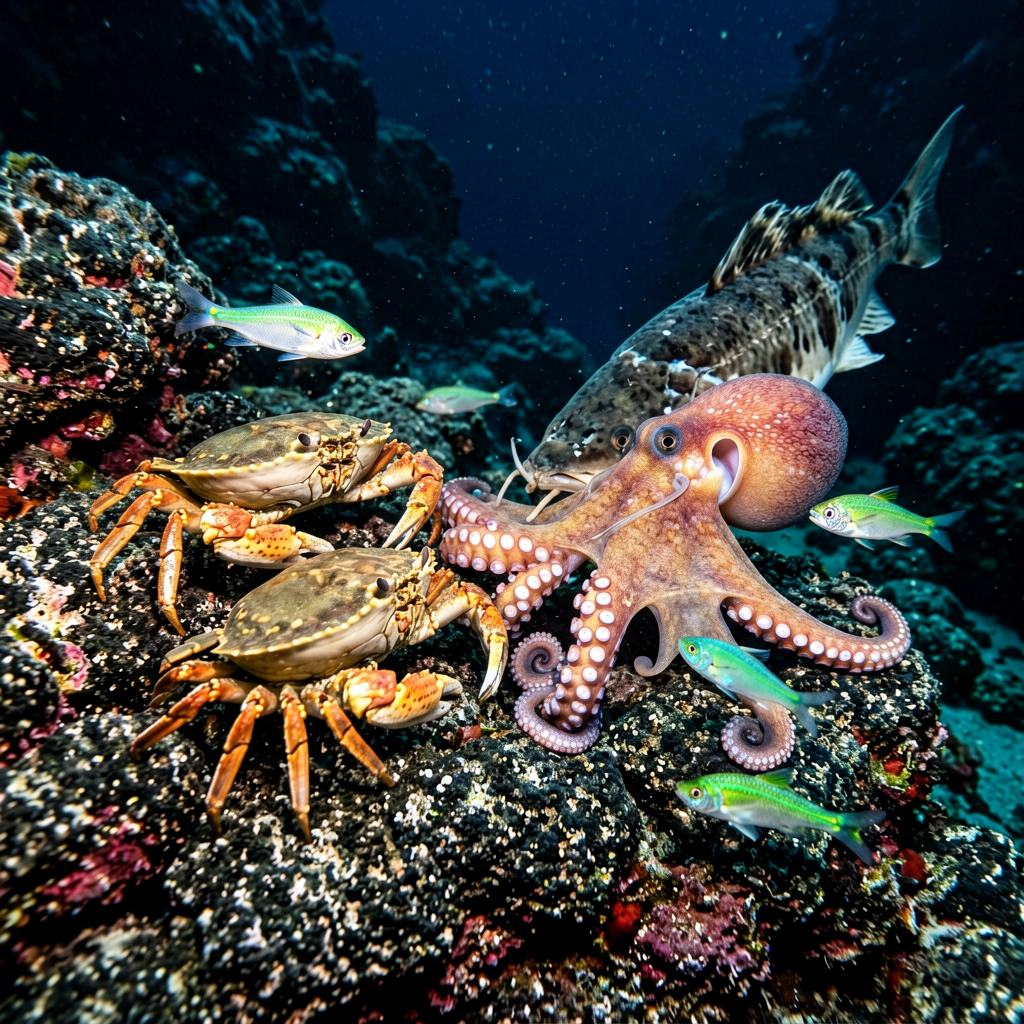
The European conger hunts and it takes whatever it can get. It eats a very wide range of animals. It will also take carrion of almost any kind. In the inshore waters of north-west Europe its food is mostly fish. These include the whiting, the pouting, the poor cod and the pollack. The wrasse, the dab and the flounder are taken too. It also takes the small gobies, blennies and rocklings of the rocky shore. To these it adds octopus, cuttlefish and squid. The larger crabs, lobsters, edible crabs and spider crabs go into the diet. So do prawns, shrimps and the common lobster.
In deeper water the diet turns more to fish. There the conger becomes one of the main hunters of the fish of the slope. These include the hake, the blue whiting and various deep-water species of the continental margin. The species is mostly active at night. It hunts largely by smell. Its eyes are small. That suggests that sight matters little to it. Its sense of smell is well developed. The conger comes out of its hole at dusk. It patrols the reef, the wreck or the harbour wall beside it.
It will chase a fish into open water. There its strong body and snakelike swimming give it good speed over short distances. The fish also takes a good deal of food that is already dead. It is a common visitor to lobster pots and to baited lines. It also visits the waste thrown overboard from fishing boats. That habit brings it into frequent conflict with fishermen. It also makes it very easy to catch with a baited hook. The small congers of the shallow inshore water feed mostly on small fishes, shrimps and crabs. They grow fast on the rich food supply of the shore. Later they move out into deeper water.
One spawning run, then death
The breeding cycle
The European conger is long-lived, slow-growing and late to mature. Its breeding biology is one of the least well known of any European species. It matters both for fishing and for sport. The adults spawn in deep water far from land. The larvae look so little like the adults. They were first named as a separate genus of fishes. The species matures at a length of between about 70 and 90 centimetres. Its age at maturity is usually put at between 5 and 8 years. Studies of the gonads of caught fish suggest the adults spawn only once.
They then die, as the freshwater eels are known to do. The evidence for that view is less complete than it is for Anguilla. The chance that a conger may spawn in more than one season has not been ruled out. The spawning grounds are thought to lie in the deep water of the eastern Atlantic. The depths there are between 2,000 and 4,000 metres. The eggs float and they are released in huge numbers into the water column. There they hatch into the larvae that are the mark of the eels. The larva of the conger is a clear, leaf-shaped creature of several centimetres in length. It feeds on small drifting organisms.
It drifts with the ocean currents for a period usually put at between 1 and 2 years. Then it changes into a small eel-like fish. That change comes with a large loss of size. The young conger that arrives at the coast is far smaller than the larva it grew from. This odd fact is known in the eels as a group. It is one reason why the early life of the group has been so hard to study. The small congers then settle in the shallow inshore water. They grow there for several years. Then they move out into deeper water and in time make the spawning migration.
Common but badly known
Conservation
The European conger has not been judged on its own on the global Red List. Nothing suggests that the species as a whole is at risk of dying out. It is wide-ranging and locally common. The large industrial fleets of the region have no interest in it. Even so, it is taken in fair numbers as bycatch. The trawl and longline fisheries of the shelf and the slope take it. It is also the target of a fishery in the Mediterranean. The waters of Iberia have a fishery too. There it is a valuable food fish.
There is very little information about three things. They are the size of the population, the age structure of the catch and the state of the stocks. A few traits of the species make it open to harm. It grows slowly. It matures late. Its output of eggs is very low for its size. Each female produces a single batch of eggs in her life. And the adults gather in a limited number of deep-water spawning areas. But the data needed to judge the state of the stock are missing.
So the running of the species is mostly a matter of the general rules of fishing. There is no special protection for the conger. The species also suffers from the damage of the rocky inshore habitat on which the young depend. The larger boulders and the weed are removed by trawling and dredging of the shallows. The wrecks and the reefs that form the main adult habitat are disturbed as well. The general lesson of the conger is this. A species can be common, and still so little known that nobody can say what its numbers are doing.
Quick hits
Five things to remember
- The European conger can reach a length of 3 metres. It can also weigh more than 100 kilograms. That makes it the largest eel of the eastern Atlantic and the Mediterranean.
- It has no scales at all, and its skin is covered in a thick layer of mucus. That layer of slime is one reason why a hooked conger is so hard to hold.
- It is thought to spawn only once in its life, and to die afterwards. The freshwater eels do the same. The spawning water may be 3,000 metres or more below the surface.
- Its larva is a clear, leaf-shaped creature called a leptocephalus. It drifts in the ocean for a year or 2. It was once named as a separate genus of fishes.
- The moray eels have no pectoral fins. The conger has a pair of well-formed pectorals just behind the gills. That is the quickest way to tell the two apart.