 By st20113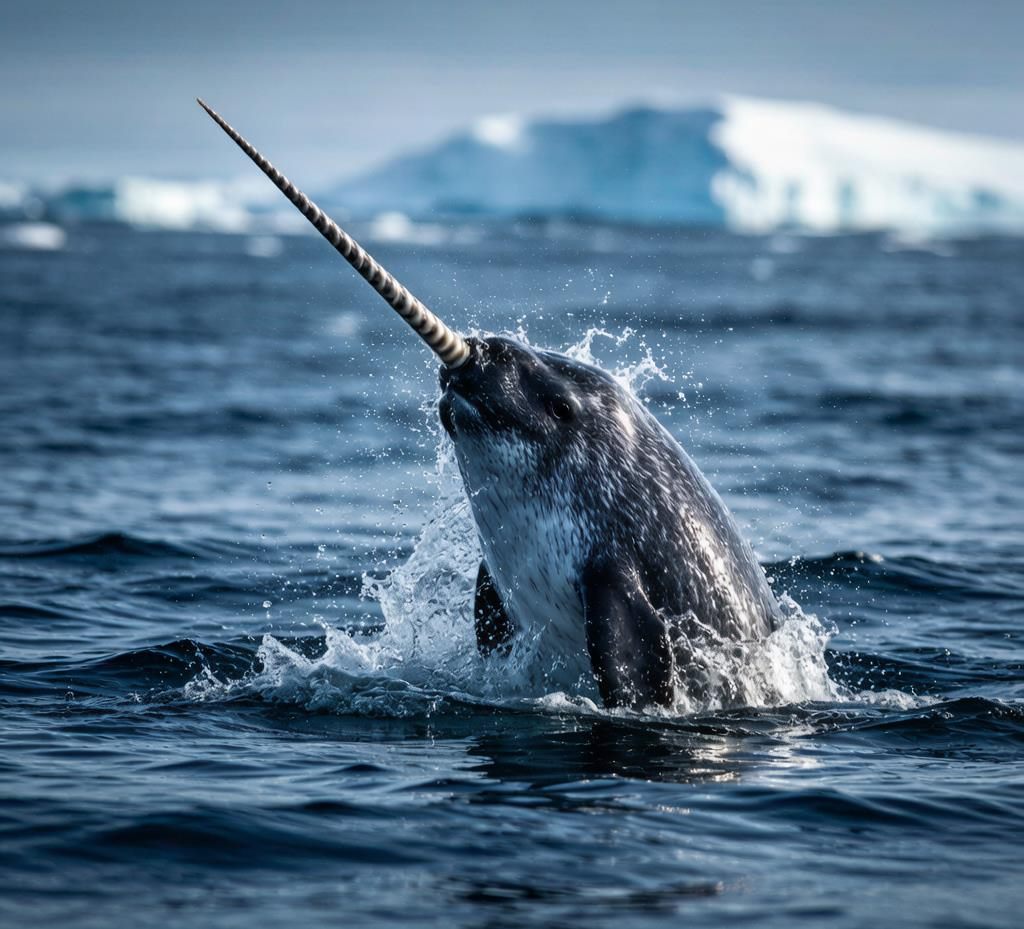
Introduction
The narwhal, Monodon monoceros, is one of the Arctic’s most distinctive cetaceans, famed for the long spiraled tusk that protrudes from its upper jaw in adult males. Nicknamed the “unicorn of the sea,” this medium-sized toothed whale inhabits the deep, icy waters of the Canadian Arctic, Greenland, and Russia’s high-latitude seas. With no dorsal fin, a rounded body, and mottled gray-to-white coloration, the narwhal is exquisitely adapted to life beneath sea ice. Its tusk — an overgrown canine tooth — has inspired myth and wonder across centuries and remains one of the most charismatic yet elusive Arctic whales.
Taxonomy
The narwhal belongs to the order Cetacea, the toothed whales, within the suborder Odontoceti. It sits in the family Monodontidae, which contains just two living species — the narwhal and its close relative, the beluga whale. The genus name Monodon means “one tooth” in Greek, and the species name monoceros translates to “one horn” — a nod to the distinctive tusk. Molecular studies indicate that narwhals and belugas diverged from a common ancestor roughly 15 to 25 million years ago.
Physical Characteristics
Adult narwhals reach 4 to 5.5 meters in length and weigh 800 to 1,600 kilograms, with males slightly larger. Coloration changes with age: newborns are blue-gray, adults are mottled gray and white, and elderly individuals are nearly pure white. The narwhal’s celebrated tusk spirals counterclockwise and can exceed three meters, packed with millions of nerve endings suggesting a sensory function. Both sexes occasionally grow a second smaller tusk. The narwhal lacks a dorsal fin — an adaptation for navigating under ice — and has small, upturned flippers.
Habitat
Narwhals are Arctic specialists found in the coastal fjords, bays, and deep offshore waters of Greenland, Canada (Nunavut and the Northwest Territories), and western Russia. They are profoundly dependent on sea ice, which provides shelter, breathing holes, and a hunting platform. In winter, narwhals make extraordinary dives exceeding 1,800 meters to feed on benthic prey. In summer, they move into coastal areas for breeding and molting. The polar bear occasionally preys on narwhals trapped at breathing holes in the ice.
Diet
Narwhals are carnivorous deep divers with a diet of benthic fish, squid, and shrimp. Key prey includes Greenland halibut, Arctic cod, and cephalopods consumed during dives lasting over 25 minutes. In winter, the narwhal feeds extensively on bottom-dwelling organisms few other Arctic predators can access. Unlike most toothed whales, narwhals lack conventional functional teeth and appear to swallow prey whole. Some researchers hypothesize the tusk may help stun prey during feeding.
Reproduction
Narwhals breed in spring with a gestation of 14 to 16 months — one of the longest of any cetacean. A single calf is born the following summer, usually between July and August, in shallow coastal waters. Calves nurse for approximately 20 months, an unusually long period that reflects the harsh Arctic environment and the importance of fat reserves for winter survival. Females give birth every three or more years and may continue reproducing into their 80s. Sexual maturity is reached between 6 and 9 years, and narwhals can live up to 90 years.
Conservation
The narwhal is listed as Least Concern by the IUCN, though some populations face serious localized threats. Climate change is the most pressing long-term risk, as warming temperatures reduce Arctic sea ice and disrupt the seasonal migrations narwhals have relied on for millennia. Bycatch in fishing gear, marine pollution, and noise disturbance from shipping and industrial activity compound these pressures. Subsistence hunting by Inuit communities in Canada and Greenland remains culturally important and is managed through strict quotas. Climate-driven habitat loss is widely regarded as the greatest future threat.
Fun Facts
Medieval Europeans prized narwhal tusks as genuine “unicorn horns,” paying fortunes for their supposed magical healing properties. Queen Elizabeth I is said to have purchased one for the price of a castle. The narwhal tusk has over 10 million nerve endings — more than any human tooth — making it one of the most sensitive mammalian structures known. Narwhals rival sperm whales in diving depth yet are less than one-fifth their size. Unlike most toothed whales, narwhals do not produce complex songs but communicate using clicks, whistles, and squeals that echo through the icy Arctic waters they call home.