 By st20113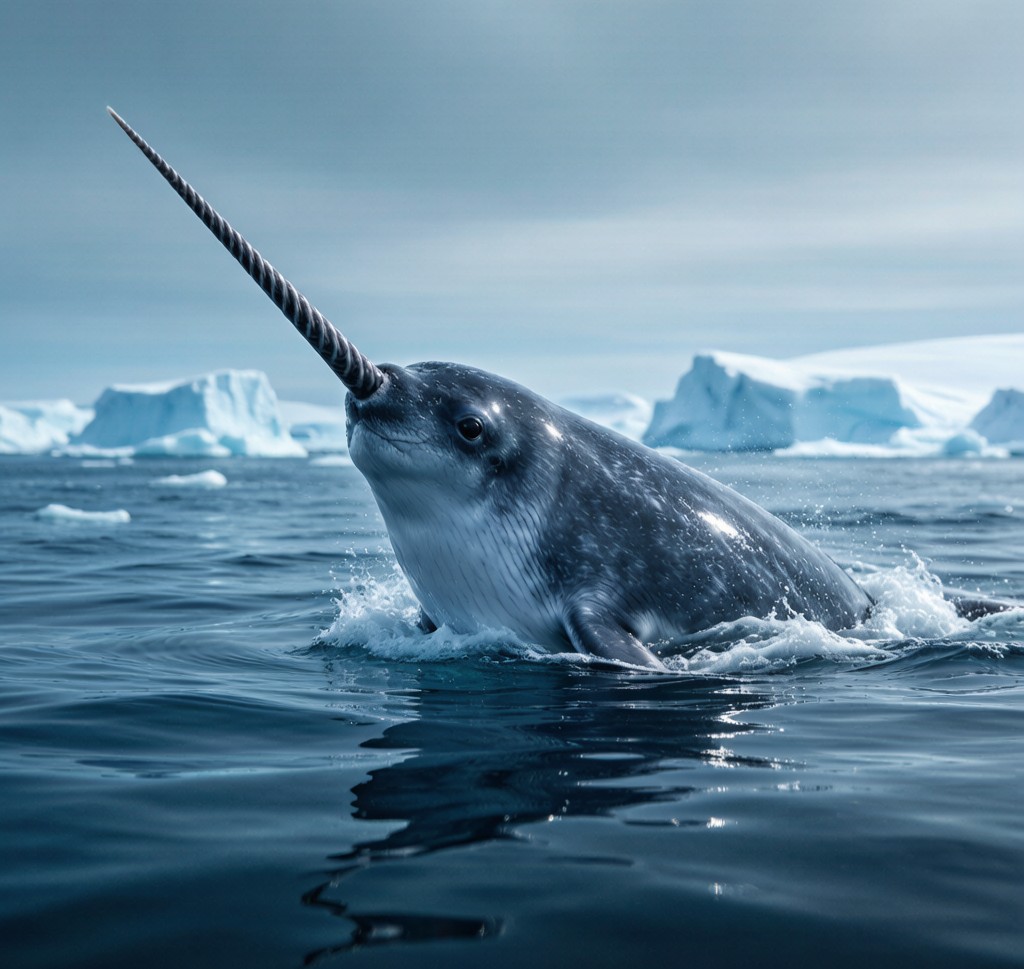
The Narwhal (Monodon monoceros) – the “unicorn of the sea” – is one of the most unusual and evocative animals in the ocean: a medium-sized toothed whale of the Arctic waters around Canada, Greenland, and Russia whose most striking feature is a spectacular spiral tusk that can grow to more than 3 meters in length, extending forward from the upper left jaw in a left-handed helix that has inspired legends of sea unicorns and contributed to the mystique of this extraordinary Arctic cetacean.
Overview
The Narwhal (Monodon monoceros) – the “unicorn of the sea” – is one of the most unusual and evocative animals in the ocean: a medium-sized toothed whale of the Arctic waters around Canada, Greenland, and Russia whose most striking feature is a spectacular spiral tusk that can grow to more than 3 meters in length, extending forward from the upper left jaw in a left-handed helix that has inspired legends of sea unicorns and contributed to the mystique of this extraordinary Arctic cetacean. The narwhal’s tusk is, in fact, a massively elongated canine tooth – one of two in the upper jaw – that has evolved into a straight or spiral, ivory-like weapon of extraordinary length and symmetry.
The narwhal’s body is mottled grey and white, covered in distinctive dark spots that are unique to each individual, much like a human fingerprint. Adults reach lengths of 4 to 5.5 meters (excluding the tusk) and weigh 800 to 1,600 kilograms, with males being slightly larger than females. The narwhal’s dorsal fin is absent – an adaptation to life in the pack ice, where a dorsal fin would be a liability – and the animal’s rounded body tapers to a short fluke. The narwhal’s blubber layer – which can be up to 10 centimeters thick – provides insulation in the frigid Arctic waters in which it lives.
Habitat and Diving
The Narwhal is found throughout the Arctic waters of Canada, Greenland, Norway, and Russia, with the largest populations occurring in the Canadian High Arctic and around Greenland. The species is strongly associated with sea ice: it inhabits the edges of the permanent polar ice cap and the seasonal ice edges and fjords of the Arctic archipelago, where it feeds, breeds, and navigates through the ice. Narwhals are highly migratory, moving south in the autumn as sea ice forms and north in the spring as the ice breaks up, following the seasonal rhythm of the Arctic ecosystem.
The narwhal is one of the deepest-diving Arctic mammals: the species has been recorded diving to depths of more than 1,800 meters, and individuals may spend up to 25 minutes underwater during a single dive. The narwhal’s diet consists primarily of Greenland halibut, Arctic and polar cod, cephalopods (particularlyGonatid squid), and shrimp, and the species is adapted to feeding at depth in complete darkness, using echolocation to locate prey in the aphotic (lightless) depths of the Arctic Ocean. The narwhal’s ability to dive to such extreme depths is made possible by its ability to collapse its lungs and store oxygen in its muscles and blood, which are rich in the oxygen-binding protein myoglobin.
The Tusk
The narwhal’s tusk is one of the most extraordinary structures in the animal kingdom. Unlike the ivory of elephant tusks, which is dentine (a form of tooth), the narwhal’s tusk is composed of cementum, dentine, and pulp – the same materials as a normal tooth – but with a uniquely modified structure in which the dentine forms a series of spiral tubes running the length of the tusk. The tusk is flexible – it can bend up to 30 centimeters in any direction without breaking – and its outer surface is covered in millions of nerve endings that make it an exquisitely sensitive sensory organ. Researchers now believe the tusk serves as a sensory tool: it may be used to detect changes in water temperature, pressure, and salinity, and possibly to detect the presence of prey or predators.
The purpose of the narwhal’s tusk has been debated for centuries: early theories ranged from a weapon for spearing fish and fighting rivals to a navigational instrument for breaking through ice. Modern research has revealed that the tusk’s sensory function is its primary role, and that male narwhals may also use their tusks in ritualized sparring behavior – two males will cross tusks and rub them together in a behavior that resembles sword-fighting. This behavior may help establish dominance hierarchies without the risk of serious injury. The spiral helix pattern of the tusk – which results from the helical arrangement of dentine layers within the tooth – has also been the subject of scientific curiosity: the helix grows in a consistent left-handed direction, as if the narwhal were screwing itself through the water.
Conservation
The Narwhal is listed as Least Concern on the IUCN Red List, reflecting its large population (estimated at more than 100,000 individuals) and wide distribution. However, the species faces significant threats from climate change and the resulting loss of Arctic sea ice: as global temperatures rise, the Arctic Ocean is warming and the extent and duration of sea ice cover is declining, which may disrupt the narwhal’s seasonal migration patterns, alter the distribution of its prey, and increase the animal’s exposure to predation and human activity.
Narwhals have historically been hunted by Inuit communities in Canada, Greenland, and Russia for their meat, skin, and ivory – a practice that continues today under quotas established by national and international agreements. The Inuit hunt of narwhals is considered sustainable and culturally important, but the species is also increasingly exposed to incidental capture in fishing gear, vessel strikes, and the impacts of industrial activities including oil and gas exploration and shipping in the Arctic. The long-term viability of narwhal populations will depend on the management of these cumulative pressures in the context of a rapidly changing Arctic environment.