 By st20113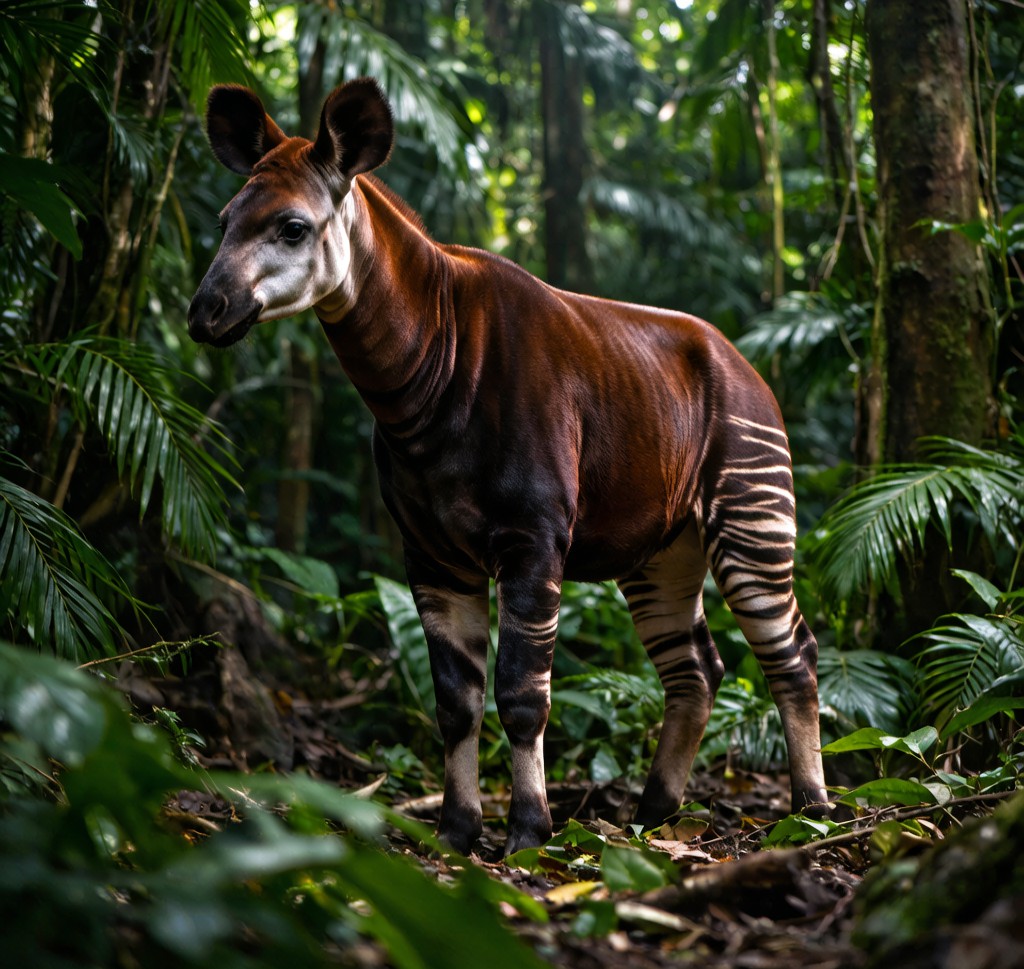
The Okapi (Okapia johnstoni) is one of the most remarkable zoological discoveries of the 20th century – a large, chocolate-brown forest ungulate with zebra-striped legs that was completely unknown to Western science until 1901, when British colonial administrator Sir Harry Johnston sent two peculiar strips of striped skin to the Natural History Museum in London.
Overview
The Okapi (Okapia johnstoni) is one of the most remarkable zoological discoveries of the 20th century – a large, chocolate-brown forest ungulate with zebra-striped legs that was completely unknown to Western science until 1901, when British colonial administrator Sir Harry Johnston sent two peculiar strips of striped skin to the Natural History Museum in London. The okapi belongs to the family Giraffidae – the same family as the giraffe – and is in fact the only living close relative of the giraffe, from which it diverged approximately 16 million years ago. Despite this close relationship, the okapi looks like no other animal: a compact, horse-sized body covered in chocolate-brown to reddish-brown fur, perched on four legs that are strikingly marked with horizontal cream to white stripes on the upper parts, and topped with a giraffe-like head bearing a long, flexible tongue and two ossicones (horn-like projections covered in skin).
The okapi’s zebra-striped legs are among its most distinctive features: the bold, horizontal cream-colored stripes on the upper legs and hindquarters are thought to serve as a form of disruptive coloration, breaking up the animal’s outline in the dappled light of the rainforest and providing camouflage among the vertical stems and tree trunks of its forest habitat. The stripes may also serve as visual cues that help calves follow their mothers through the dense forest undergrowth. The okapi’s coat is also remarkably oily and water-resistant – an adaptation to the wet, humid conditions of the rainforest environment in which it lives.
Habitat and Behavior
The Okapi is endemic to the Ituri and nearby rainforests of the Democratic Republic of Congo in Central Africa – one of the most remote and inaccessible regions of the African continent. The species was first described by science in 1901 but has remained one of the least-studied large mammals in Africa, largely because of the difficulty of accessing and working in its dense, swampy rainforest habitat. The okapi is found primarily in the middle-elevation rainforests of the Congo basin, at altitudes of 500 to 1,000 meters above sea level, where it inhabits areas with dense undergrowth, particularly along riverbanks and in swampy clearings.
The okapi is a shy, elusive animal that is most active during the day and spends most of its time feeding on the forest floor or in the lower levels of the forest canopy. The species is primarily a browser, feeding on the leaves, buds, and fruits of more than 100 different plant species, with a particular preference for the leaves and shoots of the tree genus Gilbertiodendron. The okapi’s long, flexible tongue – which can extend up to 30 centimeters and is used to strip leaves from branches – is shared with its giraffe relative and is one of the most distinctive features linking the two species. The okapi also consumes clay and other minerals from salt licks and mineral-rich soils, a behavior that is important for supplementing the mineral content of its plant-based diet.
Communication and Reproduction
Despite its elusiveness, research in recent decades has revealed that the okapi employs a sophisticated communication system based on scent – particularly the secretions of a gland on the foot – and vocalizations that include a range of chimp-like vocalizations, including a “chimp” call that researchers believe serves as a contact call between mothers and calves in the dense forest. The okapi’s foot gland – a sebaceous gland on the dorsal surface of the foot between the two main toes – produces a dark, tar-like secretion that is deposited on the ground as the animal walks, creating a scent trail that other okapis can follow. Both males and females have foot glands and engage in scent-marking behavior.
The okapi’s reproductive biology is poorly known, but based on observations of captive individuals and limited field data, the species appears to have a slow reproductive rate. Females give birth to a single calf after a gestation period of approximately 440 to 450 days (approximately 15 months) – one of the longest gestation periods of any ungulate. The calf is born in a nest or clearing in the forest undergrowth and is capable of standing within 30 minutes of birth. Calves are concealed by their mothers in the dense forest vegetation for the first few weeks of life, with the mother returning periodically to nurse, and begin following their mothers at approximately 2 to 3 months of age.
Conservation
The Okapi is listed as Endangered on the IUCN Red List, reflecting significant population declines driven by habitat loss, civil unrest, and poaching in the Democratic Republic of Congo. The okapi’s rainforest habitat is under pressure from logging, mining (particularly coltan mining for electronic components), and the expansion of small-scale agriculture in the Congo basin. However, the most significant threat to the okapi in recent years has been the political instability and armed conflict that has plagued the DRC, which has disrupted conservation activities, led to the displacement of wildlife monitoring programs, and created conditions in which poaching and illegal wildlife trade flourish unchecked.
The okapi is hunted for its meat – which is highly prized in some parts of its range – and its hide, which is used locally for clothing and other purposes. The species’ slow reproductive rate makes populations highly vulnerable to hunting pressure: with only one calf every 2 to 3 years at most, a population that loses several breeding adults per year may take decades to recover. The Okapi Wildlife Reserve – a UNESCO World Heritage Site in the DRC – protects one of the largest remaining populations of okapis, but enforcement of conservation regulations is extremely difficult in the context of ongoing civil conflict. The International Union for Conservation of Nature (IUCN) has identified the establishment and effective management of protected areas as the highest priority for okapi conservation.