 By st20113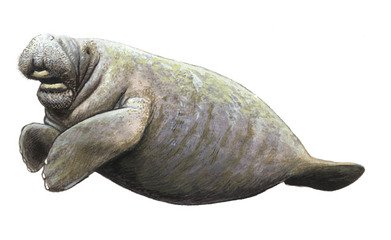
Introduction
The Florida manatee (Trichechus manatus) is a large aquatic mammal inhabiting the warm coastal and riverine waters of the southeastern United States, the Caribbean, and northern South America. Often called the “sea cow,” this slow-moving herbivore spends most of its life grazing on submerged vegetation and resting in shallow waters. Despite its formidable size, the manatee is entirely harmless and feeds exclusively on aquatic plants.
Taxonomy
The Florida manatee belongs to the family Trichechidae within the order Sirenia. Its scientific name, Trichechus manatus, derives from Greek roots meaning “hair-bearing whale.” Two subspecies are recognized: T. m. latirostris (the Florida manatee) and T. m. manatus (the Antillean manatee), which ranges across the Caribbean and northern South America. Fossil records show that sirenians diverged from other mammals during the Eocene epoch, making them among the oldest lineages of marine mammals alive today.
Physical Characteristics
Adult manatees measure 2.7 to 3.5 meters in length and weigh 400 to 590 kilograms, with the largest individuals exceeding 1,600 kilograms. Their bodies are robust and fusiform, adapted for efficient swimming, with a distinctive paddle-shaped tail. Gray to brown skin is often encrusted with algae and barnacles. Specialized prehensile lips lined with thick bristles grip and tear aquatic vegetation. Manatees have a slow metabolism and must maintain water temperatures above 20 degC to avoid life-threatening cold stress.
Habitat
Manatees inhabit rivers, estuaries, coastal lagoons, and shallow marine environments across their range. Access to warm-water refuges in winter is the critical factor limiting their distribution, and large numbers congregate near natural warm springs and power plant outflows when ambient temperatures drop. Seagrass meadows are vital habitats, providing both food and shelter. The green sea turtle shares these seagrass beds, while the bottlenose dolphin inhabits the same coastal waters. Seasonal migrations bring manatees into contact with diverse communities including the great white pelican, which forages in the same shallow waters.
Diet
As obligate herbivores, manatees consume between 4 and 9 percent of their body weight in vegetation daily. Their diet centers on seagrasses such as turtle grass and manatee grass, supplemented by floating plants like water hyacinth. Prehensile lips gather food, which is crushed by tough dental pads before passing into a multi-chambered stomach for fermenting cellulose. Manatees play a vital ecological role as grazers, maintaining seagrass bed health and recycling nutrients into the water column, similar to the role played by the sea otter in kelp forest ecosystems.
Reproduction
Manatees are polygynous and exhibit a slow reproductive strategy. Females reach sexual maturity at 4 to 5 years and typically give birth to a single calf every 2 to 5 years after a 12 to 14 month gestation. Newborns measure about 1.0 to 1.3 meters and can swim to the surface for their first breath within minutes of birth. The calf nurses for up to two years, remaining closely associated with its mother, who provides milk, protection, and guidance. This long calving interval means that even modest increases in adult mortality can outpace the species’ recovery, as demonstrated by the slow rebound of the Florida manatee population.
Conservation
Listed as endangered under the Endangered Species Act, the Florida manatee faces threats from boat strikes, fishing gear entanglement, habitat loss, and cold stress. Boat collisions are the leading cause of human-related mortality, and seasonal slow-speed zones have been established in critical habitat areas. Conservation efforts also include habitat restoration, a rescue and rehabilitation network, and public education campaigns. Population surveys show growth from roughly 1,200 individuals in the 1970s to over 7,000 today, representing a genuine conservation success.
Fun Facts
Manatees can hold their breath for up to 20 minutes and reach swimming speeds of 21 kilometers per hour in short bursts when fleeing danger. Each individual has a unique pattern of scars and markings that serves as a natural fingerprint for photo-identification research. Despite their large size, manatees are remarkably docile and have been observed interacting playfully with swimmers. In 2007, a captive manatee named Snooty became the oldest recorded individual, living to age 69 at the South Florida Museum.