 By st20113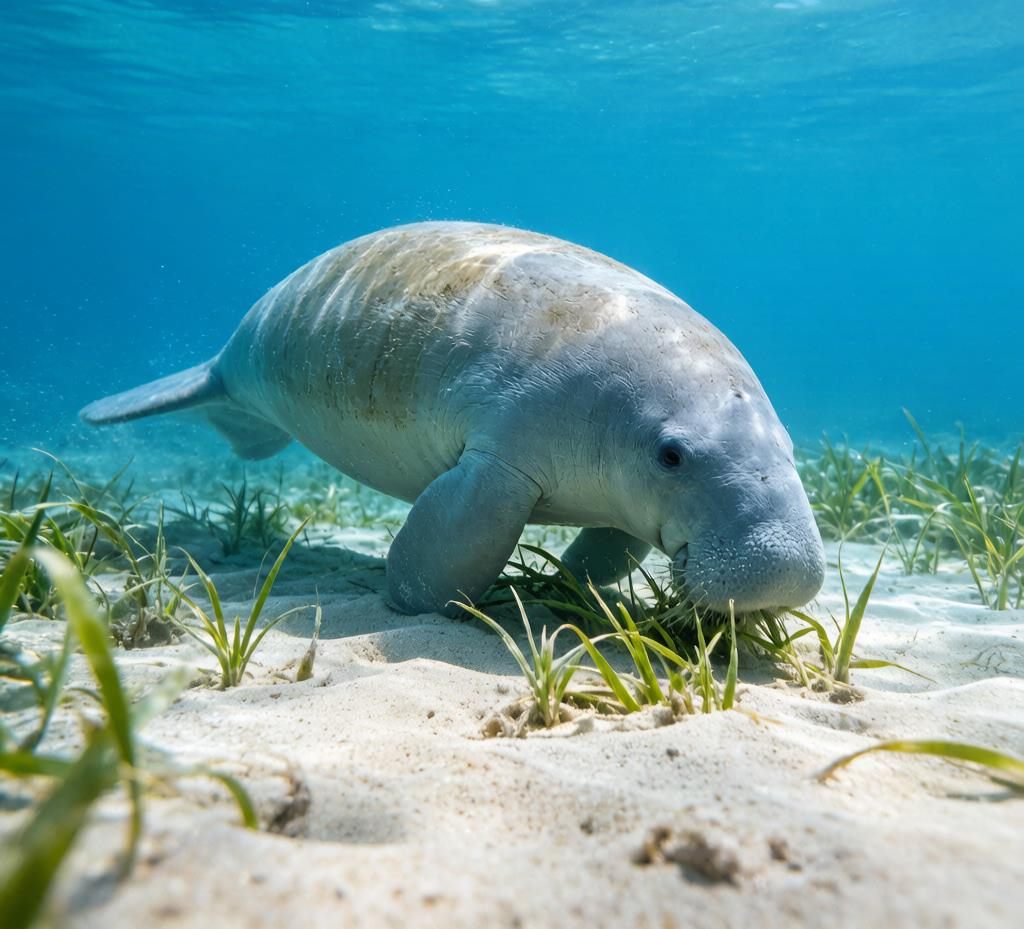
Introduction
The dugong, Dugong dugon, is the only strictly marine member of the Sirenia — the order of gentle, fully aquatic mammals that includes the three manatee species. Often called the “sea cow,” the dugong has inspired mermaid legends across cultures and inhabits warm, shallow coastal waters from East Africa through the Indian Ocean to the western Pacific, including Australia. Its docile nature, slow movements, and haunting face framed by sensitive bristles have made it a symbol of healthy coastal marine ecosystems. The dugong shares a surprising evolutionary relationship with elephants, its closest living land relative.
Taxonomy
The dugong belongs to the order Sirenia and the family Dugongidae, which contains only one living species following the extinction of Steller’s sea cow in the 18th century. Its genus name comes from the Malay word duyung, meaning “lady of the sea” or “mermaid.” The closest living relatives are the Florida manatee and other manatee species within Sirenia. Despite superficial resemblances to dolphins and whales, dugongs are far more closely related to elephants than to any cetacean — a fact reflected in their slow metabolism, continuous tooth replacement, and herbivorous diet. Both groups retain vestigial toenails on their flippers as a legacy of terrestrial ancestry.
Physical Characteristics
The dugong has a robust, spindle-shaped body streamlined for cruising shallow coastal waters. Adults measure 2.4 to 2.7 meters and weigh 230 to 400 kilograms, with females slightly larger. Its skin is thick and pale grayish-brown. The tail is broad, horizontal, and fluked — resembling a dolphin’s rather than the round paddle tail of manatees. The head has a large, downward-curving snout with tactile bristles for locating seagrass by touch. Adult males develop a pair of tusk-like incisors used in male-to-male competition. The dugong has no dorsal fin.
Habitat
The dugong inhabits warm, shallow coastal waters where seagrass meadows grow — its essential and essentially sole food source. Its range spans the Indo-Pacific from East Africa through the Indian Ocean to the western Pacific, including Australia, Japan, and the Philippines. The dugong prefers water depths of 1 to 10 meters with sandy or muddy bottoms. It is generally non-migratory, staying within a small home range throughout life, though individuals may travel hundreds of kilometers between key feeding and breeding areas. Seagrass beds in coastal bays and lagoons are the primary habitat, and these environments are increasingly threatened by coastal development and pollution.
Diet
The dugong is an obligate herbivore, subsisting almost entirely on seagrass — consuming the leaves, stems, rhizomes, and roots of entire plants. It feeds by rooting through the seabed with its muzzle, creating visible furrows in the seafloor. The dugong must consume up to 40 kilograms of seagrass daily to meet its energy needs. When seagrass is scarce, dugongs may supplement with jellyfish, tunicates, and small shellfish. Dugongs return repeatedly to specific seagrass meadows. Their feeding furrows promote seagrass regrowth, making dugongs ecosystem engineers of the coastal seabed.
Reproduction
The dugong has one of the slowest reproductive rates of any marine mammal, with females giving birth to a single calf every 2.5 to 7 years after a 13 to 15 month gestation. Births occur in shallow, sheltered waters where newborns are protected from tiger sharks and other predators. Newborns measure roughly 1 to 1.2 meters and may weigh 20 to 35 kilograms. Calves nurse for 14 to 18 months and remain close to their mothers, learning to navigate seagrass meadows. The dugong’s low reproductive rate makes populations extremely vulnerable to human-induced mortality — even moderate deaths from bycatch or boat strikes can outpace recovery. Female dugongs may live up to 70 years.
Conservation
The dugong is classified as Vulnerable by the IUCN, with population trends declining across most of its range. Primary threats include accidental capture in fishing gear, boat strikes from increasing maritime traffic, coastal development that destroys seagrass meadows, marine pollution, and deliberate hunting for meat and oil in some regions. Climate change adds pressure through the degradation of seagrass meadows from warming temperatures and ocean acidification. Australia holds the largest remaining dugong populations, and the species receives strong protection under Australian environmental law. Internationally, the dugong is listed under CITES Appendix I, prohibiting international commercial trade.
Fun Facts
The dugong’s Malay name, duyung, means “mermaid” — and this unassuming marine mammal is the biological origin of mermaid legends that have circulated among sailors and coastal peoples for centuries. The dugong is the only strictly marine herbivorous mammal, making it unique among ocean dwellers. Its teeth are uniquely adapted: the rear molars are cylindrical and open-rooted, continuing to grow throughout life to compensate for constant wear from grinding seagrass. Unlike most marine mammals, dugongs spend their entire lives underwater — even brief stranding is fatal. Some dugong populations practice a “tail stand” behavior, propping themselves vertically using their flippers to reach seagrass in deeper areas, a posture that early observers may well have mistaken for a mermaid resting above the waves.