 By st20113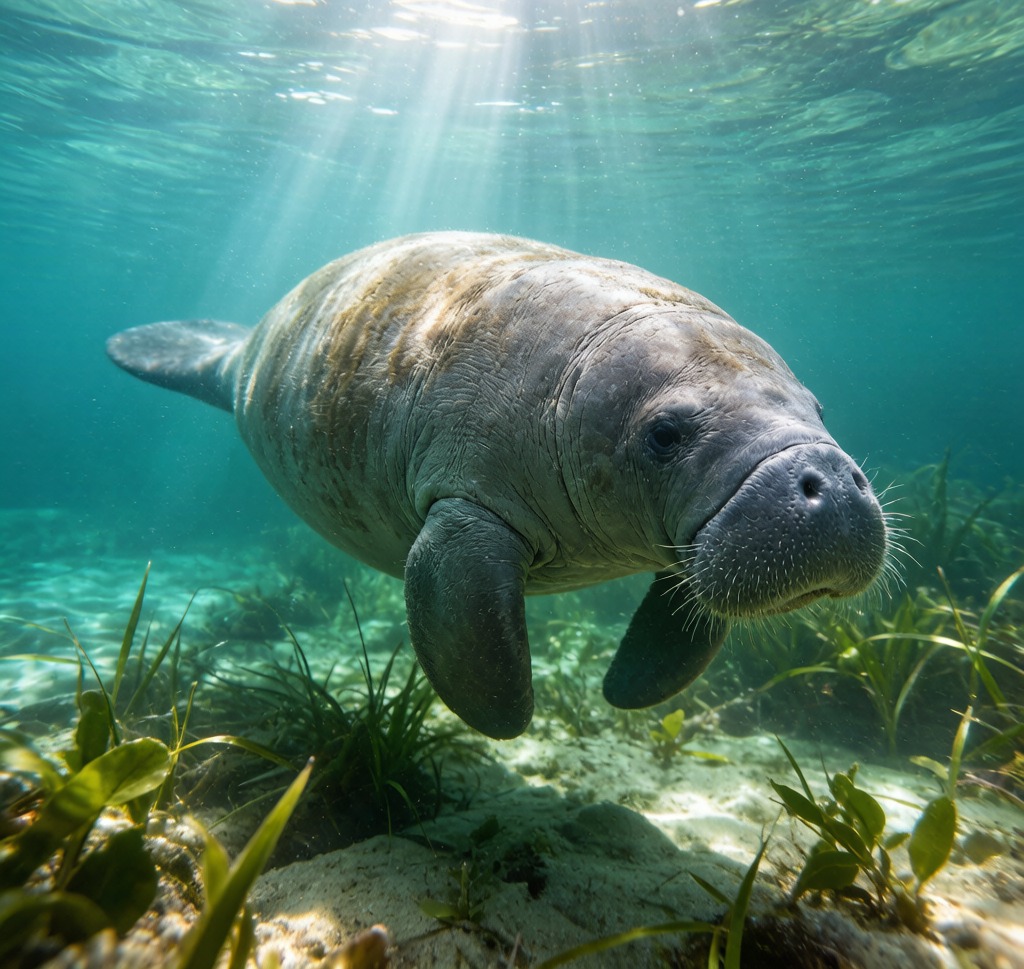
A Florida Manatee (Trichechus manatus) swimming slowly in crystal-clear spring water at Crystal River, Florida
Overview
The Florida Manatee (Trichechus manatus) is a large, gentle marine mammal that inhabits the warm coastal waters, rivers, and springs of the southeastern United States. Often called the “sea cow” due to its placid demeanor and cow-like grazing habits, the manatee is one of four remaining species of sirenians – an ancient order of aquatic mammals that also includes the dugong and three species of African and South American manatees. Manatees are believed to be the inspiration for naval myths of mermaids, which sailors spotted from a distance during long voyages.
Adult Florida manatees typically measure 2.5 to 3.9 meters in length and weigh between 400 and 1,500 kilograms, with females generally larger than males. Their bodies are large, streamlined, and paddle-shaped, with a round, blunt head, small eyes, and a flexible, prehensile snout. The forelimbs are modified into flippers, while the tail is a broad, horizontal paddle. Their skin is grayish-brown. Notably, manatees have no dorsal fin, which distinguishes them from their closest relatives, the dugongs.
Habitat and Warm Water Refuges
Florida manatees inhabit the warm waters of Florida year-round, and migrate northward along the Atlantic coast to Georgia, South Carolina, and occasionally as far north as Virginia and Massachusetts during the summer months. Their distribution is largely determined by water temperature – manatees are tropical animals that cannot tolerate water below approximately 15 degrees C for extended periods. This is why they congregate in unprecedented numbers at natural warm water springs and around power plant outflows during winter.
The dependence on warm water is a critical vulnerability. Natural springs such as Crystal River, Homosassa Springs, and Blue Spring State Park provide year-round warm water (approximately 22 degrees C) and are designated as critical manatee refuges where thousands of manatees gather during cold snaps. The loss or closure of power plants that discharge warm water has already displaced manatees from historic winter habitats, creating “thermal gaps” where no warm water refuge exists during cold winters, with sometimes catastrophic mortality consequences.
Diet and Feeding
Manatees are obligate herbivores – the only large mammals in their range with a completely plant-based diet. An adult manatee can consume 10-15% of its body weight in vegetation daily, which translates to 30-70 kilograms of seagrass and aquatic plants per day. They feed on a wide variety of submerged, emergent, and floating plants including seagrasses, freshwater plants (water hyacinth, hydrilla, water lettuce), and algae. Their flexible, prehensile lips are ideally adapted for plucking and gathering vegetation.
Manatees are sometimes called “the lawn mowers of the sea” for their role in maintaining the health of seagrass meadows. By grazing on seagrass, manatees stimulate new growth and prevent the accumulation of old, decaying vegetation that would otherwise smother the meadow ecosystem. This in turn benefits the many fish, crustaceans, and invertebrates that depend on healthy seagrass for food and shelter, making manatees an important ecosystem engineer in coastal marine environments.
Vulnerability and Boat Strikes
The most significant and immediate threat to Florida manatees is mortality from boat strikes. The slow-moving, surface-breathing behavior of manatees makes them highly vulnerable to boat collisions – propeller wounds and blunt trauma from boat hulls are responsible for approximately 25-30% of all documented manatee deaths in Florida each year. Manatees are also susceptible to entanglement in fishing gear, crab traps, and marine debris, and are occasionally shot by fishermen who consider them competitors.
Red tides – harmful algal blooms caused by Karenia brevis – produce toxins that can kill manatees directly and also kill fish and invertebrates, causing manatees to starve as their food sources are depleted. Cold stress syndrome, caused by extended exposure to water below 15 degrees C, kills dozens to hundreds of manatees in severe winters. On a more positive note, the West Indian manatee was downlisted from “Endangered” to “Threatened” in 2017, reflecting decades of conservation success – but this does not diminish the need for continued protection and habitat management.
Reproduction and Life History
Manatees have one of the lowest reproductive rates of any marine mammal – females give birth to a single calf every 2 to 5 years, after a gestation period of approximately 12 months. Twins are rare but possible. Newborn manatees measure about 1 meter in length and weigh 20-30 kilograms at birth. The mother nurses the calf underwater for 1-2 years, and the bond between mother and calf is strong – mothers have been observed cradling, nuzzling, and protecting their calves from boats and predators.
Manatees reach sexual maturity at approximately 3-5 years of age, but females may not successfully reproduce until later due to their low reproductive rate and the challenges of finding mates in fragmented populations. The lifespan of manatees is estimated at 20-30 years, though some individuals have lived over 60 years in captivity. Conservation efforts include speed zones for boats in known manatee habitats, the creation of sanctuaries in critical refuge areas, public education programs, and rescue and rehabilitation for injured and orphaned individuals.
[…] on seagrass meadows that form the foundation of shallow marine ecosystems. Closely related to the manatee of the Atlantic, the dugong has inspired centuries of mermaid legends among sailors who glimpsed it […]
[…] “lady of the sea” or “mermaid.” The closest living relatives are the Florida manatee and other manatee species within Sirenia. Despite superficial resemblances to dolphins and whales, […]