 By Iris
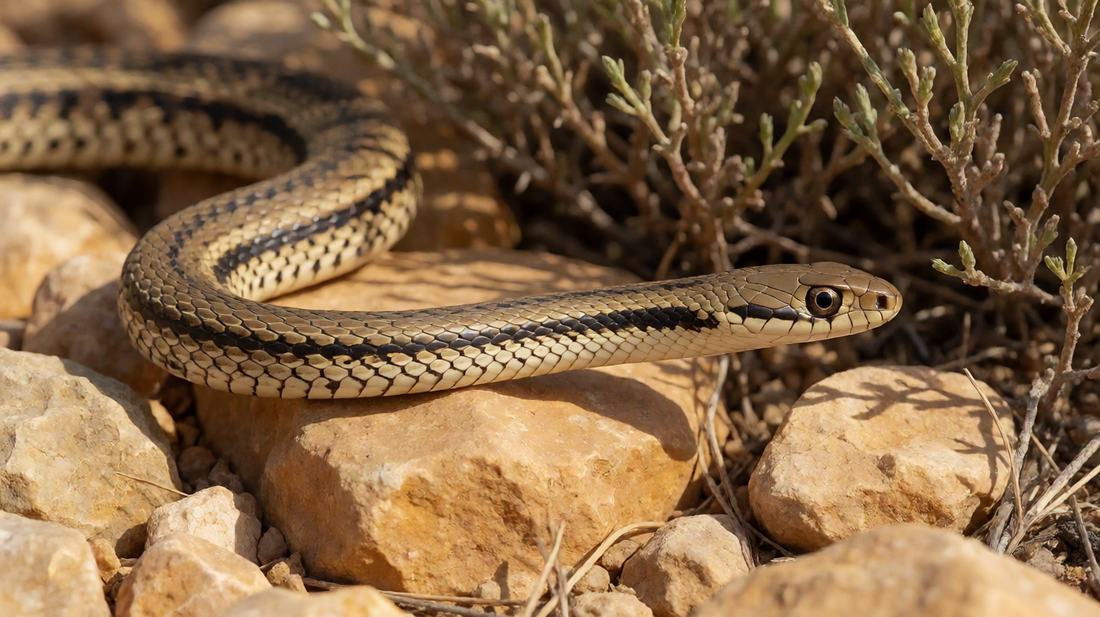
Malpolon monspessulanus | Montpellier Snake
Species Profile · Colubridae
Montpellier Snake
The long, fast snake of the dry Mediterranean sun — one of the biggest snakes in Europe and one of the few that carries venom, though the fangs sit at the back of its mouth.
IUCN: Least Concern
Range
Length
Eye
Clutch
Bite
The long snake of the dry sun
Fast, alert, and rear-fanged
The Montpellier Snake is one of the largest snakes in Europe. It is also one of the fastest and most alert. A big adult can reach 2 metres. Most are 1.2 to 1.5 metres. The slim, whip-like body is built for speed rather than for crushing. The colour is a rather plain olive-green or grey-brown. Older animals often lose the dark streaks that the young ones show.
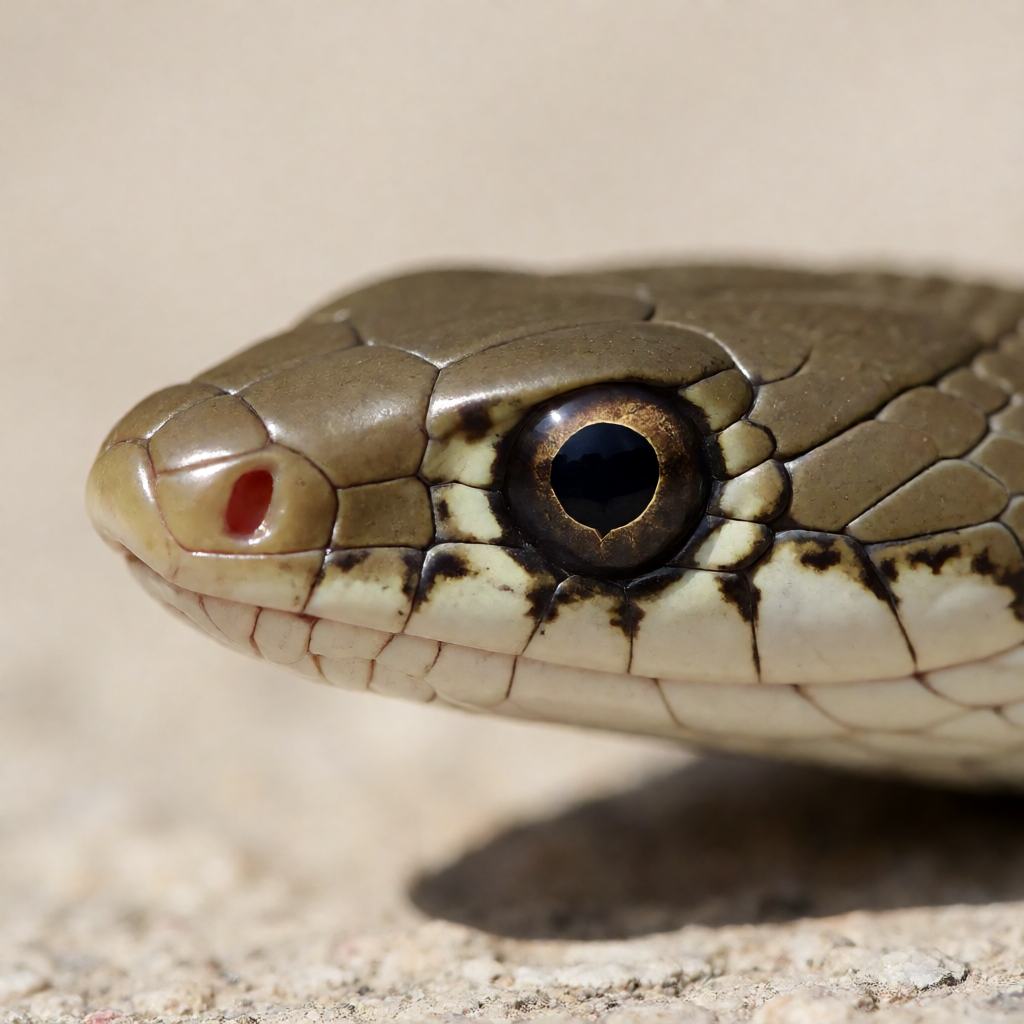
So a large adult can look almost uniform. The head is what marks the species out. The snout is narrow and slightly pointed. The eye is large. Above the eye sits a raised ridge of scale. This gives the face a hard, eagle-like look. The snake is active by day.
It hunts lizards and small mammals across dry, sunlit ground. It will also climb into low bushes to search for nests. It is rear-fanged, which means it carries venom. But the fangs sit at the back of the mouth. So the snake has to chew its prey to inject the venom. The species ranges across the western Mediterranean.
Family tree
Colubridae, the largest snake family
The Montpellier Snake sits in the family Colubridae. This is the largest snake family in the world. It was described by Hermann in 1804. Within the family the species sits in the subfamily Psammophiinae. This is a group of fast, mostly African and Mediterranean snakes. They share a set of features. The body is long and slim. The scales are keeled.
The eyes are large. Their venom glands open onto fangs at the back of the upper jaw. These snakes are called the sand snakes. Most of their relatives live in the dry savannas and deserts of Africa. The Montpellier Snake is the only member of the group that reaches far into Europe. It is one of the very few rear-fanged snakes on the whole continent. Older books placed the species in the genus Coelopeltis. Some workers still treat the North African and Middle Eastern groups as a separate species.
The genus name refers to the sharp, pointed snout. The snake uses it to push through loose sand and leaf litter. The Montpellier Snake shares its family with the Aesculapian Snake. That is a much longer, thinner snake of the same warm, dry region. The 2 are easy to tell apart by the shape of the head. The Aesculapian Snake is not venomous at all. But they sit in the same family and share the same olive groves and stone walls.
Pointed snout, ridge above the eye
How to tell one
A large Montpellier Snake can reach 2 metres. The body is slim and tapering. The tail makes up about 1 quarter of the total length. The scales are strongly keeled, so the skin feels rough. There are 19 or 21 rows of scales around the middle of the body. The belly carries 170 to 200 plates. The head is narrow and the snout is pointed.
The eye is large with a round pupil. The most distinctive feature is the raised ridge above the eye. It is made of a single enlarged scale that sticks out a little. This is why the snake is sometimes called the eagle snake. The colour of an adult is olive-green, grey-brown or almost black. Many animals carry dark streaks along the front of the body. The underside is pale yellow or greenish white.
Young snakes are much more strongly marked. They show a bold pattern of dark blotches and a yellow band across the neck. They become plainer as they grow. The fangs sit at the rear of the upper jaw. They are grooved rather than hollow. The venom is mild. A bite to a person usually causes only local pain and swelling.
1
2
3
Dry scrub and stone walls
Where it lives
The Montpellier Snake is a species of warm, dry, open country. It needs sun, loose ground and plenty of cover. It lives in dry scrub, rocky hillsides, olive groves, vineyards and field margins. It also uses stone walls and coastal sand dunes. It is a regular visitor to gardens and ruins, where it hunts among stones and wood piles. In the mountains of Morocco it climbs to over 2000 metres.
Further north it stays in low, hot places. It is absent from most of central and northern Europe. The northern limit of its range runs through southern France and northern Italy. Even there it is patchy. The species was brought to Florida in the United States. A small breeding group has settled around the Tampa area.
It is one of the few European snakes to have made a home on another continent. The snake spends the coldest months underground. It comes out in March or April and stays active until October or November. It is most easily seen in the early morning, when it lies in the open to warm up.
Lizards and the small mammals
What it eats
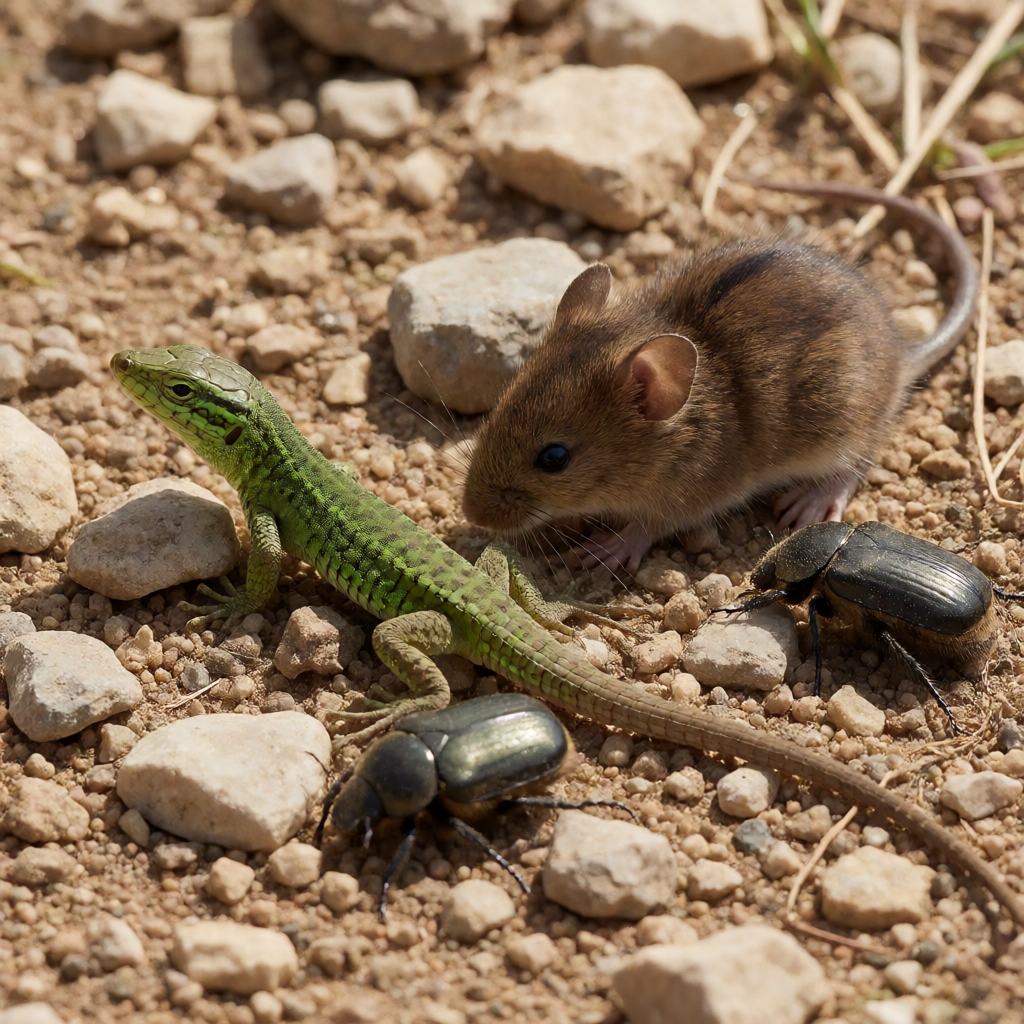
The Montpellier Snake eats a wide range of prey. Its diet changes a good deal as it grows. Young snakes take large insects, especially grasshoppers, crickets and beetles. They also eat small lizards. As they get bigger they move on to bigger animals. A full-grown adult lives mainly on lizards, other snakes and small mammals.
Spiny-footed lizards and green lizards are the most important food in most of the range. The snake is quick enough to catch them in a straight run. It also takes field mice, young rats, shrews and the young of ground-nesting birds. It will climb into low shrubs and trees to raid a nest. The snake is an active hunter rather than an ambush feeder. It moves through the plants with its head raised.
It sweeps the ground and the bushes. It uses its large eyes to spot movement. Once prey is caught the snake holds it in its jaws and chews. It works the prey backwards until the rear fangs can inject the venom. Only then does it swallow. Large adults will also eat smaller snakes of their own species.
Eggs in the warm damp ground
The breeding cycle
The Montpellier Snake mates in the spring. This happens soon after it comes out of its winter sleep. The males fight for access to females in a wrestling contest rather than with their fangs. The females lay eggs rather than giving birth to live young. The clutch is laid in June or July. The female picks a warm, damp place such as a compost heap or loose soil.
A clutch holds 4 to 18 eggs. Each egg is about 4 cm long with a soft leathery shell. The eggs hatch after 6 to 8 weeks. The young snakes are 25 to 30 cm long when they come out. They are strongly marked at this stage. The bold pattern fades as they grow older.
Females do not breed every year in the north of the range. They may skip a season if the summer is poor. The species is thought to live for 15 to 20 years in the wild. It reaches maturity at 3 or 4 years old. Growth is fast in the first few years and then slows sharply. A snake of 1.5 metres is likely to be well over 10 years old.
Least Concern, killed on sight
Conservation
The Montpellier Snake is not threatened worldwide. It is listed as a species of least concern. It is still common across most of Spain, Portugal, southern France and Italy. It can survive in quite heavily changed landscapes such as farmland and plantations. Local declines have been recorded at the northern edge of its range.
The loss of dry stone walls, rough field edges and scrub has removed both the basking sites and the cover. Direct killing is another serious problem. The species is large, fast and venomous, so it frightens people. Many are killed on sight, even though the bite is not dangerous to a healthy adult. Road traffic is a further cause of death.
The snakes often bask on warm tarmac in the early morning. The species is protected by law in France, Italy and Spain. It is also listed on the Bern Convention. Killing it is therefore illegal across most of its European range.
Quick hits
Five things to remember
- A large adult can reach 2 metres, which makes it one of the biggest snakes in the whole of Europe.
- The raised ridge of scale above the eye gives the face an eagle-like look, and the snake is often called the eagle snake.
- The fangs sit at the very back of the mouth, so the snake must chew its prey before the venom can be delivered.
- A small group has been living around Tampa in Florida since the species was brought there, far outside its native range.
- The snake often basks on warm tarmac in the early morning, and road traffic is now one of the main causes of death.