 By Iris
Bufotes viridis | Green Toad
Species Profile · Bufonidae
Green Toad
The spotty green toad of the dry open ground — the one amphibian that breeds in water a third as salty as the sea and grows up in pools that vanish in weeks.
IUCN: Least Concern
Range
Length
Mark
Water
Young
The green toad of the dry ground
A toad that likes salt water
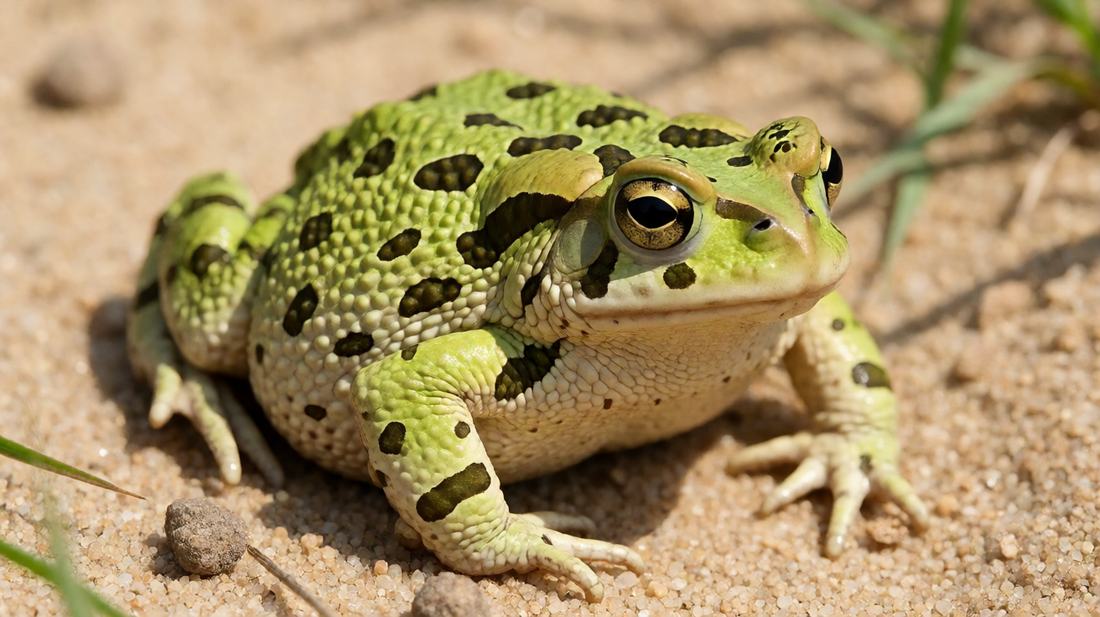
The Green Toad is the bright, spotty cousin of the common toad. It is much more tolerant of heat than most toads. The body is plump with short legs. The skin is a pale green or cream colour. A scatter of dark olive blotches breaks up the colour. The whole animal looks like a small painted stone. The warts on the back are small and rounded.
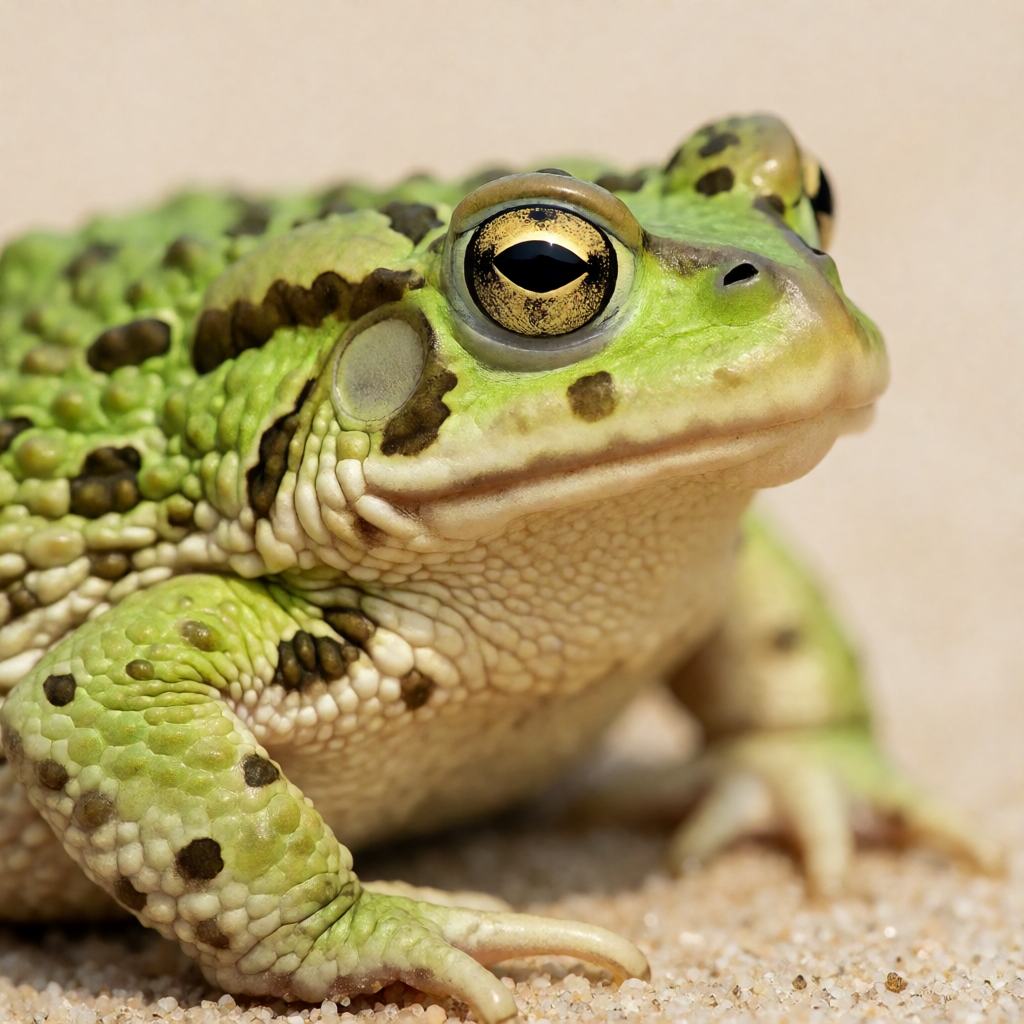
Behind each eye sits a large oval gland. It holds a milky, bitter poison. The eyes are the most striking feature. They are golden or olive with a flat pupil. This gives the toad a calm, almost sleepy look. A full-grown female reaches 10 cm. The males are smaller, at 5 to 8 cm.
The males also carry a dark pad on the thumb. It helps them grip during mating. The Green Toad lives in dry, open, often disturbed ground. It will happily live in a gravel pit, a stone wall or a sandy garden. Its range is enormous. It covers central and southern Europe, North Africa, the Middle East and central Asia.
Family tree
Bufonidae, the true toads
The Green Toad sits in the family Bufonidae, the true toads. It belongs to the genus Bufotes. It was described by Laurenti in 1768, when it was placed in the genus Bufo. The family Bufonidae is a very large one. Its members live on every continent except Antarctica and Australia. The family is defined by a set of features. There are no teeth in the lower jaw. The body is short and stocky.
A pair of large poison glands sits behind the eyes. These are called the parotoid glands. Within the family the Green Toad sits in a group with a rather different way of life. These toads live in dry places. They tolerate salty water. They breed in pools that dry out. This group now has its own genus, Bufotes. The taxonomy is still unsettled.
Workers have split the old species Bufo viridis into a series of species across its wide range. So the name Green Toad may cover several close forms. The genus name means the same as the old one. The species name viridis is Latin for green. The Green Toad shares its family with the common toad. That is the familiar brown warty animal of damp gardens and woods. The 2 are easy to tell apart by colour and by habitat. But they sit in the same family and both carry the same bitter poison in the skin.
Green skin, dark blotches
How to tell one
The Green Toad reaches 10 cm. The female is noticeably larger than the male. The body is plump and the head is broad and short. The snout is blunt and rounded. The upper surface carries small warts. The largest of them sit in a row along each flank. The colour is pale green, cream or greyish.
Dark olive or brown blotches break up the surface. The pattern is different in every animal, so a person can know one toad by its spots. The underside is pale grey or white and is never spotted. This separates the species from the common toad. The eyes are large and set high. They are bright golden with a black flat pupil. Behind each eye sits the parotoid gland.
It is an oval swelling about 1 cm long. The skin there holds a milky poison. The limbs are short and the toes are only slightly webbed. So the toad is a walker and a climber rather than a strong swimmer. Males carry a dark, rough patch on the inner side of the first finger. This pad helps them hold on to the female. The young are small, dark grey and speckled.
1
2
3
Sand, gravel and old walls
Where it lives
The Green Toad lives in warm, dry, open ground. It is far more tolerant of heat and drought than the common toad. It lives in sand dunes, steppes, rocky slopes and dry meadows. It also uses vineyards, quarries, gravel pits and waste ground. In the villages of southern Europe it is a regular animal of gardens, walls and old buildings.
It avoids dense woodland, deep shade and cold, wet places. In the mountains it usually stops below 2000 metres. The species is strongly tied to soft, loose soil. It digs itself in during the day to keep cool and to avoid losing water through its skin. At night it comes out to hunt.
It is often seen around street lamps and on warm paths. One of the most remarkable features of the species is its tolerance of salt. Green Toads breed in salt marsh pools, coastal lagoons and water that is a third as salty as the sea. The young can survive conditions that would kill the young of almost any other amphibian. This lets the species use the coastal marshes of the Mediterranean and North Africa.
Beetles, ants and spiders
What it eats
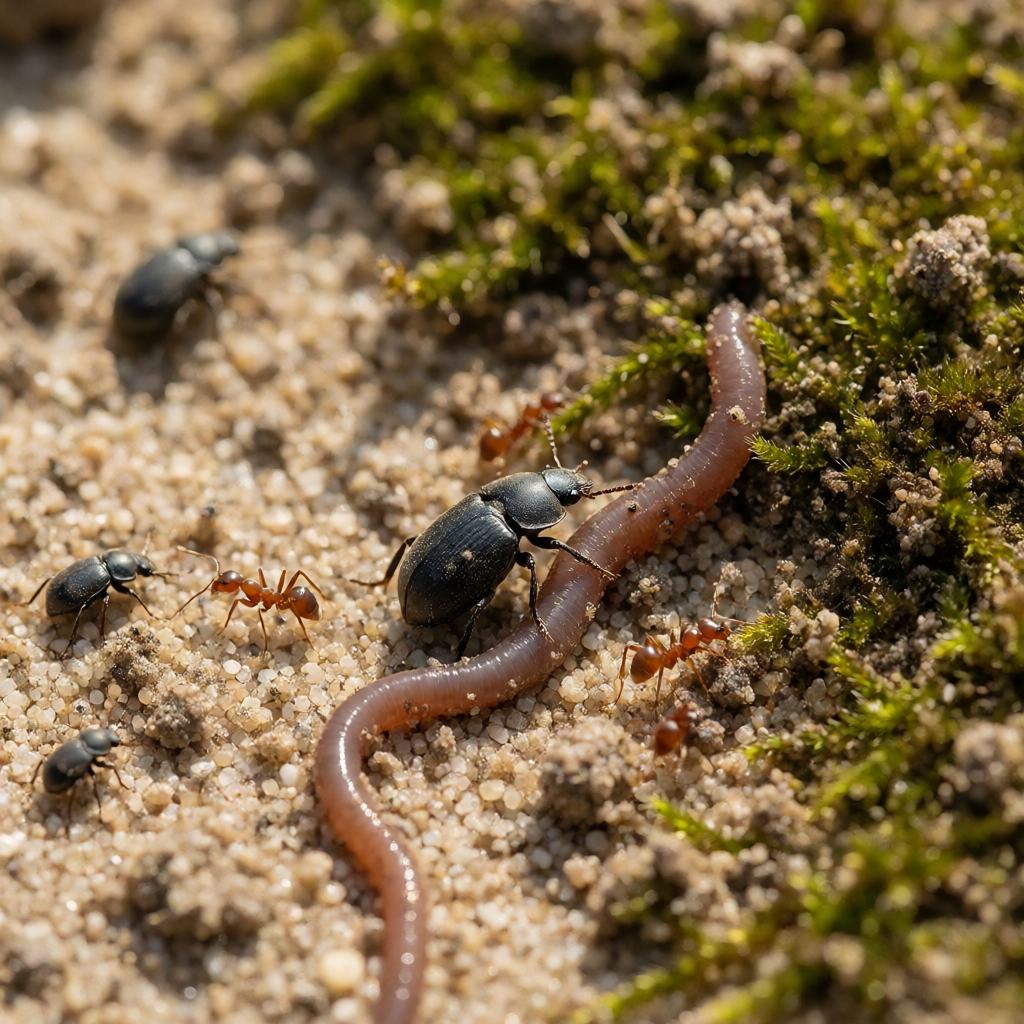
The Green Toad is a generalist hunter. It eats almost any small animal that will fit into its mouth. The main food is insects. Beetles of many kinds are the most important group. Ants, flies, bugs, grasshoppers and moths come next. Spiders, woodlice, millipedes and small slugs also turn up.
Large toads will take earthworms, small lizards and young mice. The toad hunts at night, when the air is cool and the ground is damp. It uses a simple sit-and-wait method. It sits still and watches for movement. Then it flicks out a sticky tongue to catch the prey. The tongue is short, so the toad has to be close to its target.
It spends much of its time walking slowly through the plants in search of prey. The animal eats a great deal in a short season. In the north it is active for only about 6 months of the year. In that time it must build up enough fat to survive the winter underground. A large toad can take over 100 small insects in a single night.
Trilling song, fast young
The breeding cycle
The Green Toad breeds in the spring and early summer. Its choice of water is the key to its success. It lays its eggs in shallow, warm pools that hold water for only a few weeks. It also uses ditches, flooded fields and coastal lagoons. Because the pools dry out quickly, the young must develop fast. They can turn into small toadlets in as little as 6 to 8 weeks.
The males arrive at the water first. They call with a long, high, trilling song that carries a surprising distance. The sound is one of the classic noises of a warm southern night. The female lays her eggs in long strings. A large female can produce several thousand eggs. The eggs are small and dark.
They are wrapped in a double row of jelly that swells in the water. The young hatch within a week and feed on algae and small particles. The small toads leave the water in mid summer. They spend the rest of the year hunting in the surrounding dry ground. Females reach maturity at 3 to 4 years, and the species can live for 10 years or more.
Least Concern, lost in the west
Conservation
The Green Toad is listed as a species of least concern. It remains common across a huge part of its range. That range runs from Spain and Morocco through the Balkans and Turkey to central Asia. The picture is less comfortable at the western edge. In Switzerland, Austria, Germany and Belgium the species has declined sharply. It has gone from many of its old sites.
The main causes are the loss of small, warm water bodies. Ponds, ditches and flooded fields have been filled in. The dry, open ground the toad needs for hunting has been built over. Fertilizers and sprays on farmland are a further problem. Traffic is another large risk. The toads often cross roads at night as they move towards their breeding water.
The most effective work has been the digging and care of new small ponds. This works best in fields and gravel pits. Tunnels under roads also help. In several countries the species is protected by law and appears on the Bern Convention list.
Quick hits
Five things to remember
- The Green Toad can breed in water a third as salty as the sea, and its young survive where almost no other amphibian could.
- Every toad has a different pattern of dark blotches, so a single animal can be known by its spots like a person by a face.
- The males call with a long, high, trilling song on warm spring nights, and the sound carries a surprising distance.
- The young must grow fast, because the shallow pools they live in may dry out completely within 6 to 8 weeks.
- The skin holds a milky bitter poison, and a dog that bites a Green Toad will usually drop it at once.