 By st20113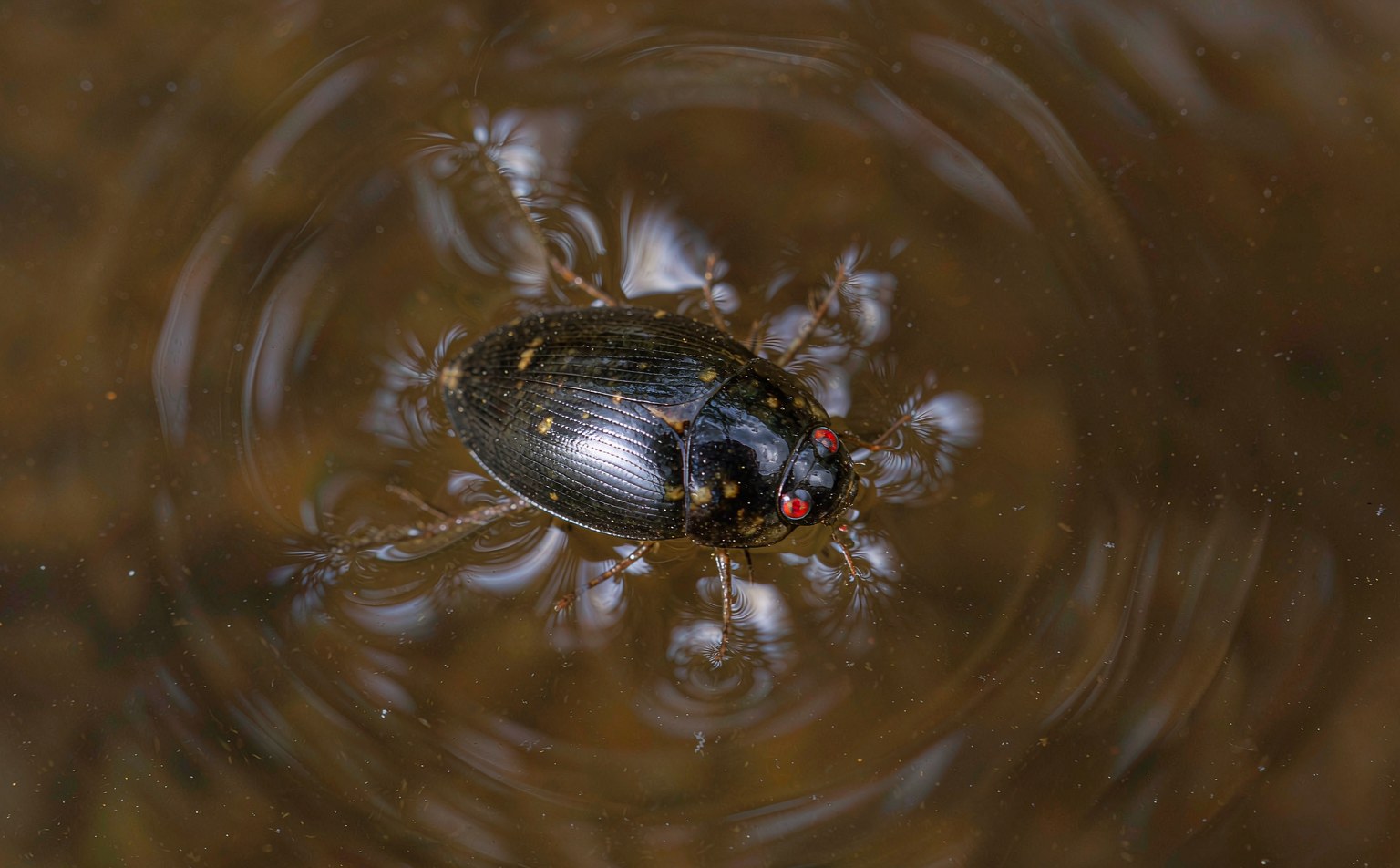
Gyrinus substriatus | Whirligig Beetle
Introduction
The Whirligig Beetle (Gyrinus substriatus) is a small, shiny black beetle of ponds and slow rivers that is impossible to mistake: it spins in restless, criss-crossing circles on the water surface, dozens sometimes wheeling together like tiny clockwork toys. These whirls are not play but hunting and safety, as the beetle scans the surface from every angle for falling prey and watches for predators at the same time. A master of the pond skin, it bridges the world of water and air.
Common across Europe, the Whirligig Beetle is most often seen in warm, calm backwaters where it forms restless shoals. Its bizarre behaviour and mirror-like body have made it one of the best-known pond insects, and its senses are specialised for a life lived precisely at the water’s edge.
Taxonomy
The Whirligig Beetle was described by Carl Linnaeus in 1758 and belongs to the genus Gyrinus within the family Gyrinidae, the whirligig beetles. The genus name reflects the whirling motion, and the family is found on every continent except Antarctica. G. substriatus is among the common European species of still and slow water.
It shares the surface with the Common Frog in pond margins and overlaps in habitat with the Smooth Newt, whose larvae develop in the same waters. Both are part of the rich invertebrate community that also attracts the Grass Snake to hunt at the water’s edge.
Physical Characteristics
The Whirligig Beetle is 5 to 7 millimetres long, with a smooth, oval, jet-black body that gleams with a metallic sheen. Its legs are short but the hind and middle pairs are flattened into broad paddles for rapid swimming, while the front legs are used to grasp prey. The head bears a remarkable pair of eyes split into two parts: one pair looks up into the air, the other down into the water, so the beetle watches both worlds at once.
The underside carries a store of air that lets it stay submerged for a while, and the body is streamlined for skimming the surface. When alarmed it can dive and cling to a stone, or simply shoot away in a tight spiral. The wing cases meet in a clean line down the back, and the whole insect is built for speed and manoeuvrability.
Habitat
Whirligig Beetles favour still or very slow fresh water: ponds, lakes, canals and the sheltered margins of rivers. They need open surface with nearby plants and a supply of terrestrial insects that drop onto the water, and they gather where the water is warmest and calmest. They are absent from fast or polluted streams.
They are social, often forming dense, wheeling groups that break apart and re-form as individuals dive or are disturbed. In winter they rest in the mud or among roots below the ice, emerging to whirl again in spring.
Diet
The Whirligig Beetle is a predator and scavenger of the surface. It catches small insects, gnats and spiders that fall onto the water, seizing them with its front legs and chewing them with strong jaws. It also feeds on dead and drowning animals, helping to clear the surface of carrion, and it may snap at tiny prey just below the film.
Its whirling motion is a foraging strategy: by constantly turning, it scans a wide area and confuses predators while staying ready to dive. The beetles communicate with each other through surface vibrations, a quiet language of ripples that helps the group stay cohesive.
Reproduction
Mating occurs on the surface in spring and summer. The female lays her eggs on the submerged parts of aquatic plants, sometimes in neat rows. The larvae that hatch are very different from the adult: elongate, soft-bodied and armed with gills and fearsome jaws, they live underwater and hunt other small creatures among the vegetation.
The larva grows through several stages before leaving the water to pupate in a cocoon on a bank-side plant or stone. The adult emerges and returns to the surface to join the whirling shoal, completing a life cycle split between water and air.
Conservation
The Whirligig Beetle is common and secure across its range, needing only clean, calm fresh water with some vegetation. It is a good indicator of healthy pond life, since it disappears from polluted or heavily shaded water. Garden ponds and restored wetlands support thriving populations.
Maintaining a mix of open water and emergent plants, limiting herbicide and pesticide use, and allowing some natural marginal clutter all help the species. Because it flies to new waters, a single thriving pond can seed others, knitting wetland habitats together.
Fun Facts
- A Whirligig Beetle has split eyes: one pair looks into the air, the other into the water, at the same time.
- The spinning circles are how it hunts and watches for danger from every direction at once.
- The beetles “talk” to each other in ripples, a silent language of surface vibrations.
- It can dive and hide under a stone when threatened, carrying its own bubble of air.
- Dozens may whirl together, scattering and reforming like a living kaleidoscope on the pond.