 By st20113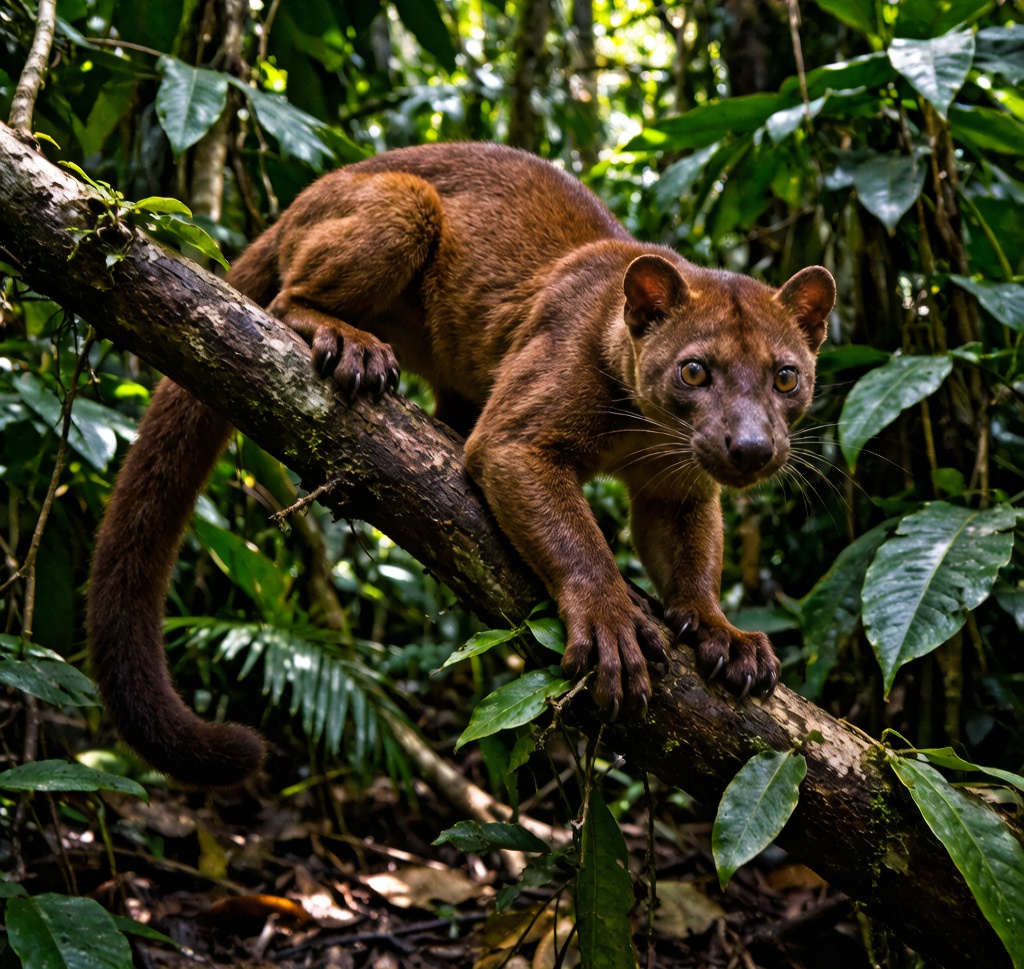
The fossa (Cryptoprocta ferox) is Madagascar’s largest endemic carnivore and one of the island’s most formidable predators — a sleek, agile mammal that occupies an ecological niche similar to that of small cats or weasels on other continents. Despite its cat-like appearance, the fossa is more closely related to mongooses and belongs to the family Eupleridae, a group of carnivorans endemic to Madagascar. The fossa’s long, muscular body, semi-retractable claws, and exceptional climbing ability make it an effective hunter of lemurs, which constitute the bulk of its diet. As the top predator in Madagascar’s forest ecosystems, the fossa plays a critical role in regulating lemur populations and maintaining the ecological balance of the island’s unique rainforests.
## Physical Characteristics
The fossa is a large, slender carnivore with a body length of 70 to 80 centimeters and a tail nearly as long as its body, adding another 65 to 70 centimeters. Adults weigh 5.5 to 8.6 kilograms, with males typically larger than females. The fur is short, dense, and sleek, ranging in color from reddish-brown to dark brown on the back and flanks, with a lighter greyish or cream-colored underside. The head is relatively small with a short muzzle, large, round, forward-facing eyes that provide excellent binocular vision, and rounded ears. The fossa’s most distinctive feature is its long, muscular tail, which provides balance when climbing and leaping through trees. Its paws are large and equipped with semi-retractable, sharp claws that allow it to grip tree bark and capture fast-moving prey. The soles of the feet are bare and provide traction on branches. Like other euplerids, the fossa possesses scent glands on its chest and anal region, used for territorial marking and communication.
## Habitat and Distribution
The fossa is endemic to Madagascar, where it is found in forested areas throughout most of the island, from sea level to approximately 2,000 meters elevation. It inhabits a variety of forest types, including humid lowland rainforests, dry deciduous forests, and montane forests, and is occasionally found in degraded or secondary habitats where suitable prey remains available. The species’ range has contracted significantly due to habitat loss, and it is now absent from the central highlands, where most forest cover has been converted to agriculture. Fossas are most abundant in large, contiguous forest blocks such as those in Mantadia National Park, Kirindy Forest, and Ankarafantsika National Park.
## Behavior and Diet
The fossa is a highly agile and versatile hunter, capable of pursuing prey both on the ground and in trees. It is active during both day and night, with peaks of activity around dawn and dusk. Lemurs — ranging from small mouse lemurs to large indris and sifakas — constitute up to 50 percent or more of its diet, making the fossa one of the most significant lemur predators. It also hunts small mammals, reptiles, birds, and occasionally domestic chickens and livestock in areas near human settlements. The fossa hunts by stalking and ambushing its prey, using its speed, agility, and powerful jaws to capture and kill animals larger than itself. When hunting in trees, it is capable of remarkable feats of acrobatics, including leaping between branches and descending headfirst down tree trunks. Fossas are generally solitary, though males sometimes form small, temporary coalitions during the breeding season.
## Reproduction
Fossa breeding is highly seasonal, with mating occurring between September and November. During this period, several males may gather around a receptive female, competing for mating opportunities through vocalizations, scent marking, and occasional combat. After a gestation period of approximately 90 days, females give birth to a litter of one to six (usually two to four) young in a secluded den — often a hollow tree, termite mound, or rock crevice. Newborn fossas are born blind and helpless, weighing only 50 to 100 grams. They open their eyes at approximately two weeks and begin taking solid food at two to three months, though they may nurse for up to four months. Young fossas remain dependent on their mother for at least one year and may stay with her for up to 18 months before dispersing. Sexual maturity is reached at three to four years of age. Captive fossas have lived up to 20 years.
## Conservation
The fossa is classified as Vulnerable on the IUCN Red List, with an estimated population of fewer than 10,000 mature individuals. Major threats include habitat loss and fragmentation due to slash-and-burn agriculture, logging, and human settlement, as well as direct persecution by humans for predation on poultry. The species’ large home range requirements make it particularly vulnerable to habitat fragmentation, and populations in small forest fragments are often unsustainable. Fossas are protected within Madagascar’s network of national parks and reserves, but enforcement of protection laws is often inadequate.