 By st20113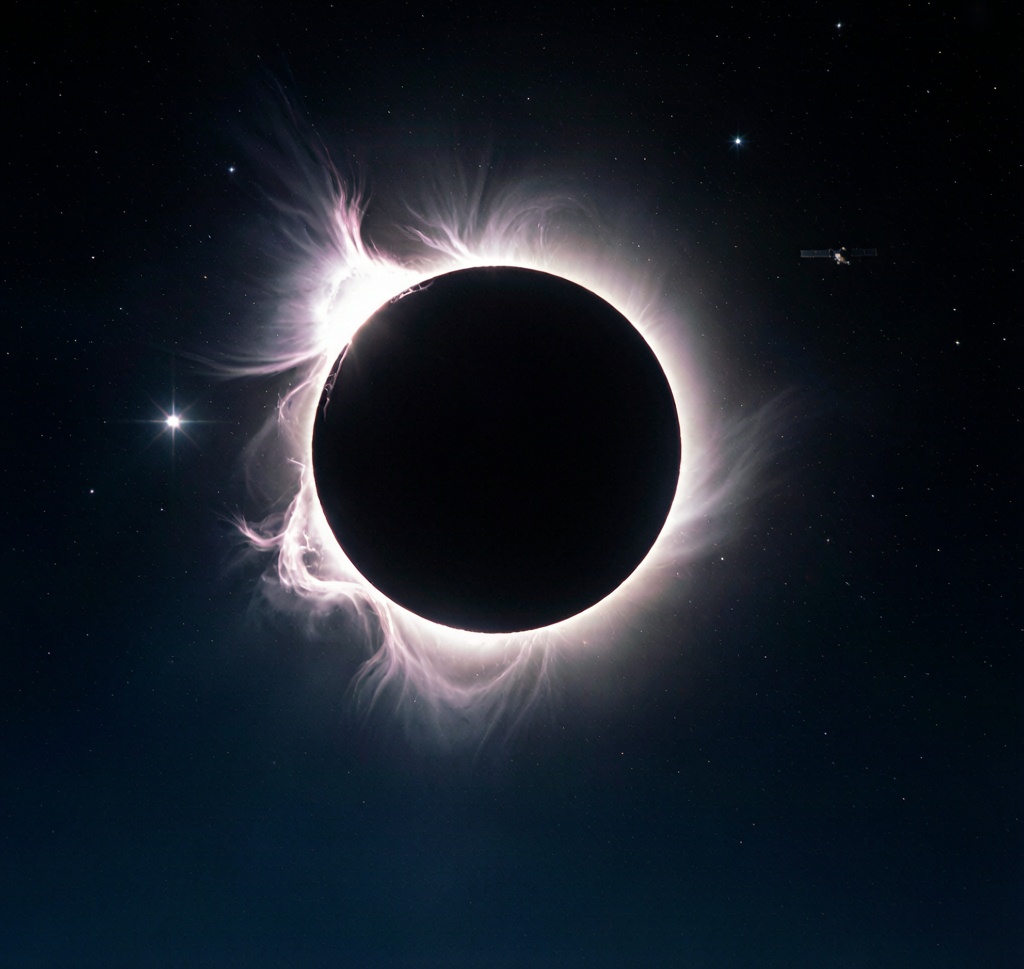
Introduction
A solar eclipse occurs when the Moon passes between the Earth and the Sun, temporarily blocking all or a portion of the Sun’s light from reaching the Earth’s surface. This alignment of three celestial bodies—Sun, Moon, and Earth—is one of the most dramatic and awe-inspiring natural phenomena observable from Earth, and total solar eclipses, in which the Moon completely covers the solar disk, are among the most extraordinary events in the natural world. During totality, the solar corona—the Sun’s outer atmosphere—becomes visible as a shimmering, white-glowing halo of ionised gas, and the sky darkens to near-twilight levels, allowing stars and planets to become visible in broad daylight. Solar eclipses have been observed, recorded, and interpreted by human cultures for millennia, and they continue to inspire scientific investigation, public fascination, and mass pilgrimages to the narrow paths of totality.
Types of Solar Eclipses
Three types of solar eclipse are distinguished by the geometry of the Sun-Moon-Earth alignment. A total solar eclipse occurs when the Moon’s umbra (the fully dark inner shadow) touches the Earth’s surface, completely obscuring the solar disk for observers within the narrow path of totality (typically 100–160 kilometres wide). The apparent diameters of the Sun and Moon must be approximately equal at the time of eclipse for a total eclipse; this requires the Moon to be near its perigee (closest approach to Earth), a condition that occurs only during a fraction of solar eclipses. When the Moon is near apogee (farthest from Earth), its apparent disk is too small to cover the Sun completely, producing an annular eclipse.
An annular eclipse (from Latin annulus, ‘ring’) occurs when the Moon’s disk is centred on the Sun but does not fully cover it, leaving a bright ring of sunlight (the ‘ring of fire’) visible around the dark lunar silhouette. A partial eclipse occurs when the Moon’s penumbra (the partially shaded outer shadow region) falls on the Earth, and only a portion of the Sun is covered. A rare hybrid eclipse shifts between total and annular along its path as the curvature of the Earth moves the observer slightly closer to or farther from the Moon’s antumbra shadow. All three types are observable from Earth due to the combination of the near-perfect size coincidence between the Sun and Moon and the elliptical orbits of both bodies.
The Geometry of Solar Eclipses
Solar eclipses are geometrically constrained by the orbital planes and relative positions of the Earth, Moon, and Sun. The Moon’s orbit around Earth is inclined by approximately 5 degrees relative to the ecliptic plane (the plane of Earth’s orbit around the Sun), meaning the Moon is usually above or below the direct line between Earth and Sun. Eclipses can only occur when the Moon crosses the ecliptic plane (a point called a node) at or near the time of new Moon, when the Moon lies directly between Earth and Sun. This condition is called syzygy.
The number and types of solar eclipses per year vary according to the geometry of the lunar orbit and the relative positions of the nodes. A minimum of two solar eclipses occurs somewhere on Earth each year; a maximum of five is possible. Total solar eclipses are the least common, with approximately one to two occurring somewhere on Earth each year, though any given location on Earth experiences totality on average only once every 375 years. The longest possible total solar eclipse is approximately 7 minutes 32 seconds of totality, though most total eclipses last 2–4 minutes. The upcoming total solar eclipse of August 12, 2026, will be visible from Iceland, Greenland, Spain, and Portugal, with a maximum duration of totality of approximately 2 minutes 18 seconds.
Observing and the Path of Totality
Observing a total solar eclipse requires eye safety precautions of the highest order, except during the brief phase of totality itself. Looking directly at the partially eclipsed Sun—even for a few seconds—can cause permanent retinal damage and blindness within milliseconds due to the concentrated solar radiation focused by the eye’s lens onto the retina. Safe viewing methods include ISO 12312-2 certified eclipse glasses, pinhole projection cameras, and indirect viewing techniques. Camera lenses and telescopes must have certified solar filters mounted at the front aperture (not the eyepiece) to avoid catastrophic damage to equipment and injury to the observer.
During totality alone, when the Sun’s bright photosphere is completely obscured, direct observation without protection is safe and indeed necessary to see the corona. The dramatic transition into and out of totality—the diamond ring effect (a bright point of sunlight at the lunar limb just before or after totality), Baily’s beads (breakthroughs of sunlight through lunar valleys), and the rapid darkening of the sky—is among the most intensely sensory experiences available in the natural world, lasting only seconds before and after the brief period of complete darkness.
Scientific Significance
Solar eclipses have been scientifically significant throughout the history of astronomy. The 1919 total solar eclipse observed by Arthur Eddington and Frank Dyson provided the first experimental confirmation of Albert Einstein’s general theory of relativity: the deflection of starlight by the Sun’s gravitational field, as predicted by relativity, was found to match the theoretical prediction when measured during totality. This result catapulted Einstein to global fame and confirmed one of the most profound predictions of modern physics.
Eclipses continue to provide unique research opportunities in solar physics, astrophysics, and atmospheric science. The solar corona is accessible to direct observation and instrumentation only during total eclipses, as its brightness is approximately one-millionth that of the photosphere. Studies of the corona’s structure, magnetic field configuration, and plasma dynamics—conducted during total eclipses and, increasingly, with specialised ground-based and space-based solar telescopes—have revealed fundamental insights into solar activity, space weather, and the mechanisms driving the solar wind. Atmospheric scientists use eclipse events to study rapid changes in atmospheric chemistry, temperature, and wind patterns caused by the sudden shadow.
Eclipses in Culture and History
Solar eclipses have been recorded and interpreted across virtually every human culture. The earliest known records of solar eclipses date to Babylonian astronomical tablets from the 8th–7th centuries BCE, which demonstrate sophisticated recognition of repeating eclipse patterns (the Saros cycle, a period of approximately 18 years 11 days after which eclipses repeat in a similar geometry). Chinese historical records from at least 2,000 years ago include eclipse observations that have been used by modern astronomers to calculate long-term changes in Earth’s rotation and the Moon’s orbital dynamics. The Greek historian Herodotus records that the solar eclipse of 585 BCE ended a battle between the Lydians and Medes, who interpreted the darkening of the Sun as an omen of divine displeasure.
In many traditional cultures, solar eclipses were viewed as portents of disaster, divine anger, or significant political upheaval—interpretations that, while scientifically unfounded, reflected a genuine recognition of the eclipse as an extraordinary and unusual event. Modern eclipse-chasing has become a global phenomenon, with enthusiasts known as umbraphiles (shadow-lovers) travelling to remote locations to witness totality. Mass eclipse tourism to accessible paths of totality generates significant economic activity in local communities and has helped fund conservation and infrastructure in historically isolated regions.