 By st20113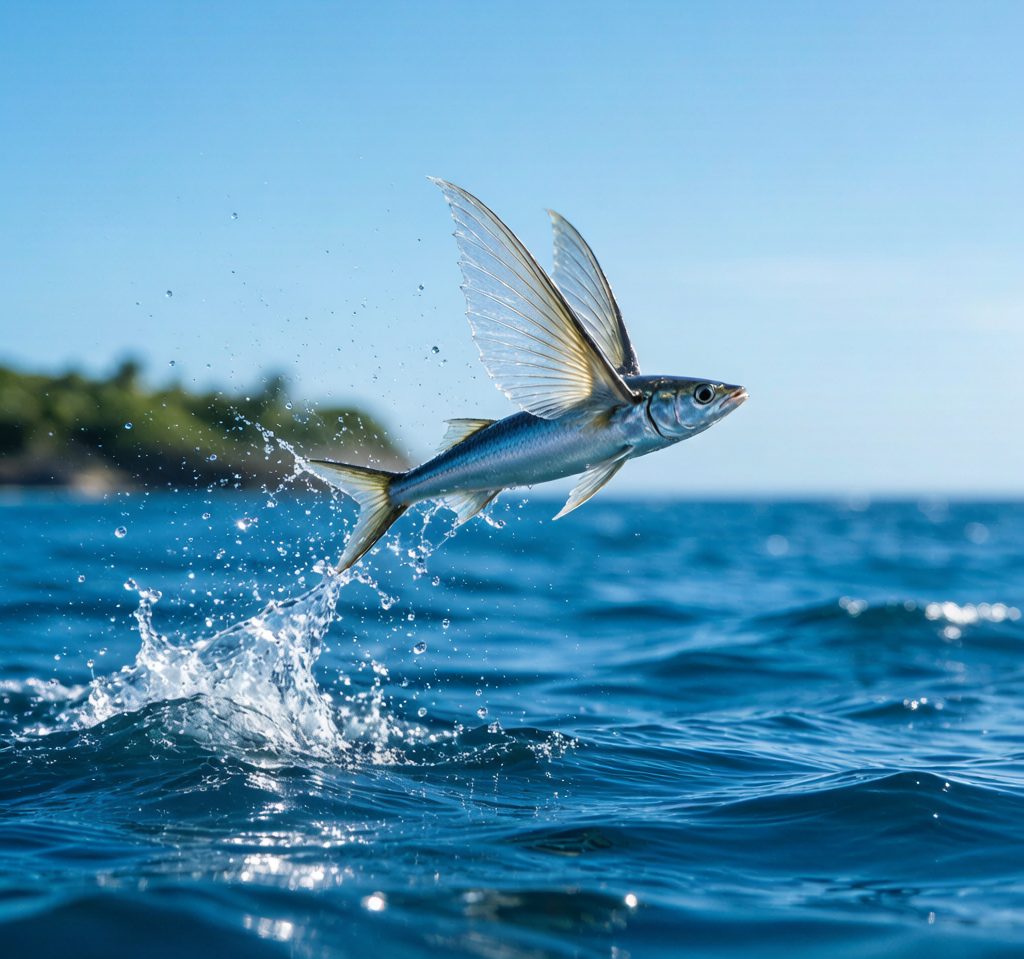
Introduction
Flying fish are a remarkable family (Exocoetidae) that have evolved the ability to launch from the ocean surface and glide through the air for considerable distances. Found throughout tropical and subtropical oceans, these fish have fascinated humans for centuries, appearing in art and mythology. Their aerial ability is not true powered flight but extended gliding assisted by greatly enlarged pectoral fins that act as wings. With approximately 64 species across seven genera, flying fish represent one of the most successful evolutionary experiments in aerial locomotion among vertebrates. They are ecologically important as planktivorous predators and as critical prey for larger marine animals and seabirds.
Taxonomy
The family Exocoetidae belongs to the order Beloniformes, which also includes needlefish and halfbeaks. Seven genera are recognized: Cheilopogon (approximately 40 species), Exocoetus, Hirundichthys, Parexocoetus, Prognichthys, Cypselurus, and Aethoglossa. Mitochondrial DNA studies have confirmed that enlarged fins and gliding evolved independently in multiple lineages. The closest relatives are the halfbeaks. The evolutionary origin of gliding is estimated at approximately 65 million years ago, arising as a predator-avoidance strategy in oligotrophic tropical seas.
Physical Characteristics
The defining feature of flying fish is their greatly enlarged pectoral fins, which create a wing-like surface generating aerodynamic lift during leaps from the water. In Exocoetus species, the pelvic fins are also enlarged, creating a four-winged configuration providing greater stability. Flying fish typically measure 15 to 50 centimeters, with dark blue dorsal coloration and silvery white ventral surfaces. Their forked caudal fin is asymmetric, with the lower lobe longer than the upper, enabling thrust generation during underwater acceleration. Flying fish build speed beneath the surface by vibrating their tails at up to 70 beats per second before breaking the surface at an angle and gliding.
Habitat
octopus octopus shares comparable ocean habitats with this species.
Flying fish inhabit warm, tropical, and subtropical waters worldwide, with the greatest species diversity in the Indo-Pacific region around coral reefs and oceanic islands. They are primarily epipelagic, inhabiting the sunlit upper 200 meters of the ocean where plankton is most abundant. Flying fish are associated with warm surface waters above 20 degrees Celsius and are commonly found near floating debris, seaweed mats, and sargassum, which provide shelter and serve as focal points for feeding. Seasonal migrations follow warm water masses poleward in summer and equatorward in winter.
Diet
great white shark great white shark shares comparable ocean habitats with this species.
Flying fish are primarily planktivorous, feeding on zooplankton including copepods, amphipods, larval fish, and other small invertebrates in the upper ocean. Some species supplement their diet with small fish and marine algae. Flying fish are critically important prey for a wide variety of marine predators, including seabirds and mammals. Intense predation pressure from open-ocean hunters is believed to have driven the evolution of gliding as an escape mechanism. Like the whale shark, flying fish feed in the open water column rather than on the seafloor, and both species rely on selective capture of small prey items in sunlit surface waters.
Reproduction
Flying fish spawn in warm, shallow, surface waters during spring and summer. Eggs are equipped with delicate filaments that attach to floating objects such as sargassum mats, providing shelter from predators in the open ocean. Fecundity ranges from approximately 300 to 1,000 eggs per clutch. Fertilization is external. Embryonic development lasts 1 to 3 weeks, after which larvae hatch and begin feeding on plankton. Flying fish larvae are highly distinctive, with elongated bodies and disproportionately long fins compared to adults, retaining this morphology for several months before metamorphosing into juveniles.
Conservation
Many flying fish species lack sufficient data for IUCN assessment due to limited population monitoring. Primary threats include targeted commercial fisheries in the Caribbean, the Maldives, and Japan, where several species are harvested for food and fishmeal. Bycatch in pelagic longline and purse-seine fisheries also contributes to mortality. Climate change poses a growing threat by shifting ocean temperatures and altering plankton distribution. Conservation efforts should prioritize improved species-specific monitoring and seasonal fishing closures in key spawning areas.
Fun Facts
The longest recorded flying fish glide covered approximately 200 meters, though most flights are 30 to 50 meters. Individuals have been documented reaching heights of up to 6 meters above the sea surface. Flying fish do not flap their fins while airborne—instead they glide, occasionally touching the water surface with their lower tail fin to gain additional thrust in a behavior called taxiing. Flying fish are a national symbol in Barbados, appearing on the coat of arms and celebrated in a traditional fishing season. Like the giant squid, flying fish have captured human imagination and inspired countless works of art and folklore. Like the seahorse, flying fish are celebrated in cultural traditions and have become symbols of freedom, grace, and the wonder of the natural world.