 By st20113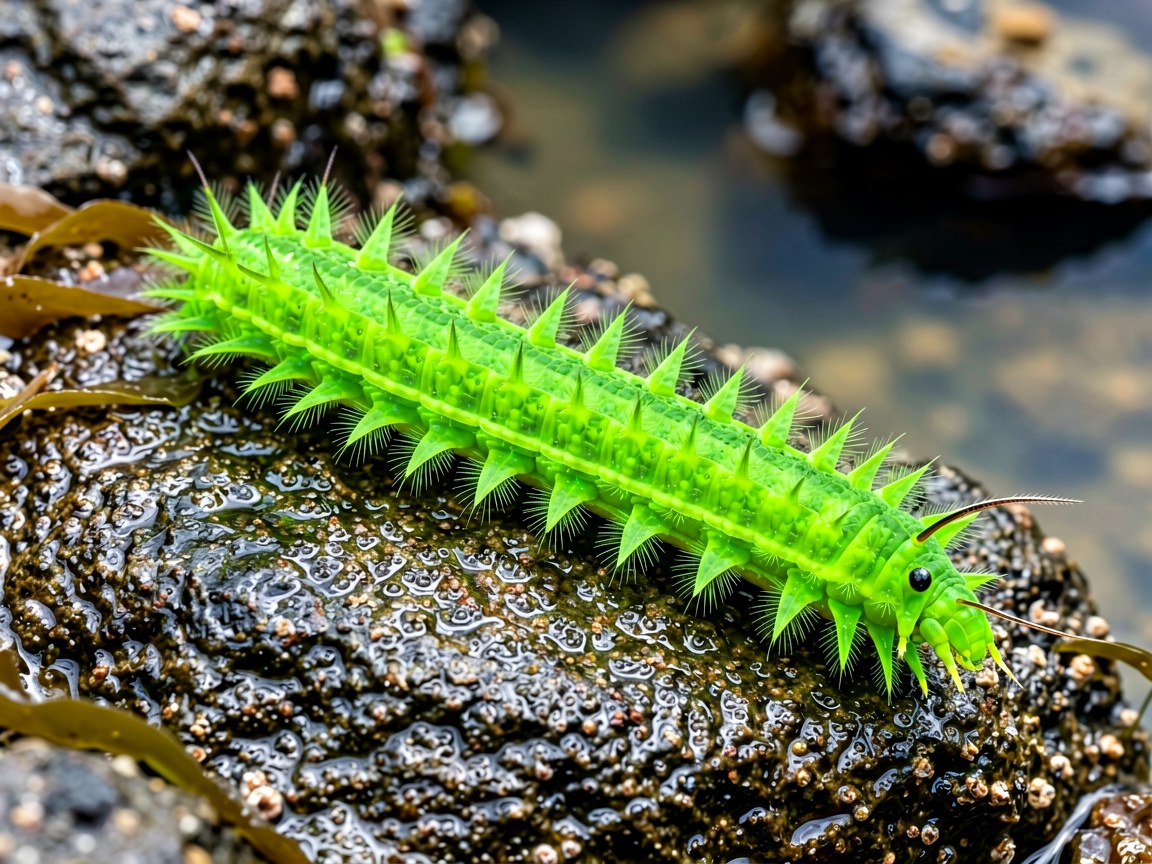
Eulalia viridis | Green Leaf Worm
Introduction
Eulalia viridis, the green leaf worm, is a slender, vividly coloured marine worm of the rocky shore and shallow subtidal, a member of the bristle worms whose bright green body and quick, snakelike swimming make it one of the more conspicuous of the smaller seashore animals. It is an errant polychaete, a free-moving annelid rather than a tube-dwelling one, and it lives among seaweed, under stones and in crevices on rocky ground, where it hunts small prey and darts away when uncovered. The body is long, flat and leaf-like, fringed along each side with paddle-like lobes bearing bristles, and it is coloured a striking green, sometimes with iridescent hints, that comes from the animal’s blood pigment. It ranges through the north-east Atlantic and the Mediterranean and is common on British and Irish coasts. As an annelid it is a close relative of the earthworms of the soil, and like Lumbricus terrestris, the common earthworm, it is a segmented worm, though it has taken the basic plan of the worm into the sea and armed it with bristles and jaws.
Taxonomy
The green leaf worm is a polychaete annelid in the family Phyllodocidae, the leaf worms, a group of free-swimming and crawling marine worms with broad, leaf-like parapodia, the paddle-like side lobes that bear the bristles. The genus Eulalia is found in cool waters worldwide, and the specific epithet viridis means “green,” the most obvious feature of the animal. The Phyllodocidae are part of the errant polychaetes, the mobile, predatory or scavenging bristle worms, as opposed to the sedentary, tube-building kinds, and they are distinguished by their flattened bodies and by parapodia that are leaf-like rather than limb-like. The green leaf worm is told from its relatives by its uniform green colour, its size and the shape of its head, which bears four small antennae and a pair of jawed, reversible pharynx used for seizing food. Within the annelids it sits far from the earthworms in a different subclass, the Polychaeta, but the segmentation, the coelom and the bristle-bearing lobes are shared legacies of the worm body plan. The leaf worms are chiefly predators and scavengers of the seaweed and rock surfaces, and the green leaf worm is among the most familiar of them to the shore explorer.
Physical Characteristics
The adult is a long, flat, ribbon-like worm, usually five to ten centimetres in length though it can be longer, and only a few millimetres wide, with a body that is clearly segmented and slightly tapering at both ends. Each segment bears a pair of broad, flattened parapodia, the leaf-like side lobes, fringed and bearing bundles of bristles that the worm uses both for crawling and for swimming; the parapodia give the body its leafy, fringed outline and its common name. The colour is a bright, even green, from the chlorocruorin, a green respiratory pigment in the blood, and the skin may show a faint iridescence along the margins. The head is small, with two pairs of short antennae, a pair of small eyespots and a muscular, reversible pharynx that can be everted to reveal a pair of dark jaws used to grab prey. The body is soft and fragile, and the worm can shed parts of its tail when attacked, a trick of self-defence. It moves with a looping, snake-like crawl across the surface and, when alarmed, can swim by undulating the whole body, the parapodia beating like tiny oars. The overall effect is of a small, bright green, fringed ribbon that is surprisingly active for a worm.
Habitat
The green leaf worm lives on rocky shores and in the shallow subtidal, from the lower shore down to some tens of metres, among kelp, wracks and other algae, under stones and in crevices and rock pools where it can hide by day. It favours clean, reasonably wave-exposed rock and the weed-covered surfaces of piers and breakwaters, and it is found across the north-east Atlantic from the Mediterranean north to the Arctic and around the British Isles and Ireland, where it is common. It is a species of hard substrata rather than of sand or mud, because it needs the weed and crevices in which to hunt and hide, and it is sensitive to drying, so it is most abundant in the lower, always-wet zones of the shore. It can tolerate a range of salinities and temperatures but is essentially a marine animal of cool to temperate waters. Because it is mobile and predatory it ranges over its home surface, and it is one of the bristle worms most likely to be seen by anyone turning stones or lifting weed on a rocky beach, often flashing green as it darts for cover. Its presence indicates a healthy, unpolluted rocky shore with a rich algal cover.
Diet
The green leaf worm is an active predator and scavenger, using its eversible, jawed pharynx to seize small prey such as tiny crustaceans, other small worms and the larvae of various shore animals, and to tear at carrion and the soft tissues of dead animals it encounters. It is not a filter feeder or a deposit feeder like the earthworm of the soil; instead it hunts across the surfaces of rock and weed, probing with its sensitive head and striking with the reversible pharynx when it finds food. The bristles and the leaf-like parapodia help it to hold position on the weed in moving water while it feeds, and the green colour may help to conceal it among the algae. It is itself eaten by a range of predators, including fish, crabs, shore birds and larger worms, and it forms a small but real link in the rocky-shore food web, passing the energy of the tiny prey it catches up to the larger animals that take it. Compared with the earthworm, which enriches soil by ingesting detritus, the green leaf worm is a carnivore of the sea floor, a reminder that the annelid body plan has been bent to many ways of making a living.
Reproduction
Like many polychaetes, the green leaf worm has separate sexes and reproduces by spawning eggs and sperm into the water, where fertilisation takes place. In some related leaf worms the rear part of the body becomes a swimming, egg- or sperm-carrying region that breaks away to release the gametes, but in Eulalia the details are less dramatic, and the worms shed their gametes from the body into the plankton. The fertilised eggs develop into free-swimming larvae that drift and feed in the water column before settling to the bottom and metamorphosing into the segmented, bristle-bearing juvenile. This planktonic stage lets the species spread along the shore and colonise new rocky habitats. The adults can live for a year or more and may breed in the warmer part of the year, and they are capable of regenerating lost tail segments, so an individual that escapes a predator can repair itself. The life cycle, from drifting larva to green, hunting worm, ties the species to the richness of the algal shore and to the plankton that feeds its young.
Conservation
The green leaf worm is common and widespread across its north Atlantic and Mediterranean range and is not considered threatened; it is a familiar and abundant member of the rocky-shore fauna and a routine record in shallow-water surveys, with stable populations over most of its distribution. Its main sensitivities are to the degradation of rocky habitat, including the loss of algal cover to pollution or to intensive coastal works, and to the oxygen depletion and contamination of enclosed waters. Because it is small and of no commercial value it is not directly exploited, and it benefits simply from the protection of clean, rocky, seaweed-rich shores. It is not legally protected, and there is no conservation action aimed specifically at it, but it is a useful indicator of healthy rocky substrata with intact invertebrate communities. For the shore naturalist it is a rewarding animal to find, a small green worm that shows the predatory, free-moving side of the bristle worms and that demonstrates, beside the earthworm of the garden, how far the segmented worm plan has travelled into the sea.
Fun Facts
- Its bright green colour comes from a green blood pigment, chlorocruorin, not from the algae it lives among.
- It can swim by undulating its whole leaf-fringed body when disturbed, like a tiny green ribbon.
- It hunts with a reversible, jawed pharynx that it everts to grab small prey.
- It can shed part of its tail to escape a predator and later regrow it.
- Though a worm like the earthworm, it is a sea predator, not a soil recycler of detritus.