 By st20113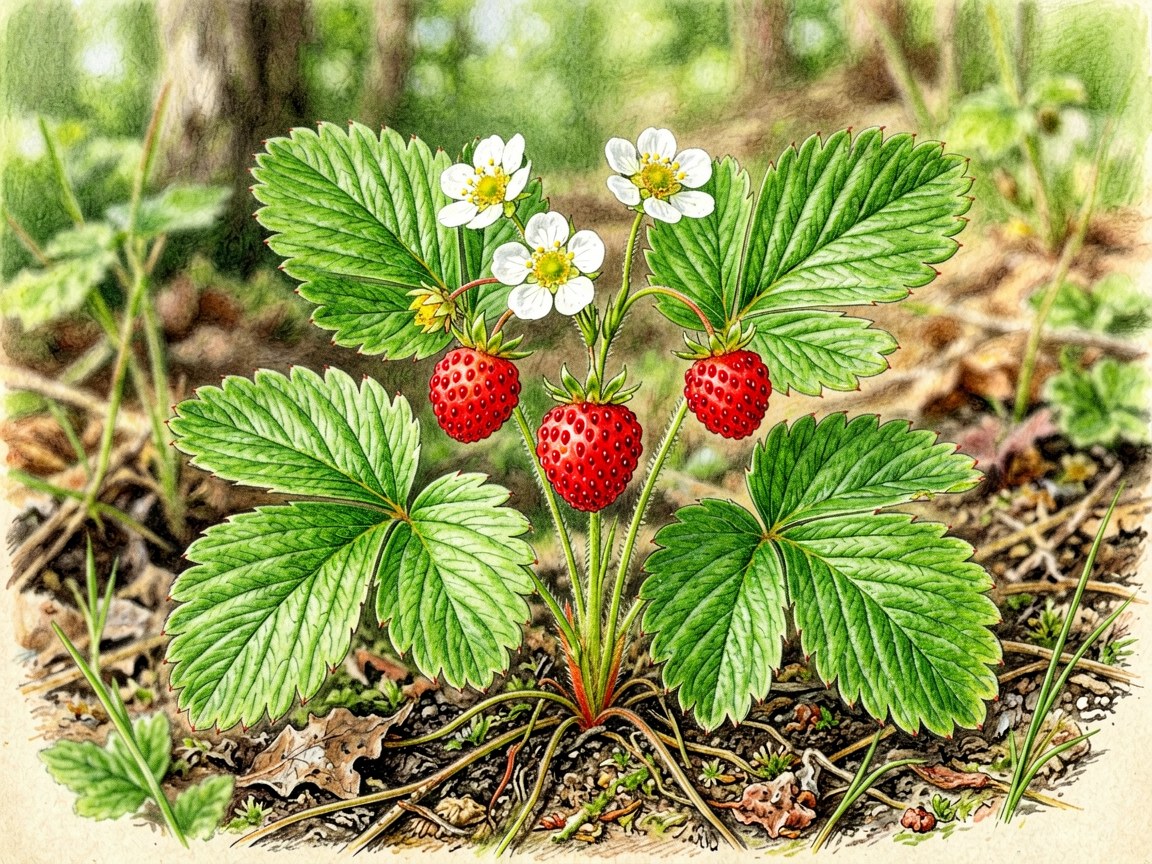
Fragaria vesca | Wild Strawberry
Introduction
Fragaria vesca, the wild strawberry or woodland strawberry, is a small perennial that carries the unmistakable fragrance and flavour of its domesticated relatives in miniature. Native across most of the northern temperate zone, it sprawls through woodland edges, hedgerows, scrub and rocky banks, sending up triplets of bright green leaves and, in early summer, modest white flowers that give way to intense red fruits no bigger than a fingernail. Unlike the fat fruits of the garden strawberry, the wild strawberry’s berries are tiny but famously aromatic, and for centuries they were gathered from the wild and cultivated in cottage gardens long before larger hybrids arrived. The plant is also of quiet economic importance as one of the parent ancestors behind modern strawberry breeding, contributing hardiness and flavour. Tolerant of shade yet happiest at the woodland margin, it is a familiar sight to walkers and foragers alike, and it plays a small but real role in feeding birds and insects in early summer when other fruits are scarce. The plant has travelled with people for millennia, escaping gardens to colonise hedge banks and woodland edges, and its persistence in semi-natural ground makes it a useful, if modest, sign of undisturbed habitat. Because the fruits are so small yet so perfumed, a single plant rewards a careful forager with a concentrated taste of early summer that the large cultivated berry can rarely match, and it remains a favourite of those who gather from the wild.
Taxonomy
Wild strawberry belongs to the rose family, Rosaceae, within the genus Fragaria, a group of about twenty species of strawberries distributed across the northern hemisphere and the Andes. Its specific epithet vesca means “edible” or “thin” in Latin, distinguishing the dainty wild form from coarser relatives. The cultivated garden strawberry, Fragaria × ananassa, is not a direct descendant of F. vesca but arose from a cross of two American species; nevertheless, the woodland strawberry’s diploid genetics have made it a valued parent in breeding programmes aimed at disease resistance and concentrated flavour. Like all green plants it depends utterly on photosynthesis to fix the carbon that builds its leaves, runners and fruit. Botanically, what we call the “berry” is not a true berry at all but an enlarged receptacle studded with dozens of true fruits, each a tiny dry achene on the surface.
Physical Characteristics
Wild strawberry is a low, spreading perennial usually 5–20 cm tall, with a network of slender runners (stolons) that arch out from the parent and root at their tips to form new plantlets. The leaves are trifoliate — three toothed, rounded leaflets on a long stalk — and a lighter green beneath, with a slightly hairy surface. The flowers have five white, notched petals and a spray of yellow stamens at the centre, borne in small loose clusters on leafless stalks. The fruit ripens from green to red, is conical to round, and is covered with the tiny seed-like achenes that give wild strawberries their characteristic speckled look. The flesh is soft, juicy and far more perfumed relative to its size than any shop-bought berry. In autumn the leaves may turn red or bronze, and the plant survives winter as a rosette of leaves close to the ground, protected by leaf litter.
Habitat
This strawberry favours the edges of deciduous and mixed woodland, hedgerows, scrub, grassy banks and the margins of paths, where dappled light meets open ground. It grows on a wide range of soils but does best on free-draining, slightly calcareous loam rich in leaf mould, and it is often a sign of ancient, undisturbed ground. It tolerates more shade than most strawberries and is frequently found under hazel, oak and ash, yet it fruits most heavily where it catches a few hours of sun. Across Europe it ranges from lowland to montane zones, and it has been introduced to parts of North America and Australasia, where it naturalises in similar habitats. Because it spreads by runners, a single colonising plant can slowly form a fragrant patch, though it rarely dominates a sward and is easily overshadowed by more vigorous competitors in fertile, disturbed ground.
Diet
As a photosynthesising plant, the wild strawberry builds its sugars in the leaves from carbon dioxide and water using sunlight, then allocates that energy to leaves, runners and fruit. Its roots take up mineral nutrients from the soil, and like many Rosaceae it commonly forms arbuscular mycorrhizal associations with fungi, which help it capture phosphorus in exchange for carbon. The plant is not a heavy feeder and thrives in relatively poor soils where rank grasses struggle, which is why it persists at woodland edges rather than in rich meadow. The red fruit is essentially a lure: its sugars, acids and volatiles are there to attract animals that will eat it and disperse the achenes within, an investment the plant makes only after the leaf canopy has already paid the energy bill through photosynthesis.
Reproduction
Wild strawberry reproduces both sexually and vegetatively. The flowers are visited by a range of small bees, flies and beetles, and although each flower is hermaphrodite, cross-pollination generally improves fruit set and seed number. After fertilisation, the receptacle swells and reddens while the true seeds remain on the surface, ripening over two to three weeks in early to mid summer. Vegetative spread is at least as important: long, thread-like runners arch outward, touch the soil, and there produce a new plantlet complete with roots and leaves, effectively cloning the parent. This dual strategy lets the species hold a territory at the woodland edge and recover quickly after browsing or trampling. Seedlings from fallen achenes also establish in bare soil, giving the species a routes both into new gaps and into long-term persistence in a single spot.
Conservation
In its native range the wild strawberry is common and secure, and it is not a conservation priority in itself. Its presence is nevertheless valued as part of the diverse ground flora of semi-natural woodland and hedgerows, habitats that have contracted and simplified across much of Europe. Where scrub is flailed relentlessly or woodland floor is compacted and fertilised, the plant declines, but it is remarkably resilient and readily returns once light and leaf litter are restored. It is widely grown in gardens and as a ground-cover ornamental, and wild populations are occasionally threatened locally by over-collection of fruit, though this is rarely significant at scale. For foragers the chief advice is simply to leave enough for the birds and to avoid pesticided roadside verges when gathering.
Fun Facts
- The “seeds” you see on a strawberry’s surface are each a separate true fruit, with the red flesh being a swollen stem tip.
- Wild strawberries are far more aromatic relative to their size than the large cultivated varieties.
- The plant spreads by above-ground runners that root at the tip to clone the parent.
- Linnaeus himself prized the woodland strawberry, and it was cultivated in European gardens long before the modern garden strawberry existed.
- Birds such as robins and thrushes are major dispersers of the tiny surface seeds after eating the fruit.