 By st20113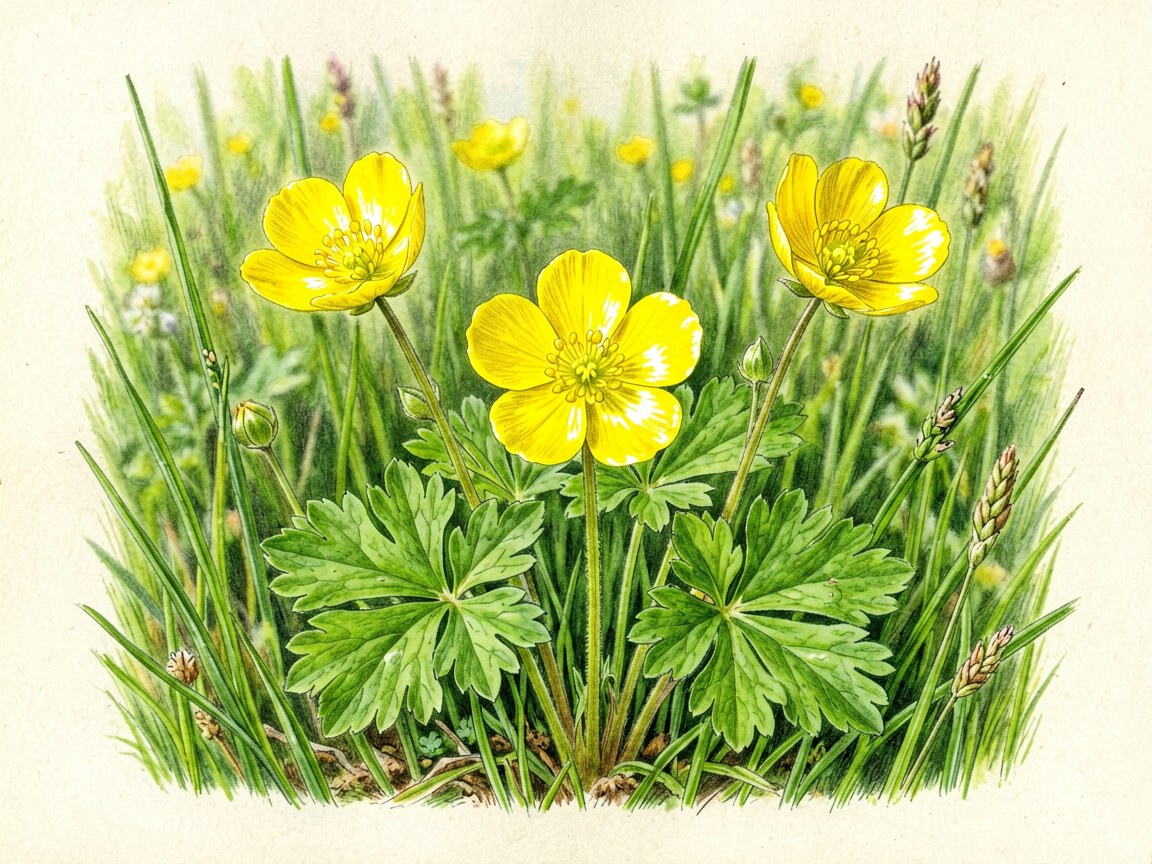
Ranunculus acris | Meadow Buttercup
Introduction
Ranunculus acris, universally known as the meadow buttercup, is one of the most familiar wildflowers of temperate Eurasia and a defining splash of colour in traditional grassland. A perennial herb of the buttercup family (Ranunculaceae), it paints hay meadows, pasture margins, road verges and unimproved grassland with sheets of glistening yellow from late spring through high summer. Plants grow in loose, long-lived clumps that can persist in the same spot for decades, sending up branched flowering stems year after year from a tough, slightly fibrous rootstock. It is a cornerstone species of species-rich meadow communities, supporting a wide array of pollinating insects, and it serves as a classic field indicator of pasture that has escaped heavy fertiliser improvement. Although beloved for its brightness, every part of the living plant contains acrid compounds that make it unpalatable and mildly toxic to grazing livestock — a chemical defence that helps it hold its ground in grazed swards where more palatable grasses are cropped back. Across its huge native range, from the Atlantic fringe of Europe to the steppes of Siberia, it remains one of the most abundant and recognised wild flowers.
Taxonomy
The meadow buttercup sits within the genus Ranunculus, a sprawling group of perhaps 600 species worldwide that share the defining buttercup traits of numerous free carpels and often glossy, petal-like flowers. Its specific epithet acris — Latin for “sharp” or “bitter” — refers to the biting taste of the foliage when chewed. Together with close relatives such as Ranunculus repens (creeping buttercup) and Ranunculus bulbosus (bulbous buttercup), it forms the core of the European buttercup flora, and the three are easily confused until they flower. As a green plant it is fundamentally dependent on photosynthesis, capturing sunlight in its leaves to build the sugars that fuel its growth, flowering and seed set. Within Ranunculaceae it is placed among the members with simply lobed basal leaves and a tall, branched flowering stem. Several botanical varieties have been described, mainly differing in hairiness and the depth of leaf division, but they intergrade freely in the wild and are not always easy to separate.
Physical Characteristics
Meadow buttercup typically reaches 30–100 cm in height, though in tight grazed grassland it may stay much shorter. From the rootstock rise erect, scarcely branched stems that are round in section and hairless to sparsely hairy. The basal leaves are the plant’s signature: deeply divided into five to seven toothed lobes radiating from a central point like an open hand, borne on long stalks. Stem leaves are progressively smaller and less divided higher up the shoot. The flowers are 2–3 cm across, with five (occasionally up to eight) glossy, wax-like yellow petals surrounding a crowded button of yellow stamens and many tiny green carpels. The shine of the petals comes from a thin layer of air-filled cells beneath the cuticle that reflects light strongly. After flowering, each carpel ripens into a small, flattened, beaked achene, and dozens of these cluster into a spherical head about the size of a pea. The whole plant is smooth and lacks the runners of its creeping relative, instead holding a tidy upright form.
Habitat
This is a plant of mesotrophic, base-rich grasslands that are neither too dry nor too waterlogged. It thrives in traditionally managed hay meadows, lowland pastures, chalk and limestone grassland, roadside verges, churchyards and hedgerow edges, and it frequently accompanies species such as oxeye daisy, yellow rattle and cuckooflower. It tolerates a surprising degree of grazing and mowing because its growing point sits low among the basal leaves, and because its bitterness deters cattle and sheep from eating it to the ground. It is far less common on acid heaths, in deep shade, or on intensively farmed land where nitrogen fertiliser and reseeding have simplified the sward. Across its native range it climbs from sea level to sub-alpine meadows, always favouring open ground with at least partial sun and soil that does not dry out completely in summer. In North America and parts of the southern hemisphere it has been introduced and is now naturalised in analogous grassland habitats.
Diet
Like virtually all green plants, the meadow buttercup is autotrophic, manufacturing its own food through photosynthesis in the chlorophyll of its leaves. Carbon dioxide drawn from the air and water taken up by the roots are combined using solar energy into sugars, which are then converted into the structural carbohydrates, oils and proteins the plant needs. The roots also absorb dissolved mineral nutrients — notably nitrogen, phosphorus and potassium — from the soil, along with trace elements such as magnesium and iron. Unlike many later-successional woodland plants, R. acris forms only weak or inconsistent associations with mycorrhizal fungi, relying more directly on its own root system to mine the soil. Its chemical defence, protoanemonin, is produced from precursors in the foliage and is released when cells are damaged; it deters herbivores rather than assisting feeding, and it breaks down to the harmless anemonin as cut material dries. The plant’s nutrient economy is therefore a straightforward solar-powered loop closed by mineral uptake from the ground.
Reproduction
Meadow buttercup is primarily insect-pollinated. The open, nectarless but pollen-rich flowers are visited by a broad spectrum of bees, hoverflies, beetles and other insects that forage the abundant stamens, and the bright colour acts as a long-distance advertisement. The flowers are protandrous, releasing pollen before the carpels become receptive, which encourages cross-pollination between different plants and promotes genetic mixing. Although self-pollination can occur, many populations are largely self-incompatible, so outcrossing dominates. Seeds are produced in profusion — a single plant can shed several hundred achenes — and are dispersed mainly by gravity, by adhering to the wet coats of grazing animals, and by moving water in flooded meadows. The persistent rootstock also allows the clone to survive and expand vegetatively for many years, so an established patch is a mix of genetic individuals from seed and a long-lived parent clone from the root. Flowering peaks in early to mid summer, with seed shed following a few weeks later.
Conservation
Across most of its native range the meadow buttercup is abundant and is assessed as a species of least concern. Its real conservation story is tied to the habitat it signals: species-rich lowland meadow has declined by the majority in many European countries since the mid twentieth century because of agricultural improvement, fertiliser use and field abandonment. Where such meadows survive, R. acris is usually plentiful, so its presence is a useful field sign of neglected, wildlife-friendly grassland rather than of rarity in itself. Conservation effort is therefore directed less at the buttercup than at maintaining traditional rotational grazing and late-season hay cuts that let it and its companions flower and set seed. In some regions, agri-environment schemes pay farmers to delay cutting until after mid summer precisely so buttercups and their neighbours can complete their life cycle. The plant’s tolerance of grazing means it often survives better than more delicate associates when management is less than ideal.
Fun Facts
- The genus name *Ranunculus* comes from the Latin for “little frog”, a nod to how many buttercups grow in damp places where frogs abound.
- Holding a buttercup flower under your chin makes the skin glow yellow — light reflected from the glossy petals is the trick, not any dye.
- Every fresh part of the plant contains protoanemonin, an oil that can blister skin and sicken livestock if eaten in quantity.
- A single meadow buttercup can produce several hundred tiny achenes in one season.
- The flowers have no nectar; they reward insect visitors entirely with protein-rich pollen.