 By st20113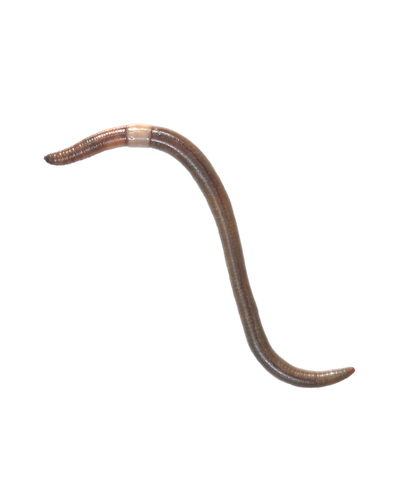
Introduction
The common earthworm (Lumbricus terrestris), often called the night crawler, is a segmented invertebrate found in soils across Europe, North America, and many other temperate regions where it has been introduced. Though seldom seen by day, its burrowing quietly shapes the soil on which terrestrial life depends. It plays a quiet but essential role in agriculture, improving soil structure wherever it is abundant. Adults typically reach 20 to 30 centimetres in length, though size varies with soil and climate. Its body is cylindrical, reddish-grey, and divided into ring-like segments. It shares the soil ecosystem with animals such as the European rabbit, which occasionally feeds on worms exposed at the surface.
Taxonomy
Lumbricus terrestris is classified in the family Lumbricidae, class Oligochaeta, within the phylum Annelida, the segmented worms. It was described by Carl Linnaeus in 1758. The genus Lumbricus includes several burrowing earthworms of the Northern Hemisphere. The species name terrestris means of the earth, reflecting its soil-dwelling life. Earthworms are distinct from flatworms and roundworms, possessing a true coelom and a segmented body plan characteristic of annelids.
Physical Characteristics
The earthworm has a soft, moist body made of many similar segments, each bearing tiny bristles called setae that grip the soil during movement. A thickened band near the front, the clitellum, produces the cocoon for eggs. The body lacks eyes and lungs; it senses light and vibration through receptors in the skin and breathes through its moist surface. Like other burrowers such as the red fox‘s prey community, the worm is built for a hidden, subterranean existence rather than speed or armour.
Habitat
This species prefers deep, moist, loose soils rich in organic matter, such as gardens, meadows, forests, and cultivated fields. It digs permanent, near-vertical burrows that can extend more than two metres down, emerging at night to drag leaves into the entrance. The worm avoids waterlogged, acidic, or frozen soils and is highly sensitive to drying. Its burrowing mixes the soil and improves aeration and drainage, making it one of the most important engineers of terrestrial ecosystems.
Diet
Earthworms feed on decaying plant material, soil, and microorganisms. The common earthworm pulls leaves and other litter into its burrow and consumes them along with the surrounding earth, extracting nutrients as the mixture passes through the gut. The excreted material, known as castings, is rich in minerals and benefits plant growth. By breaking down organic matter, worms accelerate nutrient cycling and support the productivity of soils on which countless plants and animals depend.
Reproduction
Earthworms are hermaphrodites, carrying both male and female organs, but they normally exchange sperm with a partner during mating on the soil surface at night. After mating, the clitellum secretes a cocoon into which eggs and sperm are placed; the cocoon is deposited in the soil. Young worms hatch as miniature adults and grow by adding segments. They can also regenerate lost tail segments to a limited degree. A single individual may live several years under favourable, undisturbed conditions.
Conservation
The common earthworm is abundant and classified as least concern, and it is arguably expanding through human-assisted spread. However, intensive agriculture, pesticide use, and soil compaction can reduce local worm populations and degrade the services they provide. Their loss can impoverish soils and reduce crop yields. Encouraging organic matter addition, reduced tillage, and limited chemical use helps maintain healthy earthworm communities that sustain fertile ground worldwide.
Fun Facts
An earthworm has five pairs of hearts, called aortic arches, that pump its blood. It can eat up to a third of its body weight in soil and litter each day. The familiar piles of coiled casts on a lawn are the worm’s processed leftovers, rich in plant nutrients. If cut, a worm may regrow a new tail but usually cannot regrow a new head, dispelling the myth that any two pieces become two worms. At night it may pull a leaf underground with surprising strength for its size.
[…] are among the oldest known land animals, with a fossil record extending over 400 million years. earthworm […]
[…] forcipules, just behind the head. It shares the soil and leaf litter with decomposers such as the Lumbricus terrestris, but where the earthworm recycles dead plant matter the centipede is an out-and-out […]
[…] by bearing two pairs of legs on most body segments rather than one, and by lacking venom. Like the Lumbricus terrestris and other soil animals, it is a decomposer, but it works on dead plant matter where the earthworm […]
[…] and the family Glomeridae, described by the German zoologist Carl Ludwig Koch in 1844. Like the Lumbricus terrestris and other soil animals it lives among dead plant matter, but where the earthworm works below ground […]
[…] the class Polychaeta and the phylum Annelida—the segmented worms, the same phylum that includes Lumbricus terrestris (Common Earthworm). Like other nereidids, it has a well-developed head with sensory palps and antennae, a body of many […]
[…] its earthworm relatives such as Lumbricus terrestris, described in our article on Lumbricus terrestris (Common Earthworm), the medicinal leech is a segmented worm with a soft, muscular body, but it has abandoned the […]
[…] and Irish coasts. As an annelid it is a close relative of the earthworms of the soil, and like Lumbricus terrestris, the common earthworm, it is a segmented worm, though it has taken the basic plan of the worm into […]
[…] belongs to a different marine branch of the annelids and shares the basic segmented body plan with the common earthworm, though it is built for a life of hunting in salt water rather than burrowing in soil. It ranges […]
[…] with human activity to many parts of the world, and it is a key worker of the soil, much like Lumbricus terrestris, the common earthworm, though it keeps more to the surface and to richer, more disturbed […]
[…] shore and in shallow sublittoral mud. As a segmented worm it shares the annelid body plan with the common earthworm, though it has traded the earthworm’s soil-swallowing for a sedentary, filter- and […]