 By st20113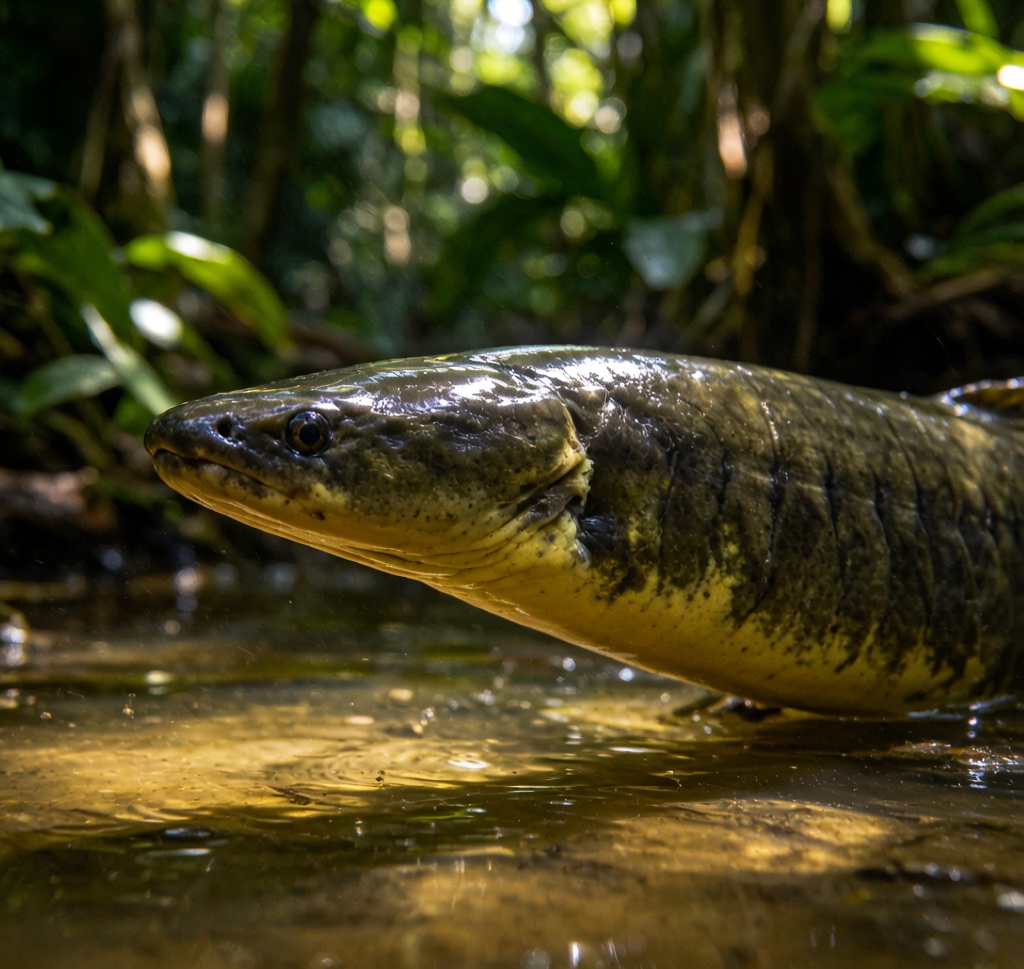
Introduction
The electric eel (Electrophorus electricus and related species) is a South American freshwater fish native to the Amazon and Orinoco river basins, famous for its ability to generate powerful electrical discharges. Despite its name, it is not a true eel (which are ray-finned fish of the order Anguilliformes) but a knifefish of the order Gymnotiformes, more closely related to catfish and carp. The species generates electricity through specialised cells called electrocytes, stacked in series like biological batteries, which collectively produce discharges of up to 860 volts at around one ampere—enough to incapacitate prey, deter predators, and (in rare circumstances) cause serious harm to humans. Three species are currently recognised within the genus Electrophorus: E. electricus, E. varii, and E. voltai.
Physical Characteristics
Electric eels are elongated, cylindrical fish capable of reaching lengths of 2–2.5 metres (6.5–8 feet) and weights of up to 20 kilograms (44 pounds), making them among the largest freshwater fish in South America. Their body lacks scales and is covered in smooth, slimy skin that is dark grey-brown on the back and yellow-orange on the underside. The elongated body houses the electrocyte organs—three pairs of specialised, disc-shaped cells derived from muscle cells—that constitute up to 80% of the body length and function as biological voltaic piles.
The head is slightly flattened and houses the vital organs, with a mouth positioned at the very front adapted for surface air breathing. Electric eels are obligate air-breathers: they must surface every 10–20 minutes to gulp atmospheric oxygen, a physiological adaptation to the oxygen-depleted (anoxic) waters of their swampy habitat. Their eyes are small and appear to have limited visual function; they navigate and detect prey primarily through low-voltage electric fields (electrolocation), analogous to the echolocation used by bats.
Habitat and Distribution
Electric eels inhabit the freshwater rivers, streams, floodplains, and swamps of the Amazon and Orinoco basins, including portions of Brazil, Venezuela, Colombia, Peru, Ecuador, and the Guianas. They prefer slow-moving, murky, oxygen-poor waters with dense aquatic vegetation, submerged roots, and leaf litter, typically in the flooded forest zones of the Amazon basin during the wet season. During the dry season, they are forced into increasingly confined pools as water levels recede, which concentrates prey and leads to frequent encounters with other fish—and occasionally with humans wading in drying pools.
Despite their name, electric eels are poor swimmers and move primarily through undulations of the elongated body rather than active propulsion. They are ambush predators of the bottom layer, often partially burying themselves in sediment and surfacing near the water’s edge to breathe air while their sensory and electrical organs remain submerged.
Electrogenesis and Electrical Abilities
The electric eel’s electrical abilities are generated by three pairs of electrocyte organs: Main organ, Hunter’s organ, and Sachs’ organ, arranged along the body from tail to head. When activated, thousands of electrocytes in the main organ discharge simultaneously, creating a potential difference of up to 860 volts. The high current is made possible by the stacking of electrocytes in series (increasing voltage) and the high conductivity of the freshwater environment, which allows current to flow effectively between the eel’s tail and head through the surrounding water.
Different organs serve different functions. Sachs’ organ produces continuous low-voltage (around 10 volts) discharges used for electrolocation—sensing the environment by detecting distortions in the eel’s own weak electric field, similar to the electroreception used by weakly electric fish and sharks. The main and Hunter’s organs produce high-voltage pulses used for hunting (stunning or killing prey fish) and self-defence. Research published in 2019 confirmed that electric eels can also deliver a ‘leaping attack’: individuals can leap partially out of the water to press their chin (positive pole) directly against a perceived threat, delivering a shock far more concentrated and dangerous than the dispersed underwater discharge.
Diet and Predation
Electric eels are carnivorous apex predators of the freshwater benthos. Their diet consists primarily of fish, including smaller electric eels, as well as amphibians, crustaceans, and insects. A hunting sequence typically involves the eel locating prey by electrolocation, then delivering a high-voltage volley to stun the prey at close range, after which the eel swallows the incapacitated victim headfirst. Prey that survives the initial shock may be weakened and captured in subsequent attacks. The eel’s electrical discharges appear to trigger involuntary muscle contractions in nearby fish, causing them to convulse and reveal their position.
Despite their formidable electrical arsenal, electric eels face predation from large caimans, anacondas, and river dolphins, all of which have evolved varying degrees of resistance or avoidance strategies. The caiman in particular appears able to attack electric eels from angles that minimise the electrical discharge density, suggesting coevolutionary arms dynamics between predator and prey.
Scientific Research and Conservation
Electric eels have been a subject of scientific fascination since the pioneering work of Luigi Galvani and Alessandro Volta in the late 18th century, who used them as a model for understanding bioelectricity. Modern research has advanced understanding of electrogenesis, electroreception, and the physiology of excitable cells. In 2020, researchers at Nagoya University announced the development of an electric eel-inspired waterproof biocompatible battery using cultured electrocyte cells.
While not currently assessed as globally threatened, electric eels face pressure from habitat destruction, dam construction (which alters floodplain dynamics and fish migration routes), and water pollution. Their large size, low reproductive rate, and specialised habitat requirements make them vulnerable to environmental change. Electrophorus electricus is classified as Data Deficient on the IUCN Red List, partly because its remote habitat makes population assessment difficult. The discovery of E. varii and E. voltai in 2019 highlights how much remains unknown about these remarkable animals even after centuries of study.