 By Iris
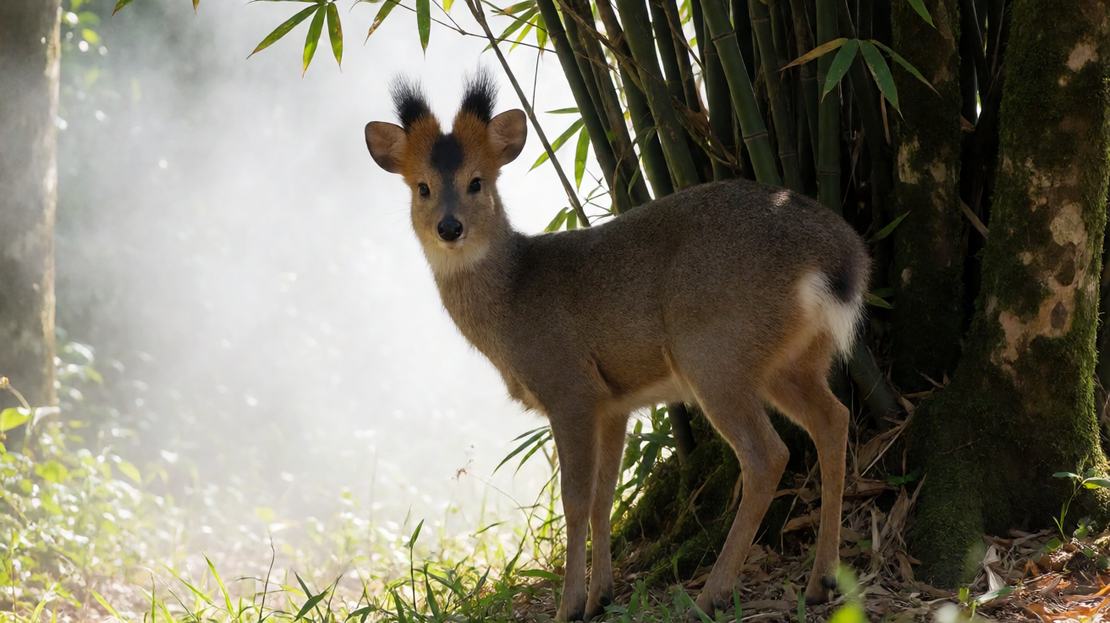
Elaphodus cephalophus | Tufted Deer
Species Profile · Cervidae
Tufted Deer
A black fringe of hair hides the smallest antlers in the deer family, and the tusks below it do the fighting.
Near Threatened
Length
Shoulder height
Weight
Antlers
Range
Rating
Two fangs and a fringe of hair
A deer with hidden antlers
A small deer with a black forehead tuft lives in central China. It is one of the few deer that keep visible fangs. Males carry short antlers. Those antlers stay buried in the tuft, so few people ever see them. Females have no antlers at all.
Most of the range lies inside China, although a few animals reach northern Myanmar. Dense forest and bamboo thickets decide where the deer can live. Dense growth gives cover, since the animal freezes at the first sound. Walkers seldom see one. Because the deer is small and the forest is thick, a walker can pass within a few metres of one and never know.
Local people know the species by many names, and the forehead hair gave it the English one. Its shy habits keep it out of most field guides. Hunters know the animal very well, though few of them write anything down. A glance at the face explains the name, while the rest of the body stays plain brown.
Family tree
Cervidae, the deer family
One small deer sits alone in the deer family, and it is the only member of its genus. Deer in this family share antlers made of bone. This species carries the smallest pair of all. Its closest relatives are the muntjacs, which bark when alarmed and fight with sharp teeth.
Unlike those cousins, the tufted deer has a longer tail and a blunter face. It stands apart from the roe deer in size and habitat. Scientists describe three subspecies across the range. Northern animals grow darker coats, whereas southern ones look warmer and browner.
No other deer combines a forehead tuft with fangs and antlers as short as these. Early taxonomists read the teeth as muntjac features, although the body suggested something else. Modern genetic work supports that reading, and the genus keeps the place Milne-Edwards gave it in the year 1872.
Tuft, tusks and short horns
How to tell one
An adult stands about 50 to 70 cm at the shoulder. Body length runs 110 to 160 cm, and weight falls between 17 and 30 kg. A well fed male in autumn can pass 35 kg. Coats are dark brown in the north and red brown further south. Guard hairs are coarse and hollow.
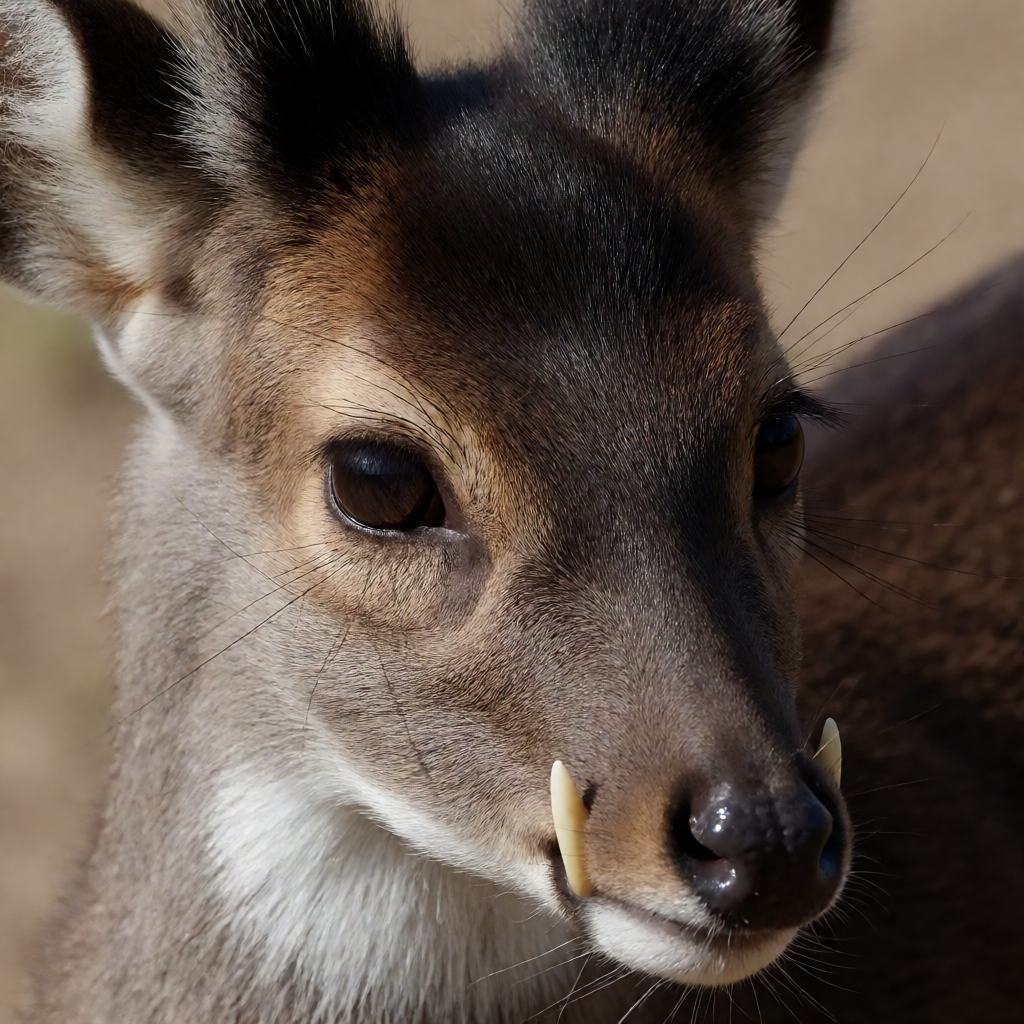
Fur looks thick, and it holds warmth on cold nights. Black hair grows from the forehead and hangs between the ears as a tuft. That tuft hides the antlers almost completely. Antlers grow only 1 to 5 cm long, and they never fork. Male upper canines push past the lip as small tusks.
Tusks stay sharp through life, and they work far better in a fight than the short horns do. Ears are short and rounded, the tail is bushy underneath, and the legs look slender for a body of this weight. Fawns are born with pale spots along the back, although the spots fade within a few months.
1
2
3
Bamboo thickets on hill ridges
Where it lives
Hill forest holds the species from about 300 to 2,600 m. Bamboo often grows thick beneath the trees, and the deer needs that cover. Mixed broadleaf and conifer stands suit it best. Deer also enter scrub and young plantations, although they keep off open ground.
Cover matters more than food, since dense plants let the animal freeze and vanish. Bare slopes get crossed only at night. Unlike the fallow deer of open parkland, this species stays inside cover all day. Streams and gullies inside the forest give it water.
Damp ground keeps the undergrowth green through the dry months. Snow pushes animals downhill in winter, and they drift toward valleys where the bamboo still stands above the drifts. Fires and clear cutting remove the thickets, so the deer retreats into whatever patches remain. Roads cut through the hills and open corridors that let people and dogs reach places that were once remote.
Bamboo leaves, browsed at night
What it eats
This deer is a browser, and it takes leaves, shoots and soft stems. Bamboo leaves form a large part of the diet. Animals also eat grasses, herbs and fallen fruit, although bamboo stays the staple. Browsing happens along fixed routes. Deer follow the same trails night after night, since they know every gap in the thicket.
Feeding peaks near dawn and again near dusk. Each deer pulls a leaf with a sideways jerk of the head. Males feed apart from females for most of the year. Pairs share a patch in the breeding season, though the arrangement lasts only weeks. Salt from mineral soil draws animals to seepage sites, and those spots get used for generations.
Farmers lose bean seedlings at the forest edge, because the deer steps out at night. Its stomach handles fibrous food in small amounts, so the animal feeds often and rests between bouts. Water comes from streams and dew, and drinking is quick and always close to cover.

One fawn, hidden in grass
The breeding cycle
Adults live alone or in pairs, and each animal holds a small home range that it keeps for years. Scent marks along trails tell neighbours who passed. Both sexes rub glands on twigs, since scent lasts longer than a call. When alarmed the deer stamps a front foot, then barks and slips into cover.
That bark sounds short and hoarse, although it carries a long way through still air. Males fight in the rut with tusks and forehead. Short antlers serve little purpose in a clash, so the teeth do the work. Breeding runs from September into December.
Pregnancy lasts about 210 days, so births fall from May into July. A female leaves the group to give birth and hides the fawn in tall grass. One fawn is usual, and twins stay rare across the range. Young males leave at about one year, while young females may stay for a second season.
Near Threatened, and still falling
Conservation
This species is listed as Near Threatened, since the population has fallen for decades. Forest loss across central China drives the decline. Poaching for meat and for the tusks continues, although the law protects the animal. Dogs used in hunting kill more animals than the hunters take.
Protected areas hold good numbers in Sichuan and Shaanxi. Camera traps now record animals in districts where nobody had seen one for years. Farming moves uphill and replaces thicket with fields. Edge habitat slowly disappears, so the deer crowds into smaller patches of forest.
Hunted groups recover slowly, because a female raises one fawn a year at best. China lists the deer as a second class protected animal. That status forbids trade in wild animals, and it covers the tusks as well as the meat. Long term survival depends on connected forest, since isolated patches lose the species within a few decades.
Side by side
How It Compares
| Trait | Tufted Deer | Chinese Water Deer |
|---|---|---|
| Size | 110 to 160 cm body, 50 to 70 cm at the shoulder | 75 to 100 cm body, 50 to 70 cm at the shoulder |
| Weight | 17 to 30 kg | 9 to 14 kg |
| Antlers | a short pair, 1 to 5 cm, hidden inside the tuft | none at all, in either sex |
| Canine teeth | small tusks that barely clear the lip | long tusks that hang below the lip |
| Home | hill forest in central China and northern Myanmar | reed beds and marsh edge in eastern China |
| Rating | Near Threatened | Vulnerable |
Common misreadings
What People Get Wrong
- Many people assume the tuft marks an old male, yet both sexes carry it from birth.
- Some guides say the deer has lost its antlers, although males still grow a short pair.
- Field notes often place the species in Tibet, yet every record comes from lower hill forest.
Going further
Sources and Further Reading
Quick hits
Five things to remember
- Tuft hair hangs over the forehead and hides the antlers from view.
- Males keep tusks.
- A startled deer barks once, then bolts into the thickest cover.
- Fawns carry pale spots for a few months.
- Wild ones live only in China and a small corner of Myanmar.