 By st20113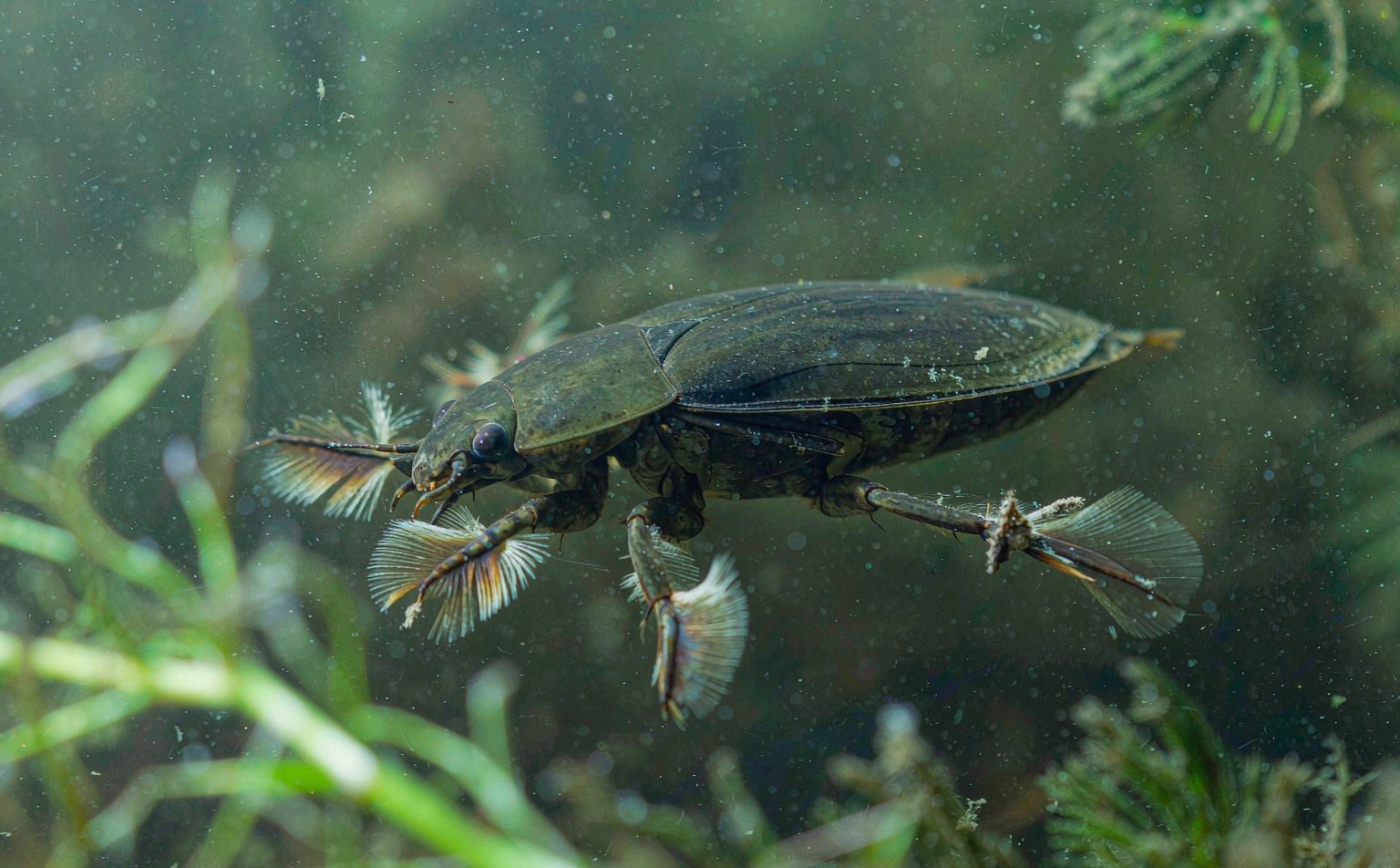
Dytiscus marginalis | Great Diving Beetle
Introduction
The Great Diving Beetle (Dytiscus marginalis) is the largest and most impressive of the European pond beetles, a predatory insect up to 3.5 centimetres long that rules the underwater world of ponds, lakes and canals. With its streamlined body, fringed swimming legs and fierce jaws, it hunts tadpoles, small fish, newts and a wide range of aquatic invertebrates. A glimpse of one powering through the weeds, air bubble glinting at its rear, is a highlight of any pond dip.
Both the adult and its fearsome larva, the “water tiger,” are apex predators of the freshwater shallows. The Great Diving Beetle is a true beetle of the family Dytiscidae, and its size and appetite make it one of the most consequential hunters in the still-water food web.
Taxonomy
The Great Diving Beetle was described by Carl Linnaeus in 1758 and placed in the genus Dytiscus, within the family Dytiscidae, the predaceous diving beetles. The genus name means “diver,” and the family is among the largest groups of aquatic beetles worldwide. D. marginalis is the familiar large species of European lowland waters.
It shares its pond with the larvae of the Common Toad and with the Grass Snake that hunts at the margin, and it is itself prey for larger predators. Above the water it may be taken by the Southern Hawker and other dragonflies when it climbs out to bask.
Physical Characteristics
The Great Diving Beetle measures 27 to 35 millimetres. Its body is elongate-oval, smooth and dark olive-brown to black, with a yellowish border along the edges of the wing cases that gives the species its name “marginalis.” The head is broad with large compound eyes and strong, toothed jaws. The hind legs are flattened and fringed with hairs, acting as powerful oars, while the front legs of the male bear suction pads used to grip the female.
The adult carries a bubble of air trapped under its wing cases, replenished at the surface, allowing it to stay submerged for long hunts. The larva is utterly different: a slender, segmented “water tiger” with a large head, sickle-like jaws and a pair of tail filaments that draw air from the surface. Both stages are armed and unmistakable.
Habitat
Great Diving Beetles inhabit still or slow fresh water rich in vegetation: ponds, lakes, canals, dykes and quiet river backwaters. They need both open water for hunting and plants for laying eggs and for the larvae to develop. They tolerate a range of conditions but do best in unpolluted water with a good supply of prey.
They are strong fliers and often migrate at night between waters, especially in autumn. In winter they may rest in the mud or among roots, though active adults can be found in ice-free water through the cold months.
Diet
The Great Diving Beetle is a top predator of the pond. The adult seizes tadpoles, small fish, newt larvae, aquatic insects, worms and crustaceans, gripping them with its legs and injecting digestive juices from its jaws before sucking out the soft tissues. It is bold and can tackle prey nearly its own size.
The larva is even more ferocious, ambushing prey among vegetation and piercing it with hollow jaws to drain it. Together the two stages help control populations of smaller creatures and recycle carrion, making the beetle a key part of pond ecology. Because it eats so much, it can affect the survival of tadpoles and young fish in small ponds.
Reproduction
Mating takes place in the water in spring and summer, the male holding the female with his sucker-padded front legs. The female lays her eggs singly, often in slits she cuts into the stems of aquatic plants. The larvae hatch and grow through several instars, hunting fiercely, before leaving the water to pupate in a chamber in the damp soil of the bank.
The adult emerges after a few weeks and returns to the pond. Depending on conditions there may be one generation a year, with the new adults maturing to breed the following season. The life cycle binds the beetle closely to the health of its wetland.
Conservation
The Great Diving Beetle is widespread and common, with no conservation concern, though it is sensitive to severe pollution and the loss of unmanaged pond margins. It is a useful indicator of a functioning freshwater ecosystem, and garden ponds can support healthy populations where vegetation and water quality are good.
Protecting and creating ponds, reducing pesticide and nutrient runoff, and leaving reed and sedge margins untrimmed all benefit the species. Because the adults fly between waters, well-managed ponds act as sources that recolonise deprived sites, supporting freshwater biodiversity more broadly.
Fun Facts
- The Great Diving Beetle can reach over 3 centimetres and is the giant of the pond beetle world.
- Its larva is called a “water tiger” for its slender body and savage, hollow jaws.
- The male has suction pads on his front legs to hold the female while mating.
- It breathes from a bubble of air trapped under its wing cases while underwater.
- Both adult and larva are apex predators that can eat tadpoles and small fish.