 By Iris
Anodorhynchus hyacinthinus | Hyacinth Macaw
Species Profile · Psittacidae
Hyacinth Macaw
The largest flying parrot works a palm nut open with a bill built to crush.
Vulnerable
Length
Wingspan
Weight
Clutch
Fledge
Rating
The Hyacinth Macaw
Blue, heavy and loud
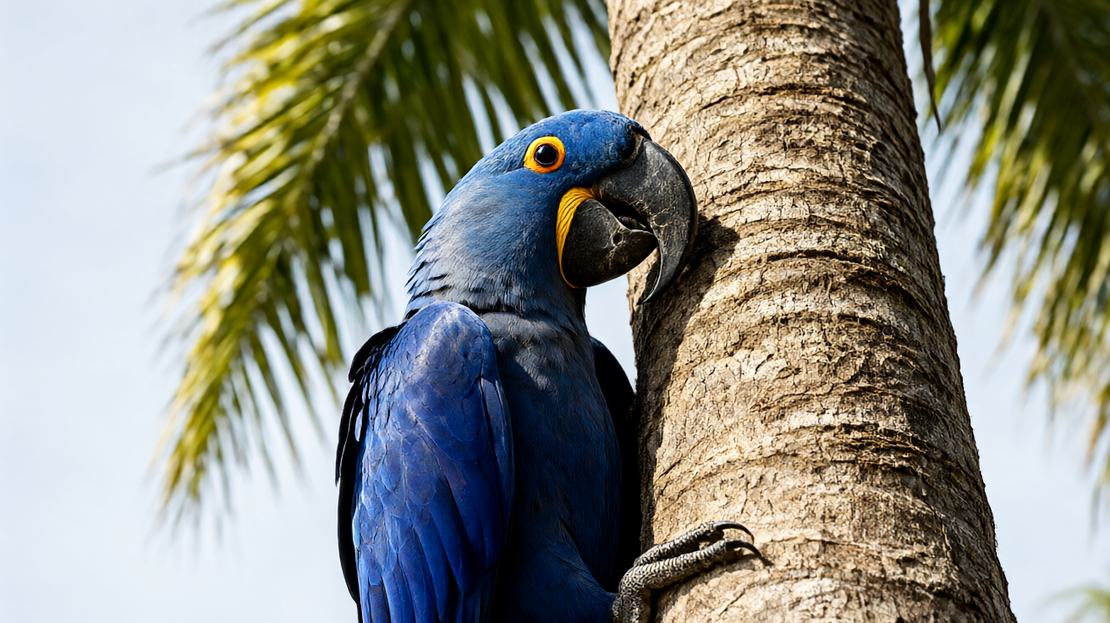
A blue macaw lands on a palm and begins to work on a nut. The bill is the largest of any flying parrot. Cobalt blue covers the whole bird.
Two bare yellow patches mark the face, one round the eye and one along the jaw. Nothing else here looks like it. A pair stays close, and the birds call in harsh rising notes.
Because the macaw depends on a handful of palm species, it lives where those palms grow. Cattle country and flood plain overlap here, and both help the bird.
Family tree
Psittacidae, the true parrots
Its proper name is Anodorhynchus hyacinthinus, one of three blue macaws. Two close relatives survive in Brazil, and both of them are far rarer than this bird, which is itself short of nest trees. The family holds the parrots of the New World, and the macaws form one branch. No subspecies are recognised, since birds across the range look alike.
Because the genus split early, its members share a deep curved bill. Collectors once treated the three blue forms as one species. Field work later showed that each lives in a different part of Brazil.
Blue, yellow and black
How to tell one
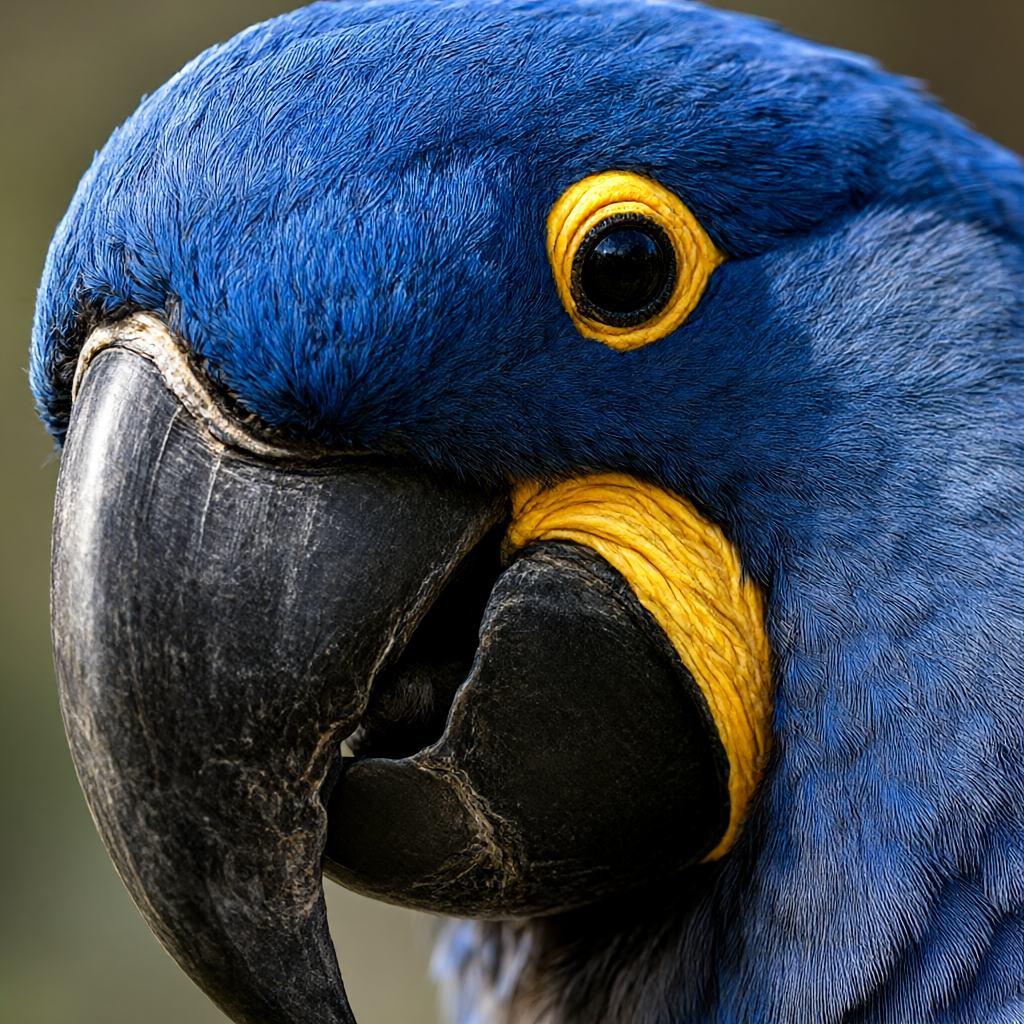
Adults measure 95 to 100 cm from bill to tail, and that makes it the largest flying parrot. Wings span 130 to 150 cm, and weight falls between 1.2 and 1.7 kg. Deep blue covers the body, and the head carries a slightly darker shade. Bare yellow skin rings each eye, and a yellow strip sits under the lower jaw.
The bill is massive and black, with a sharp hook at the tip. Bones inside the skull brace that bill. The bird must crack shells that would break a human thumb. A long tail balances the body on a thin branch.
Feet grip two toes forward and two back, leaving the bill free to work. Males and females look alike, though the male runs slightly larger. Because the bird is so heavy, it needs a wide perch and a strong take off.
1
2
3
Palm groves
Where it lives
Flooded palm savanna is the main habitat. Gallery forest along rivers holds birds wherever the right palms grow. Cliffs at the edge of the plain give nest holes in some areas. Because the two food palms need open ground, dense forest holds few birds and almost no nest trees at all.
Seasonal flooding shapes the whole cycle, since nests must stay above the high water. Cattle ranches now hold much of the range, and the birds tolerate them well. A capybara shares that wet grassland, and both species depend on the same seasonal floods.
Two kinds of nut
What it eats
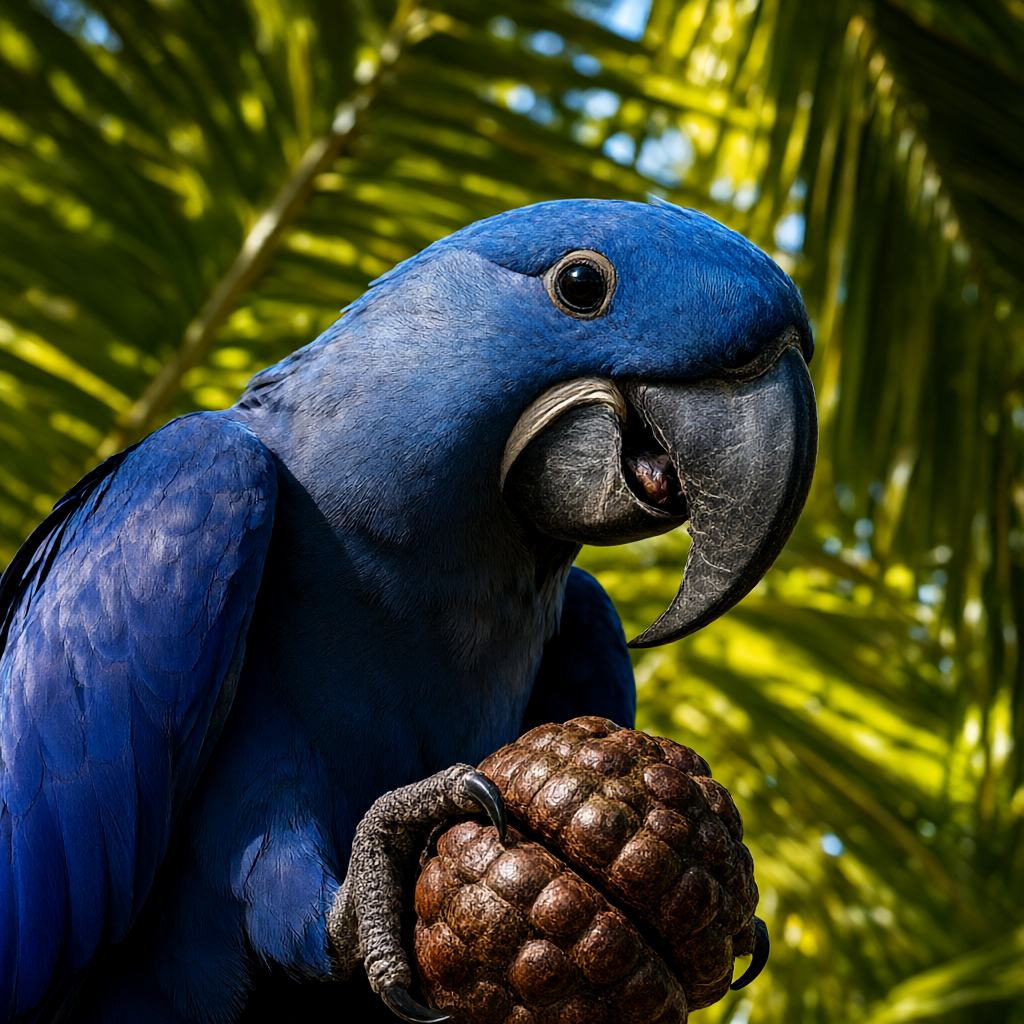
Two palm nuts make up nearly all the food. Acuri and bocaiuva supply the bulk, and macauba fills the gaps. The bill cuts a neat hole in each shell, and the kernel comes out whole. Cattle help without knowing it, since the nuts pass through the gut softened and already split open by the teeth.
Fallen nuts on the ground get collected, and the bird often feeds there. Because the diet is so narrow, the loss of one palm species would be serious. The peacock also feeds on hard seeds, though it works on much smaller ones.
One chick in a hollow
The breeding cycle
A pair nests in a hollow high inside a manduvi tree. Cliff holes get used in parts of the range where old trees are scarce. Two eggs are laid, though usually only one chick survives. Incubation lasts about 30 days, and the female does most of the sitting.
Chicks stay in the hollow for three and a half months. Fledging takes over 100 days, and the young bird then stays with its parents. Because the manduvi trees are cut for pasture, nest sites now limit the population.
Nest trees cut for pasture
Conservation
The Red List calls the species Vulnerable, with a few thousand birds left. The cage trade took tens of thousands of birds during the 1980s. Habitat change followed, since pasture replaced palm stands across much of Brazil. Because a pair needs a large hollow, and such trees are cleared first, nest sites run short.
Ranchers now protect nest trees, and tourism pays better than trapping. Fire in the dry season destroys both palms and old trunks. Legal protection covers the trade, though enforcement varies across the range.
Side by side
How It Compares
| Trait | Hyacinth Macaw | Peacock |
|---|---|---|
| Family | Psittacidae | Phasianidae |
| Length | 95-100 cm | body 90-110 cm with train |
| Food | two species of palm nut | seeds, insects and shoots |
| Nest | hollow in a manduvi tree | scrape hidden in cover |
| Grip | two toes forward, two back | strong feet for scratching |
| Rating | Vulnerable | Least Concern |
Common misreadings
What People Get Wrong
- Not a rainforest bird. It favours open palm groves with scattered trees. Two palm species supply almost all the food, though the birds move between groves that cattle ranching has left standing.
- Not the tongue. A heavy bill does the work on every hard nut. Bony braces behind the skull absorb the load, and the lower edge shears through a shell that would break a thumb.
- Not trade alone. Cattle ranching clears the manduvi trees the birds nest in. Nest sites run out before birds do, since a pair that loses a hollow may not breed again for several seasons.
Going further
Sources and Further Reading
Quick hits
Five things to remember
- It is the largest flying parrot.
- It eats mainly two palm nuts.
- Cattle soften the nuts it eats.
- Chicks stay in the nest for months.
- Two bare yellow patches mark its face.