 By st20113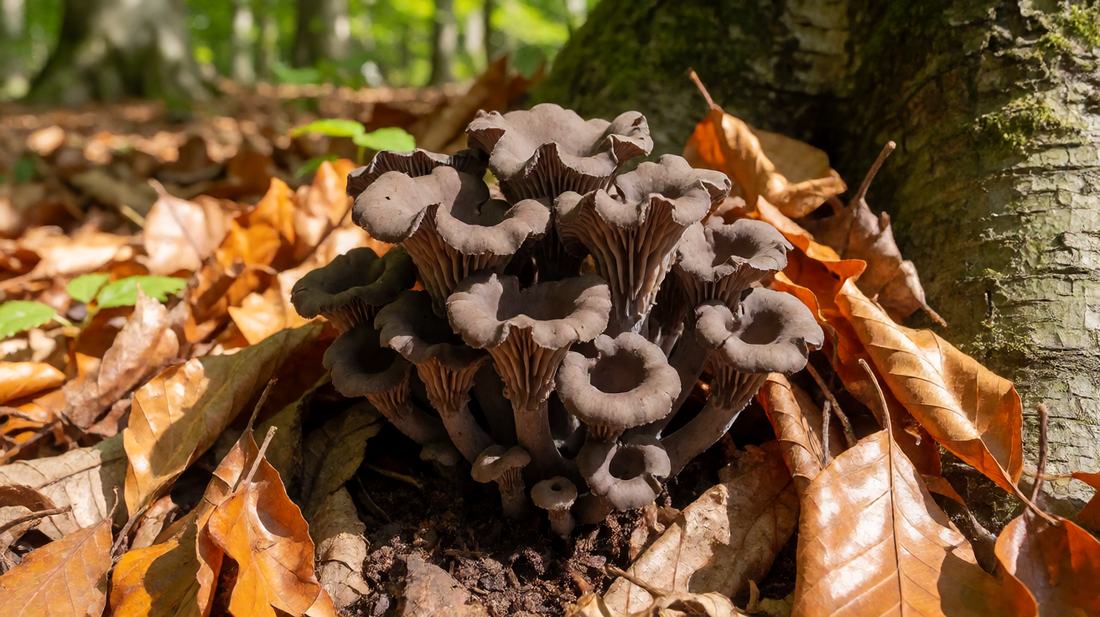
Craterellus cornucopioides | Horn of Plenty
Species Profile · Cantharellaceae
Horn of Plenty
A dark, hollow trumpet of the autumn woodland floor, with no gills, a fruity smell and a French name that means trumpet of death.
A black trumpet with no gills
Height
Gills
Colour
Spores
Season
The black trumpet
Dark, hollow and easy to know
The Horn of Plenty is one of the most distinctive mushrooms of the European autumn. It is almost impossible to confuse with anything dangerous. It grows as a hollow funnel, 3 to 10 cm tall. It is dark grey, sooty brown or almost black. From above it looks like a small black trumpet in the leaf litter.
From the side it looks like a flower pot with a wavy edge. The outer surface carries the fertile layer of the fungus. That surface is smooth or only faintly wrinkled, with no gills at all. The colour and the shape have given the species 2 common names in English. The first, horn of plenty, comes from the old idea of a horn that never runs out of food.
The second, black trumpet, is simply a description. In France it is known as the trumpet of death. That name refers to the colour of the mushroom and not to its effect. It is in fact an excellent edible species. It appears in late summer and autumn in woods of beech, oak and hornbeam.
Family tree
Cantharellales, Cantharellaceae
This mushroom belongs to the phylum Basidiomycota. That group holds the mushrooms and the bracket fungi. It is placed in the order Cantharellales and in the family Cantharellaceae. That is the same family as the chanterelle. The fungi of that family share a simple structure. They do not have true gills.
Instead they carry their spores on a smooth or wrinkled surface. The whole fruit body is built from the same soft tissue. This species is placed in the genus Craterellus. That group holds about 20 species, and they grow in woods and marshes all over the world. Linnaeus first described it in 1753 as Peziza cornucopioides. The name moved later, when its true relatives were found.
The species name means shaped like a horn of plenty, and it describes the mushroom. The fruit bodies of the genus are all thin and hollow. Our species shares its family with the Chanterelle, the golden mushroom that is one of the best known edible fungi of Europe. The chanterelle has a solid body and blunt ridges under the cap. The Horn of Plenty is hollow, dark and smooth. Both are partners of trees.
A funnel with no gills
How to tell one
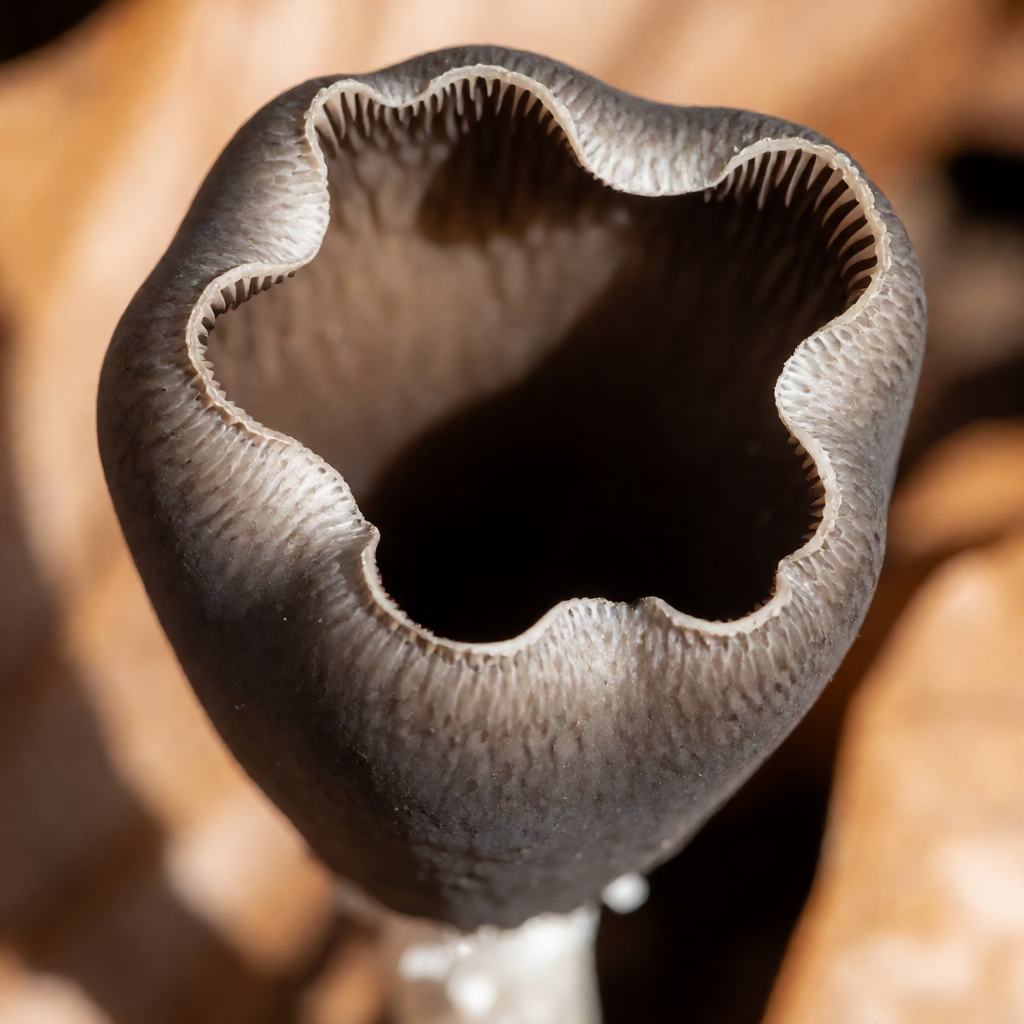
This mushroom has a fruit body 3 to 10 cm tall, and it is hollow from the base to the rim. The stem is short and merges into the funnel. It is joined to the ground by a small tuft of dark threads. The top opens into a wide mouth with a thin wavy edge. The rim is often split and curled. The inner surface of the funnel is dark grey to black.
It is dry and slightly scaly. The outer surface carries the spores. It is smooth or faintly wrinkled, and it is a lighter grey than the inside. There are no gills, no pores and no spines. The flesh is very thin, waxy and grey. It is almost clear when held to the light.
The smell is faint, and it is often described as fruity. The taste is mild and pleasant. The spores are white and smooth. A spore print on white paper is easy to miss, because it is the same colour as the paper. The fruit bodies vary a lot in size. A large one may reach 12 cm in height.
1
2
3
Ancient woodland in autumn
Where it lives
This mushroom grows on the ground in deciduous woodland. It is a fungus of the autumn. It appears from late summer until the first frosts. The best crops come after wet weather in September and October. It favours woods of beech, oak and hornbeam. It is strongly tied to lime rich soils, though it also turns up on more acid ground.
It is most often found in the deep leaf litter of a mature wood. It likes quiet corners where the soil is undisturbed and the trees are old. The mushroom grows in a group. A good site may produce 50 or more fruit bodies in a small patch. It is often hidden under fallen leaves, and the dark colour makes it hard to see. This species is a partner of trees.
Its threads join with the roots and take sugar from them. In return they pass water and minerals back. So the fungus cannot be grown in a field like a crop. Almost all of the mushrooms sold in shops come from wild woods. It is also a good sign of ancient woodland.
A partner of trees
How it feeds
This mushroom does not eat the way an animal does. It takes its sugar from the living trees that it grows beside. It draws water and minerals from the soil with its fine threads. The relationship is a partnership rather than a theft. The tree gives the fungus sugar that it has made in its leaves. The fungus gives the tree phosphorus, nitrogen and water.
It collects these from a much wider area than the roots alone could reach. This arrangement is called a mycorrhiza. It is one of the most important partnerships in a wood. The fungus also has a second way of feeding. Its threads can break down dead leaves and other plant material. That gives it a supply of food that is independent of the trees.
It takes only a small amount of sugar and does not kill its partner. So it can return to the same patch of soil year after year. The mushrooms that people pick are only a small part of the fungus. The real body is the network of threads in the soil.
Spores, knots and fruit bodies
The breeding cycle
This mushroom spreads by spores, and it also spreads through the soil. The fruit bodies appear in the autumn. Each one is covered on the outer surface with a fertile layer that makes millions of spores. The spores are white and smooth, and they are carried away by wind and water. When a spore lands in a good place and meets a thread of the right type, the 2 join.
A new network of threads then begins to grow. The threads find the roots of a suitable tree and form a partnership with them. After that the fungus can grow for years without making a single mushroom. It often lives quietly in the soil for a long time before it fruits. When the conditions are right, the threads gather into a small knot.
The knot then pushes a fruit body up through the leaf litter. The whole process takes only a few days. The mushroom lasts for about a week before it collapses. One site may produce fruit bodies for decades, because the network survives from year to year.
A sign of old woods
Conservation
This mushroom is not at risk at a global level, and it is still common in the older woods of Europe. Its future is tied to the survival of those woods. The main risk is the loss of mature woodland. When a wood is cleared, the network of threads in the soil dies with the trees that feed it. It does not return when the trees are replanted.
A new wood may be 50 years old before it holds the fungi of an old one. Pollution is the second risk. Nitrogen from farm fertiliser and car exhausts is carried into woods by rain. It changes the soil in ways that suit coarse grasses but not the fungi. Acid rain has a similar effect in some areas.
The third risk is the picking of the mushrooms. Taking the fruit bodies by hand does no lasting harm, because the network in the soil is left behind. But careless pickers who rake the litter and break the soil do real damage. The best protection is the protection of old woods with clean air.
Quick hits
Five things to remember
- The French name for this mushroom means trumpet of death, but that describes its dark colour, not any danger.
- It has no gills. Its spores are carried on the smooth outer surface of the funnel.
- It is a partner of living trees rather than a parasite, and it trades water and minerals for sugar from their roots.
- The fruit body appears in a few days and lasts about a week, but the network in the soil can live for decades.
- It is a sign of ancient woodland, and its white spores make a spore print hard to see on white paper.