 By st20113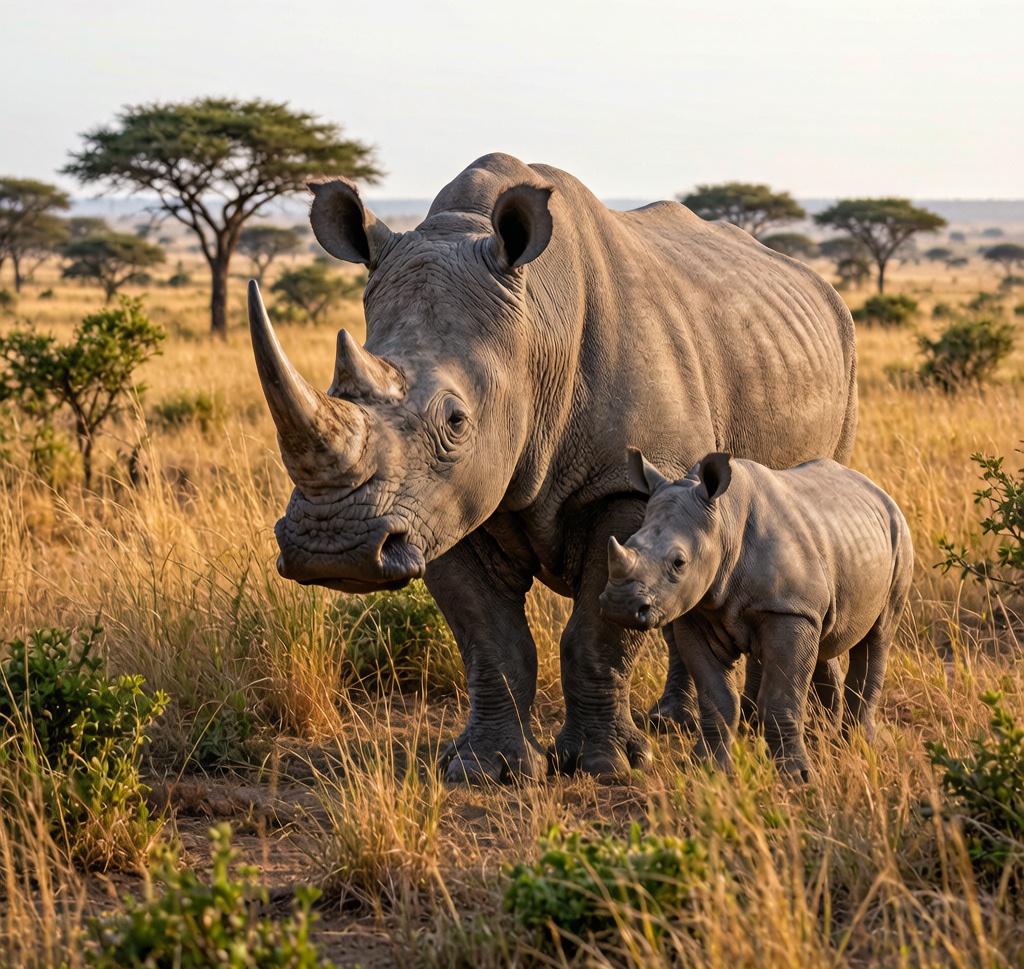
Introduction
The White Rhinoceros (Ceratotherium simum) is the largest living species of rhinoceros and the second-largest land animal after the African Elephant. Despite its name, its skin is pale gray to slate, not white. The common name likely derives from the Afrikaans word wyd, meaning wide, referencing the animal’s distinctive broad, flat snout adapted for grazing. Weighing up to 2,300 kilograms, the white rhinoceros is an ecological heavyweight of African savannas and one of the continent’s most iconic megafauna species.
Taxonomy
The White Rhinoceros belongs to the family Rhinocerotidae and the order Perissodactyla, the odd-toed ungulates that also include horses and tapirs. British zoologist William John Burchell formally described the species in 1817. Two subspecies are recognized: the southern White Rhinoceros (C. s. simum), which recovered from fewer than 100 individuals in the early twentieth century to several thousand today, and the northern White Rhinoceros (C. s. cottoni), now functionally extinct in the wild. The southern subspecies is one of modern conservation’s greatest success stories.
Physical Characteristics
The white rhinoceros is an imposing animal with a massive barrel-shaped body, a large head, and two keratin horns. The front horn is typically the larger, sometimes exceeding 150 centimeters in length. Adults measure up to 4 meters from nose to tail and stand about 1.8 meters at the shoulder. Its broad, flat upper lip is a remarkable adaptation for a grazing lifestyle, allowing the animal to crop grass close to the ground with great efficiency. The skin is thick, up to 5 centimeters in places, and largely hairless.
Habitat
White rhinoceroses inhabit the grasslands, savannas, and open woodlands of eastern and southern Africa, particularly in South Africa, Namibia, Zimbabwe, and Kenya. The species thrives in flat, open terrain with abundant grass coverage and reliable access to water in the form of rivers, wallows, and seasonal pools. Protected reserves such as Kruger National Park and Hluhluwe-iMfolozi Park hold the majority of the global population. Unlike the browsing black rhinoceros, the white rhinoceros is a dedicated grazer of open landscapes.
Diet
As a strict grazer, the white rhinoceros feeds almost exclusively on grasses, consuming up to 120 kilograms of vegetation per day to fuel its massive body. It slices through grass blades with its broad, flat lips, a feeding technique highly efficient in open savanna environments. During the dry season, when grass quality deteriorates, the species travels greater distances to find nutritious forage and may supplement its diet with certain shrubs and herbs.
Reproduction
White rhinoceroses are generally solitary, with mothers remaining close to their calves for extended periods. Females reach sexual maturity at approximately 6 to 7 years of age, while males do not become socially mature and capable of defending a territory until around 10 to 12 years. Gestation is among the longest of any land mammal, lasting roughly 16 months, and results in a single calf. Newborn calves are remarkably active within days and begin nibbling grass almost immediately, though they continue nursing for up to two years.
Conservation
The white rhinoceros faces relentless poaching pressure driven by illegal demand for its horn, which commands prices higher than gold in black markets. The northern subspecies survives only through a dedicated captive breeding program, with just two remaining individuals – both females – inhabiting a protected sanctuary in Kenya. The southern subspecies, while numerically more abundant, remains under constant threat from organized criminal networks. Anti-poaching units, dehorning programs, and community conservation initiatives have stabilized populations in well-managed reserves.
Fun Facts
Despite their enormous bulk, white rhinoceroses are surprisingly fast, capable of reaching speeds of up to 50 kilometers per hour when startled. Each individual has a unique dung scent, which other animals can identify and use to track one another across the landscape. They communicate using dung piles called middens as olfactory signposts, and a variety of vocalizations including snorts, grunts, and bellows. The Black Rhinoceros, its close relative, occupies a different ecological niche as a browser in thicket habitats. The African Lion is one of the few predators that will attempt to take a young rhinoceros calf in the open savanna.