 By st20113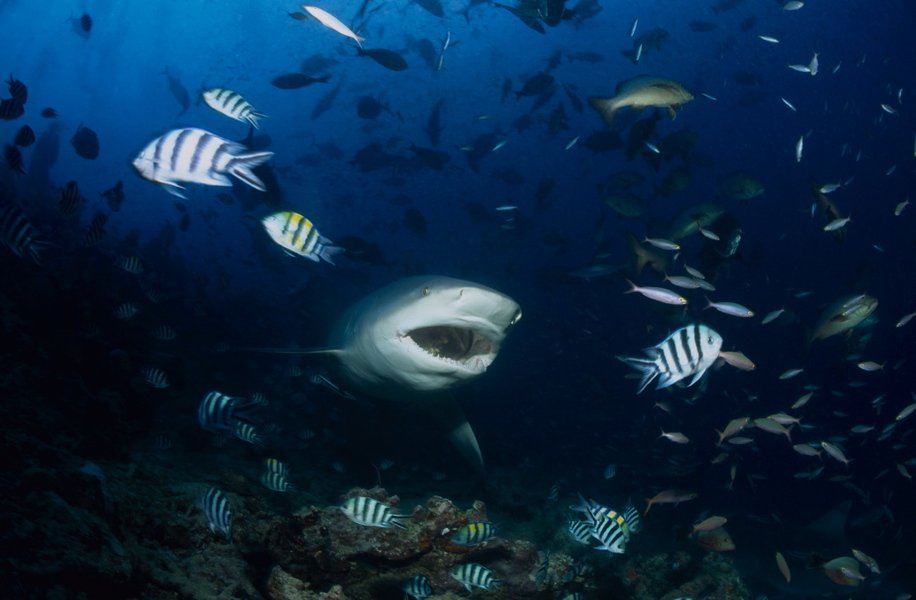
Introduction
The bull shark (Carcharhinus leucas) is a stocky, broad-snouted shark famous for venturing farther up rivers than almost any other shark species. Found in warm, shallow seas along coasts and far into freshwater systems on every continent except Antarctica, it is one of the few sharks that tolerates both salt and fresh water. Its adaptability, aggression, and proximity to human swimmers have made it one of the most discussed large sharks in the world. Its blunt profile and muscular build give it a bulky look that separates it at a glance from the sleeker open-ocean sharks.
Taxonomy
The bull shark belongs to the requiem shark family Carcharhinidae, the same group that includes the great white shark‘s smaller cousins and the tiger shark. Its genus name Carcharhinus means “sharp nose,” while the species name leucas refers to its pale underside. Unlike most sharks, it can regulate the salt balance of its blood, a rare trick that lets it cruise rivers hundreds of kilometers from the sea. Researchers once confused river-caught specimens with unrelated freshwater rays until tissue studies clarified the relationship.
Physical Characteristics
An adult bull shark typically reaches 2.1 to 3.4 meters and weighs 90 to 230 kilograms, with females larger than males. The body is robust rather than streamlined, the snout short and blunt, and the pectoral fins broad. Coloration is grey above fading to a white belly, a pattern that hides the shark from prey above and below. The jaws hold row upon row of triangular, serrated teeth built for shearing rather than gripping. A row of tiny sensory pores behind the head helps the shark detect the faint electric fields of hidden prey.
Habitat
Bull sharks prefer depths of less than 30 meters in bays, estuaries, and river mouths, but they have been recorded more than 3,000 kilometers up the Amazon and as far as 1,100 kilometers up Australia’s Brisbane River. They use turbid, low-visibility water as hunting cover and pupping nursery. This fondness for murky shallows brings it into frequent contact with people. Seasonal flooding can even carry bull sharks into flooded forests, where they hunt among the submerged treetops.
Diet
A bull shark is an unfussy, powerful predator. It eats bony fishes, rays, smaller sharks, sea turtles, dolphins, and crustaceans, and will scavenge when the chance arises. Young bulls in rivers feed heavily on freshwater catfish and turtles. Their wide mouths and crushing bite let them take prey nearly as large as themselves, and they often hunt in packs that drive schools of fish into tight, easy meals. They will also scavenge carrion and discarded offal from boats when the chance arises.
Reproduction
Bull sharks are live-bearing: the female carries her young internally and gives birth to 1 to 13 free-swimming pups after a gestation of about 10 to 11 months. Births happen in sheltered estuaries and river mouths where predators are fewer and food is rich. The pups are independent from birth and grow quickly, though many fall prey to larger sharks and crocodiles in those nursery waters. Mothers return to the same estuaries year after year, a loyalty that makes those habitats critical to local populations.
Conservation
Globally the bull shark is listed as Near Threatened, pressured by commercial and recreational fishing, bycatch, and the loss of coastal nursery habitat. It is also hunted for its fins and meat in some regions. Because it ranges so widely and breeds slowly, local declines can be hard to reverse, and several countries now protect key pupping estuaries. Citizen-science sightings have helped map bull shark movements in several river systems, aiding those protection plans.
Fun Facts
A bull shark can survive in fresh water for years by recycling salts through its kidneys and a special gland near the tail. Its bite force is among the strongest of any shark relative to its size, earning it a reputation as one of the most dangerous sharks to humans. Ancient fishers once blamed the bull shark for attacks far upriver that people assumed could only be caused by crocodiles. Tagged individuals have since been tracked crossing entire ocean basins, proving the species far more mobile than its sluggish look suggests.