 By Iris
Astrapia mayeri | Ribbon-tailed Astrapia
Species Profile · Paradisaeidae
Ribbon-tailed Astrapia
A bird of paradise whose tail ribbons run longer than its body.
Least Concern
Body
Tail
Altitude
Egg
Described
Rating
Described only in 1938
A metre of white ribbon
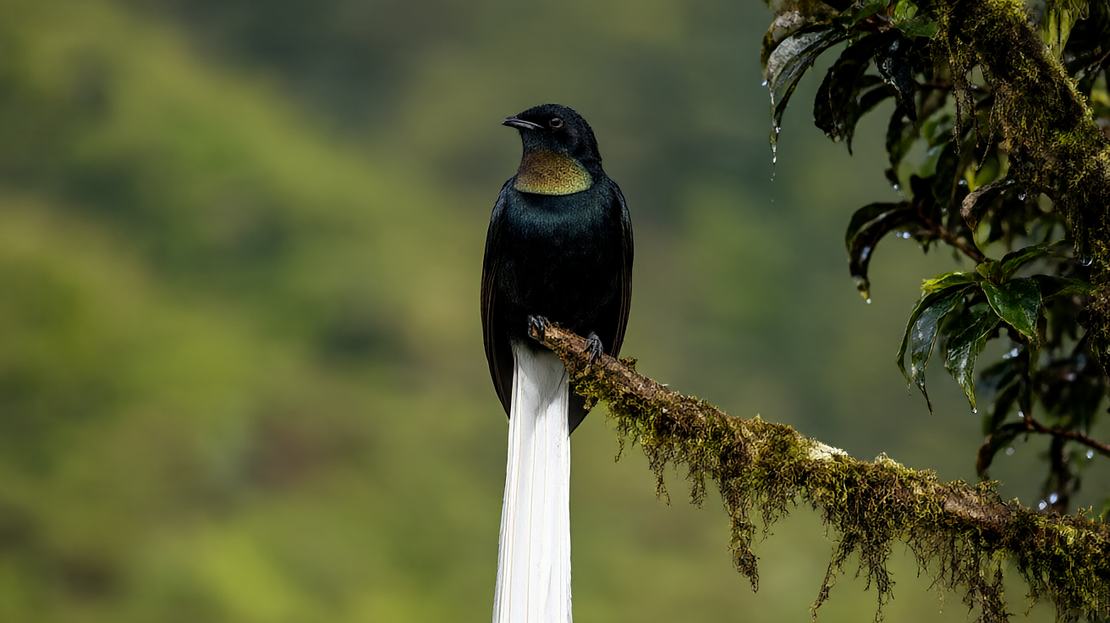
A black bird lands on a mossy limb and lets two white ribbons fall behind it. Those ribbons are tail feathers, and each one grows longer than the bird itself. Males carry the longest tail feathers of any bird, relative to body size. Bodies run about 32 cm, while the ribbons can pass a metre. Ribbon-tailed astrapias live in the highlands of New Guinea, above 1,800 m.
Nobody described the species until 1938, when a collector sent skins to England. Those skins shocked European museums. Nothing like them had been seen before. Females look nothing like the males, and they wear brown barred plumage. Pairs meet only to breed.
Fruit and insects fill most of the diet. The bird spends its life in the canopy. Ground visits almost never happen. Few visitors ever see one, although the display is unforgettable.
Family tree
Paradisaeidae, the birds of paradise
Paradisaeidae covers the birds of paradise, and this species sits inside that family. A Raggiana Bird of Paradise shares the family and much of the same display behaviour. Both males gather in loose groups and call, yet each species carries its own ornaments. Astrapia holds five species, and all of them live in New Guinea.
Hybrids turn up where two species meet, which complicates the picture. Bird of paradise males grow strange feathers from every part of the body, and the family shows more variety in plumage than any other group of birds. Feathers sold for hats nearly ended several species in the early twentieth century, since a single hat could carry a dozen plumes. Protection arrived in the 1920s, and the trade in wild plumes stopped, although the damage had been done.
Taxonomy here rests on feathers as much as on bones. Females and young males look alike, which caused confusion for years, because a brown bird tells nothing about its age. Field guides now show the female plate beside the male. Names honour nineteenth century collectors more often than they honour biology.
One family, many ornaments
How to tell one
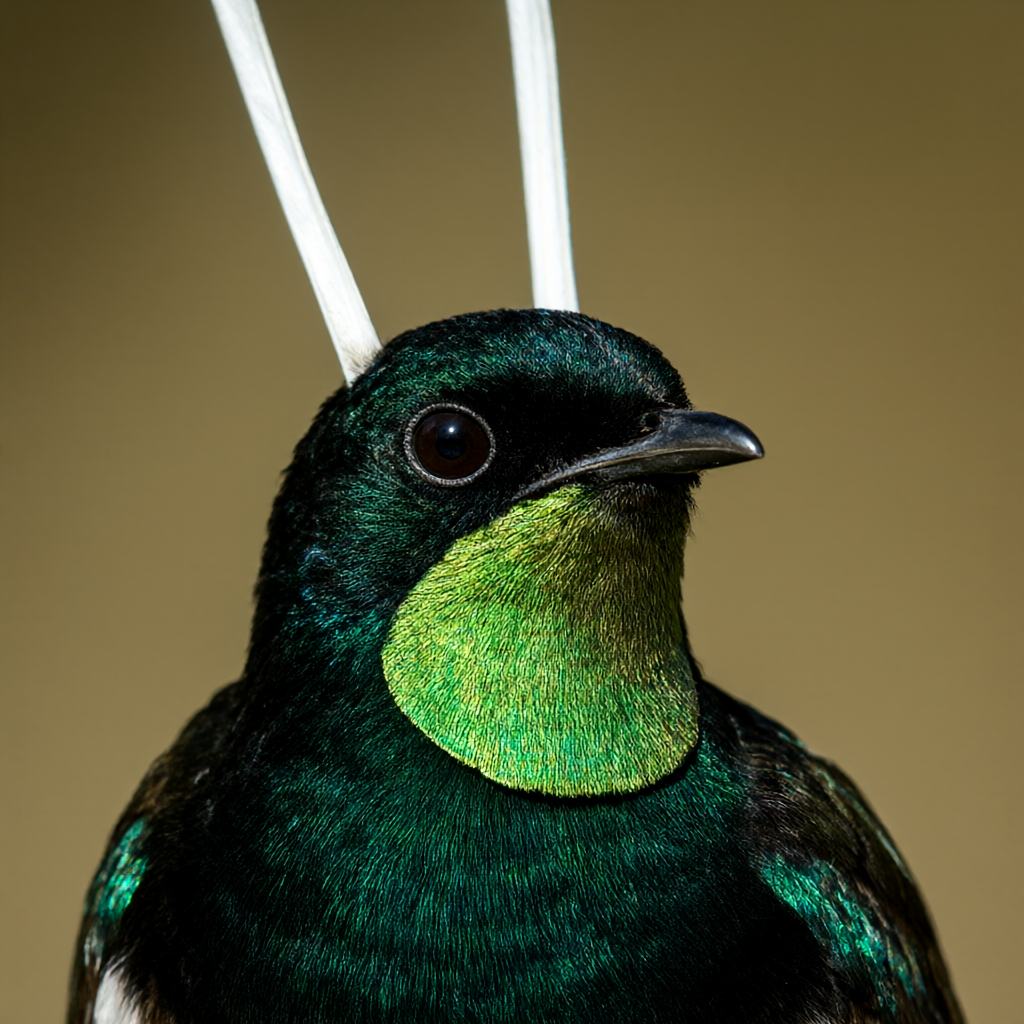
Male plumage looks velvet black, with green and blue flashes in the light. A bronzed green shield covers the throat and the upper chest. Two central tail feathers grow into white ribbons, and each carries a dark tip. Those streamers stay white because the feathers lack pigment. Females wear brown plumage with dark bars across the chest.
Tail feathers on a female stay short, which suits a bird that nests alone. Bill shape stays slender, and it works for fruit and for insects. Feet grip branches firmly, and the bird hangs upside down to feed. Wings manage short flights well. The bird never crosses open sky.
Display feathers take months to grow, and a male in poor condition loses them. Eyes sit dark against black plumage, which makes the head hard to read. Skin around the eye stays bare on some males.
1
2
3
Black plumage, white ribbons
Where it lives
Montane forest covers the ridges of the central highlands. Moss hangs from every branch, since the air stays wet through the year and the cloud rarely lifts. Tree ferns fill the understorey, and they give cover below the canopy. Altitudes between 1,800 and 3,000 m hold most birds, although that line shifts with the weather. Above that line the forest thins into shrub, and the bird disappears.
Cloud sits on the ridge for much of the day. Rain falls in most months. Moss holds water like a sponge. Forest clearance for gardens removes the lower slopes. Hunting for plumes has stopped, although hunters still take birds for food in places where no patrol reaches.
Roads now cut the highlands, and they open forest to settlement, although the ridges stay hard to reach. Patches of forest stay linked along ridgelines, and birds move through those links. A cleared valley can split a group in two for decades, since the bird refuses to cross open ground.
Mossy ridges of New Guinea
What it eats
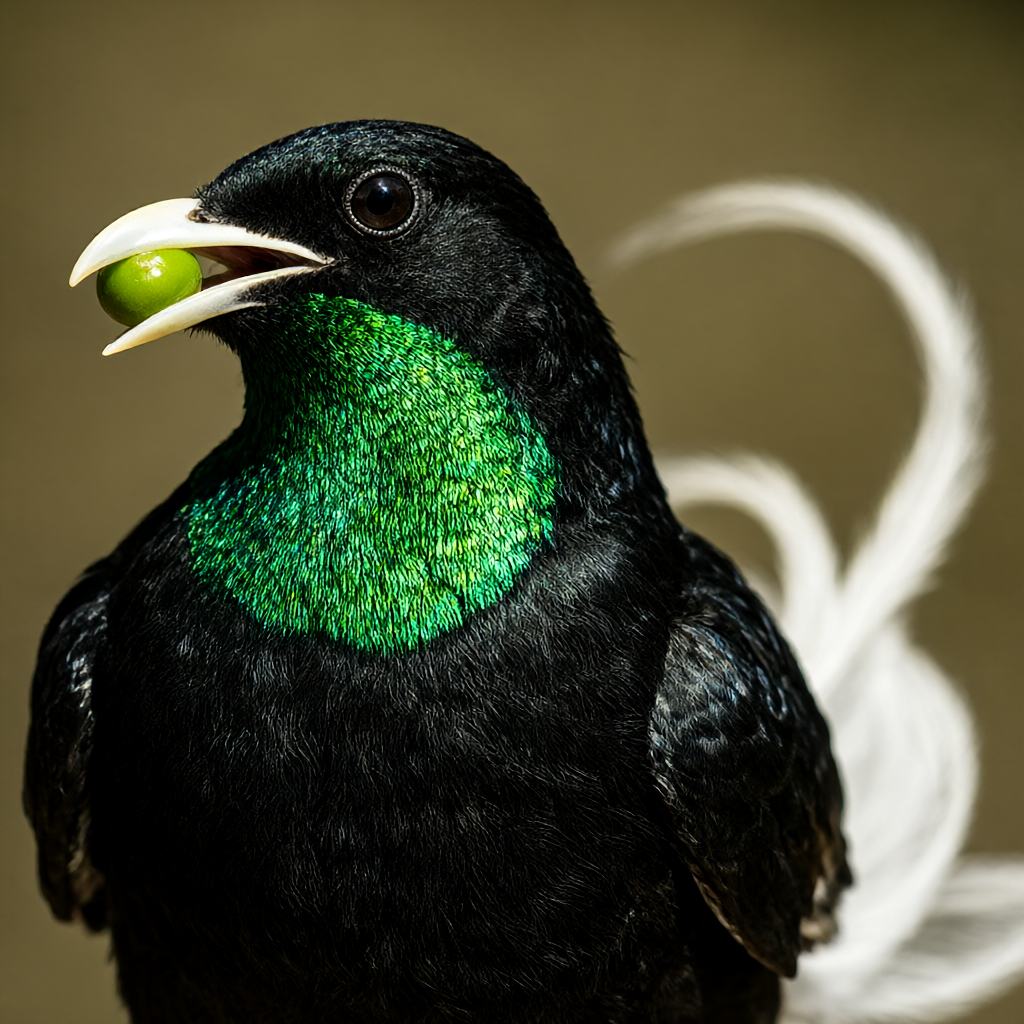
Fruit forms the main food, and forest figs rank first. Insects supply protein, especially for young birds and for females with eggs. Feeding happens in the canopy, and the bird rarely drops below it. A fruiting tree draws several birds at once, yet they feed without much fighting.
Males leave the fruit trees to females and to young birds during the display season. Spiders and beetles get taken from bark and from moss. Water comes from fruit and from wet leaves. Feeding stops in the middle of the day, when the forest goes quiet and the heat builds.
Birds follow fruiting trees across a home range that can cover a whole ridge. Mixed flocks sometimes form at a heavy crop, while young birds watch the adults. Food shortage rarely hits the species, since figs fruit through the year. Young birds learn which trees to visit by following adults.
Figs and insects
The breeding cycle
Males gather at traditional display sites and call through the morning. Each male clears a small stage on a branch and calls from it. A female visits, watches, and then chooses. Nesting falls entirely to the female.
She builds a cup nest of moss, ferns and vine, and hides it in a tangle. One egg is usual, and sometimes two. Incubation runs about three weeks. The female feeds the chick alone, and the male plays no part.
Young birds leave the nest after about a month. Males take years to grow the full plumage, and they look brown for the first seasons, so early attempts at display fail. A male may live twenty years, which gives him many chances to breed. One chick a year cannot replace a heavy loss of adults.
Least Concern, and range bound
Conservation
IUCN lists the species as Least Concern. The range stays small, and the whole world population sits in one mountain chain. Forest clearance for gardens removes habitat along the lower slopes. Hunting for food continues in some districts, although plume hunting has ended. Climate change may push the cloud line higher, since the bird needs cool, wet forest.
Protected areas cover a large share of the range, and patrols stay light. Local communities now run some of the reserves, which helps. Birdwatchers bring income to a few valleys. Roads bring the main risk. They open country that hunters could not reach before.
Long term survival depends on the forest holding together, because a bird of this size needs a wide home range. Numbers remain hard to count, since birds stay hidden in the canopy. Surveys now use recordings, and those calls carry far through the moss.
Side by side
How It Compares
| Trait | Ribbon-tailed Astrapia | Raggiana Bird of Paradise |
|---|---|---|
| Length | 32 cm body, ribbons past a metre | 34 cm body |
| Plumage | black and olive with white ribbons | red flank plumes |
| Home | highland forest above 1,800 m | lowland and hill forest |
| Diet | fruit and insects | fruit and insects |
| Habit | male fans the tail in a display | males gather at a lek |
| Rating | Least Concern | Least Concern |
Common misreadings
What People Get Wrong
- Most people expect a bird of paradise to be red, yet this one wears black and olive.
- Early collectors cut the ribbons for hats, although the trade has been closed for decades.
- Popular photos show the tail straight down, though males fan it sideways during a display.
Going further
Sources and Further Reading
Quick hits
Five things to remember
- Males carry the longest tail feathers of any bird for their size.
- Science described the species only in 1938.
- Females wear brown barred plumage.
- A display stage gets cleared on the same branch each year.
- One egg is usual, and the female raises it alone.