 By st20113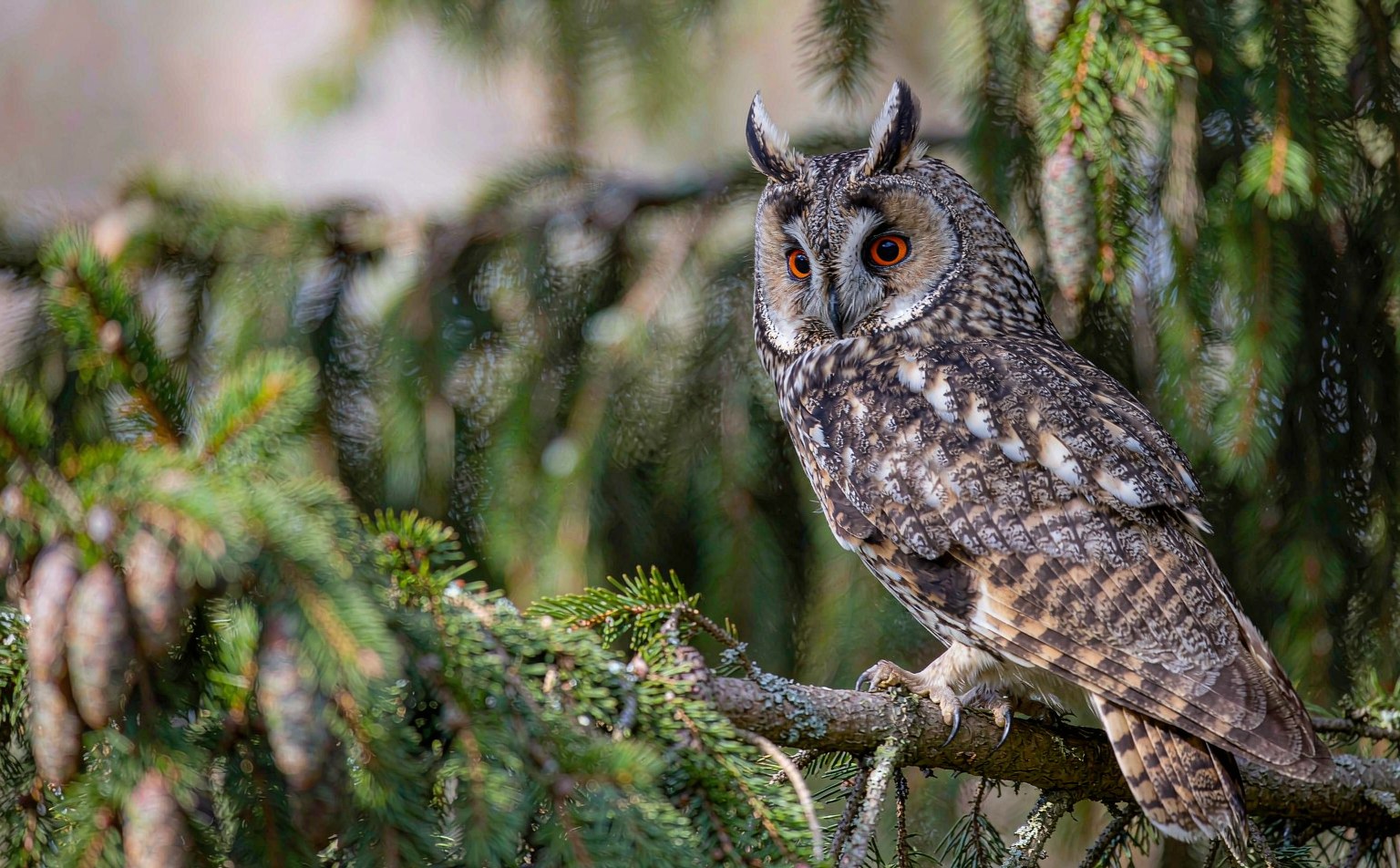
Asio otus | Long-eared Owl
Introduction
The Long-eared Owl (Asio otus) is a secretive, nocturnal bird of prey that spends the day roosting motionless among dense conifer foliage, where its streaky plumage and long, upright ear-tufts make it almost invisible. Slightly built and narrow-faced, it is one of the most widespread owls of the northern hemisphere, yet it is seldom seen because of its crepuscular habits and preference for thick cover.
More social than most owls, it often roosts in small groups in winter and nests in the old stick nests of other birds rather than building its own. It shares the night skies with relatives such as the Tawny Owl, though the long-eared owl is the more strictly nocturnal and forest-dwelling of the two.
Taxonomy
The Long-eared Owl belongs to the genus Asio, a group of eared owls with prominent facial discs and ear-tufts, within the family Strigidae, the typical owls. It was first described by the Swedish naturalist Carl Linnaeus in 1758 under the binomial Strix otus, and later moved to Asio. The genus name is Latin for a type of eared owl, and otus also means “eared”, referring to the tufts that are actually feathers rather than true ears.
Its closest relatives include the short-eared owl and the African and Asian eared owls, all of which hunt in a similar quartering style over open ground at dusk. Unlike the round-headed Strix owls such as the tawny owl, Asio owls have a more cat-like, narrow face and prominent tufts used in displays and camouflage.
Physical Characteristics
An adult Long-eared Owl measures 31 to 40 centimetres in length, with a wingspan of 86 to 100 centimetres and a weight of 160 to 430 grams, the female being noticeably larger. The plumage is a finely barred and streaked mixture of buff, rufous, and dark brown, providing superb camouflage against bark and branches.
The most striking features are the long, black-bordered ear-tufts, which the bird can raise or flatten, and the bright orange-yellow eyes set in a pale, heart-shaped facial disc. The bill is dark and hooked, and the feathered legs and toes are buff with dark barring. In flight the species shows long, narrow wings and a buoyant, moth-like quartering flight, quite different from the heavy flap of a tawny owl.
When alarmed, the long-eared owl elongates its body and compresses its feathers, becoming a slender, branch-like shape that is extraordinarily hard to detect. This posture, combined with the tufts, breaks up the outline and confuses predators.
Habitat
Long-eared Owls breed in woodland of all kinds, especially mixed and coniferous forests with nearby open ground for hunting. They are dependent on the old nests of other birds, particularly those of crows, magpies, and squirrels, which they use instead of building their own. Dense plantations, shelterbelts, and even urban parks with mature trees can support them if roosting cover is available.
Outside the breeding season they may wander to more open habitats such as reed beds, hedgerows, and farmland, and in winter they gather at communal roosts in thick evergreens, sometimes numbering dozens of birds. The species avoids treeless steppe and intense urban centres, needing both hunting openness and safe, concealed daytime perches, much like the broader guild that includes the Common Buzzard.
Diet
The Long-eared Owl is a specialist mammal hunter, feeding mainly on small rodents. Voles are the staple wherever they are abundant, with mice, shrews, and young rats taken as available. Birds are caught only occasionally, usually small passerines caught near roosts or in harsh weather.
Hunting takes place at dusk, at night, and before dawn, the owl quartering low over fields and grasslands with silent, buoyant flight, locating prey by sound as much as by sight. Like its larger cousin the Eurasian Eagle-Owl, it swallows small prey whole and regurgitates compact pellets of bone and fur, which accumulate beneath roosts and reveal its diet.
Reproduction
Long-eared Owls do not build nests but take over abandoned stick nests in trees, often those of crows or magpies, and occasionally use hollows or cliff ledges. The female lays four to six white eggs and incubates them alone for about 25 to 30 days while the male brings food. Eggs are laid at intervals, so chicks of different sizes share the nest.
The young fledge at roughly five to six weeks but remain near the nest, clambering through branches, for some time afterward. Because the species depends on the nests of other birds, its breeding density follows the availability of those structures and the abundance of voles. Poor rodent years lead to low breeding success and widespread movement in search of better hunting.
Conservation
The Long-eared Owl is listed as a species of Least Concern by the International Union for Conservation of Nature, with a vast range across the northern continents and a population that is generally stable. It is, however, locally sensitive to the loss of mature woodland, the removal of old nests, and the use of rodenticides that thin its prey base.
Being nocturnal and inconspicuous, the species is easily undercounted, and monitoring relies heavily on winter roost counts. Conservation measures that help it include retaining mature trees with old nests, maintaining rough grassland for voles, and limiting disturbance at roost sites. It shares its reliance on healthy woodlands with the Barn Owl, another nocturnal hunter vulnerable to habitat change.
Fun Facts
- The long “ears” are feather tufts, not ears; the real ears are hidden openings on the sides of the head.
- When threatened, the owl stretches upward and narrows its body to mimic a broken branch or tree stub.
- Long-eared owls often roost in tight winter groups, sometimes dozens of birds packed into one conifer.
- They rarely build their own nests, preferring the abandoned stick nests of crows, magpies, and squirrels.
- Their silent flight and keen hearing let them catch voles in total darkness using sound alone.
[…] contains the eared owls. These birds share a slim build and long wings. A close relative is the Long-eared Owl. That species lives in the same parts of […]