 By st20113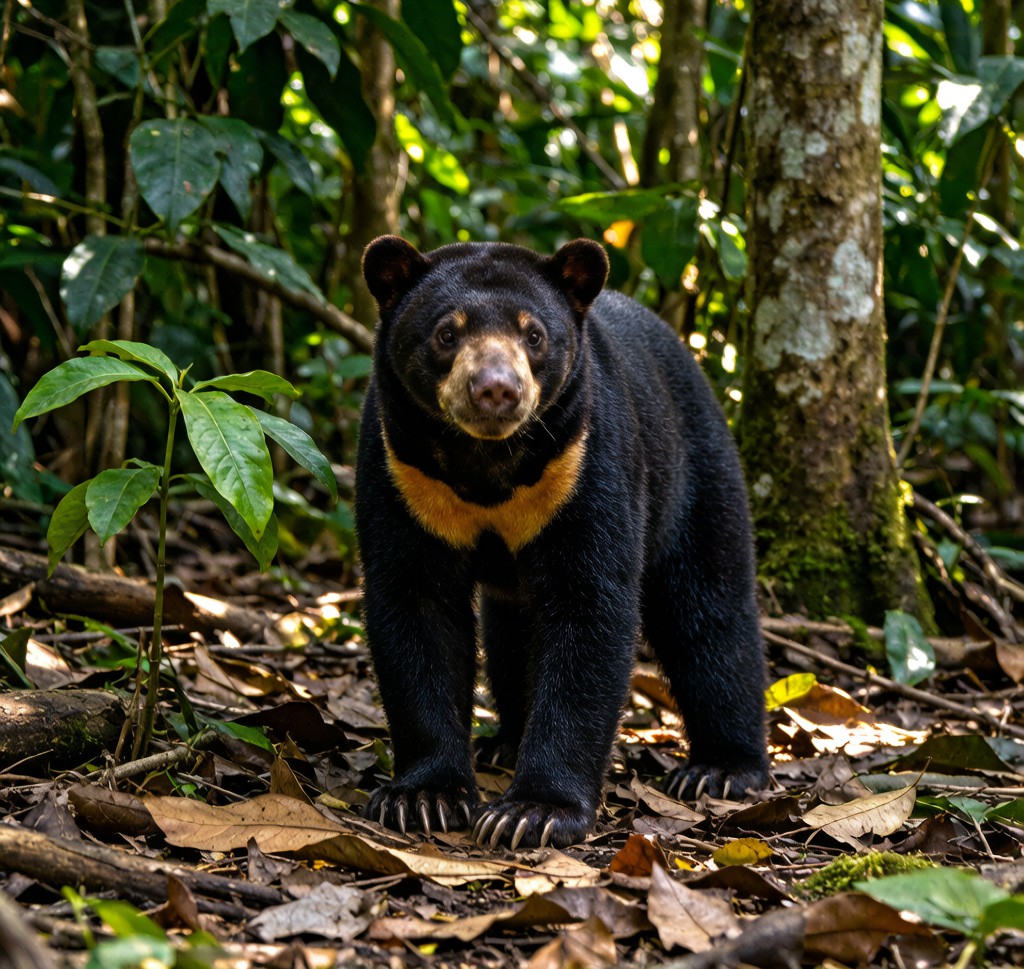
A Sun Bear (Helarctos malyanus) standing in the tropical rainforest of Southeast Asia, displaying its distinctive golden-orange chest patch
Overview
The Sun Bear (Helarctos malyanus) is the smallest of the world’s eight bear species and one of the most distinctive. Found in the tropical forests of Southeast Asia – from Bangladesh and southern China in the north to the islands of Borneo and Sumatra in the south – the Sun Bear is uniquely adapted to life in the rainforest canopy, spending significant amounts of time climbing trees where it builds sleeping platforms in the forest crown. Standing approximately 70 centimeters at the shoulder and weighing 25 to 65 kilograms, the Sun Bear is a small, stocky bear with short sleek black fur and one of the most striking fur markings in the animal kingdom: a golden-orange to creamy-white chest patch in the shape of a crescent or horseshoe, which gives the species its common name.
The Sun Bear’s short, sleek fur – an adaptation to the hot, humid tropical environment – is distinctive among bears, most of which have thick, long fur suited to cold climates. The species is also unusual among bears in that it does not hibernate, as tropical forests do not have the seasonal food shortages that trigger hibernation in temperate and Arctic bear species. The Sun Bear is almost entirely nocturnal and highly arboreal – an unusual combination for a bear – and its large, curved claws allow it to climb trees with remarkable agility, often ascending to heights of 7 meters or more to access fruit or build sleeping platforms.
Habitat and Distribution
The Sun Bear occurs throughout the tropical forests of Southeast Asia, from southern China (where it occurs in Yunnan and Sichuan provinces) and eastern India (Assam), through mainland Southeast Asia (Myanmar, Thailand, Laos, Cambodia, Vietnam, and Malaysia) to the islands of Borneo and Sumatra. The species is largely restricted to lowland and montane tropical rainforest, and is increasingly associated with areas of intact, old-growth forest as populations in degraded and secondary forest decline.
Sun Bears are highly sensitive to deforestation and are among the first large mammals to disappear from forest fragments. The species requires large areas of continuous forest – individual bears may maintain home ranges of up to 22 square kilometers – and isolated populations in fragmented forest patches are highly vulnerable to local extinction. The clearance of tropical rainforest for palm oil production, pulpwood plantations, and agricultural expansion has been the primary driver of Sun Bear population declines across their range. The species is also widely hunted – both for its meat and for its body parts, which are used in traditional medicine – and cub smuggling for the illegal pet trade is a significant additional pressure.
Diet and Role in the Ecosystem
The Sun Bear has one of the most diverse diets of any bear species, reflecting the year-round availability of tropical forest fruits and insects. The species is an opportunistic omnivore that feeds on a wide variety of food items including tropical fruits (particularly figs, durians, and other forest fruits), insects (especially termites, beetle larvae, and bees), honey, small vertebrates, and carrion. Research using camera traps and scat analysis has documented Sun Bears feeding on over 140 different food items, making them one of the most eclectic large mammals in the Asian rainforest.
Sun Bears play a critical role as seed dispersers in the tropical forest ecosystem. By consuming large quantities of fruit and dispersing the seeds through their scat, they contribute to forest regeneration and maintain the genetic diversity of tropical tree populations. The species is also a significant predator of social insects including termites, whose colonies it excavates with its powerful claws – a feeding behavior that creates small disturbance gaps in the forest floor and may contribute to soil aeration and nutrient cycling. The Sun Bear’s association with figs and other keystone fruit trees makes it a particularly important contributor to forest ecosystem function.
Conservation
The Sun Bear is listed as Vulnerable on the IUCN Red List, with populations declining throughout its range. The primary threats are deforestation for agriculture (particularly palm oil), illegal hunting for meat and body parts, and the capture of cubs for the illegal pet trade. The Sun Bear’s reliance on large areas of intact tropical forest makes it particularly vulnerable to the rapid and ongoing forest loss that characterizes Southeast Asia, which has among the highest deforestation rates in the world.
Conservation efforts for the Sun Bear include the protection of large areas of tropical forest within the national park networks of range countries, efforts to reduce hunting through law enforcement and community engagement, and the rescue and rehabilitation of orphaned cubs confiscated from the illegal wildlife trade. Bear-friendly agricultural practices – including the maintenance of forest corridors between palm oil plantations and reduced-use of pesticides that eliminate bear food sources – are increasingly recognized as important for the species’ long-term survival. The Sun Bear is also a flagship species for the conservation of Southeast Asian tropical forests, and its protection benefits the extraordinarily diverse communities of other species that share its habitat.