 By st20113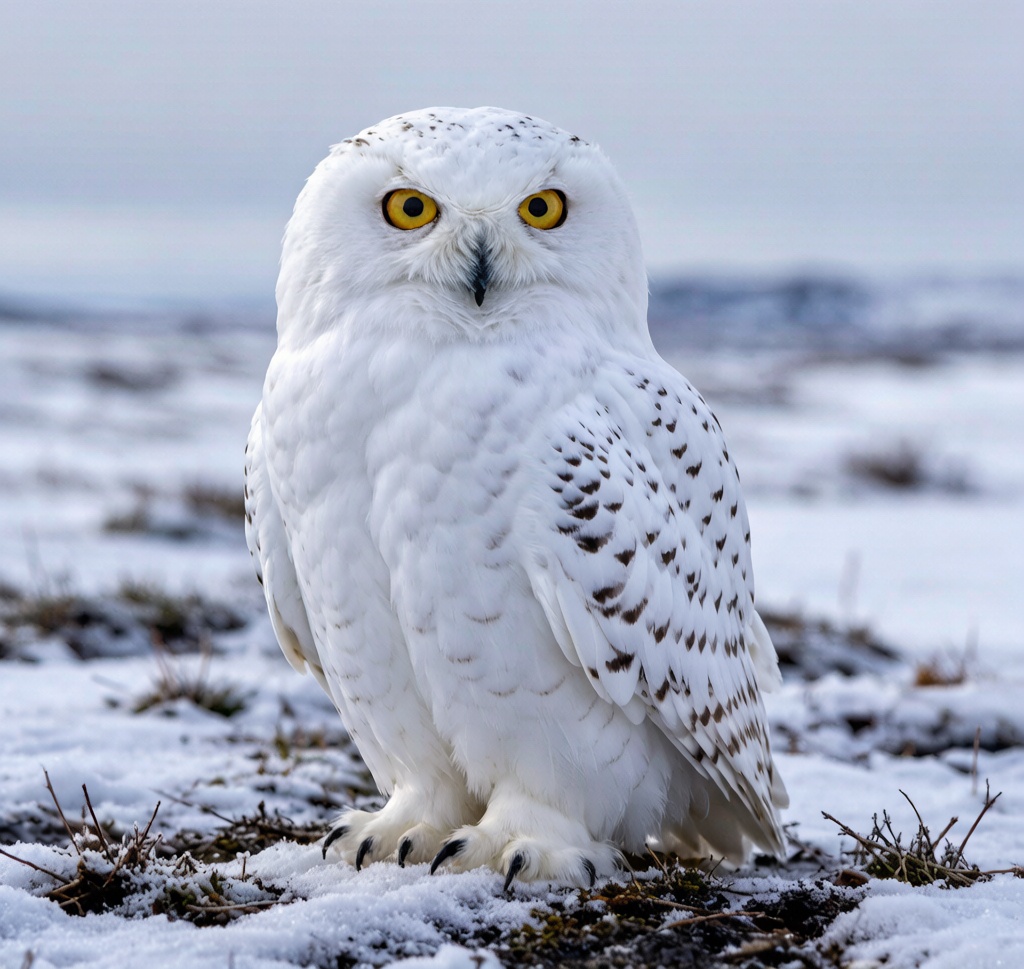
The snowy owl (Bubo scandiacus) is a large, majestic bird of prey that embodies the stark beauty of the Arctic tundra. Distinguished by its brilliant white plumage — which makes it one of the most visually striking of all owl species — the snowy owl is the heaviest owl in North America and the second heaviest in the world, surpassed only by the Eurasian eagle-owl. Unlike most owls, which are predominantly nocturnal, the snowy owl is a diurnal predator, adapted to the continuous daylight of Arctic summers. Its populations undergo dramatic fluctuations in response to the availability of its primary prey, the lemming, leading to periodic winter irruptions in which large numbers of owls migrate far south of their typical range.
## Physical Characteristics
The snowy owl exhibits striking sexual dimorphism in its plumage. Adult males are predominantly pure white, with少数个体 developing small dark markings as they age, and by old age, many males are nearly entirely white. Females and juveniles, by contrast, retain bold black barring throughout their lives, particularly on the wings, tail, and back. Both sexes possess bright, intensely yellow eyes — striking against their white plumage — and a black beak. The legs and toes are heavily feathered, an adaptation to minimize heat loss in extreme cold. The plumage is exceptionally dense, providing insulation against temperatures that can fall below minus 40 degrees Celsius. Adult snowy owls measure 52 to 71 centimeters in length, with a wingspan reaching 126 to 188 centimeters, and weigh between 1.6 and 3 kilograms.
## Habitat and Distribution
The snowy owl is a circumpolar species, breeding primarily in the Arctic tundra regions of North America, from Alaska and northern Canada across to Greenland, Scandinavia, and Siberia. Its breeding habitat is characteristically open, flat tundra with low vegetation — mosses, lichens, and small shrubs — where elevated perches provide views of the surrounding landscape for hunting. During non-breeding seasons and during irruption years, snowy owls are found in a wider range of open habitats, including coastal dunes, airports, agricultural fields, prairies, and the edges of frozen lakes and marshes, often perching on the ground or on low structures.
## Diet and Hunting
The snowy owl is an opportunistic carnivore with a strong preference for lemmings — a small tundra rodent that constitutes the vast majority of its diet during the breeding season. An adult snowy owl may consume more than 1,600 lemmings per year, and breeding success is directly tied to lemming population cycles. When lemmings are scarce, the owl switches to alternative prey including voles, hares, ducks, geese, ptarmigan, and fish. Hunting is conducted from elevated perches — or from the ground in treeless tundra — where the owl watches and listens for prey before swooping down with wings outstretched to capture quarry with its powerful talons. The bite force of a snowy owl is sufficient to break through the thick skull of a hare.
## Reproduction
Snowy owls are monogamous and breed annually, though breeding is skipped during years of low lemming abundance. Males establish territories and perform aerial displays and calling to attract females. The nest is a simple scrape on an elevated mound or ridge, lined with bits of vegetation and owl feathers. The female lays a clutch of three to 11 eggs — the largest clutch size of any raptor — and incubates them for approximately 32 days while the male provides food. The young hatch asynchronously and are covered in white down, developing juvenile plumage within weeks. Both parents feed and protect the young, which begin to fly at approximately 50 days old.
## Conservation
The snowy owl’s vast remote range provides some protection, but climate change poses a significant and growing threat. Arctic warming disrupts lemming population cycles, reduces suitable breeding habitat, and may alter migration patterns. The species is listed as Vulnerable globally, and particular concern exists for thedensifying populations at the southern edge of the range.
[…] form a significant portion of its non-breeding diet, while during breeding it actively hunts rodents, hares, and small antelopes. Its most celebrated prey is snakes — including puff adders, cobras, […]