 By st20113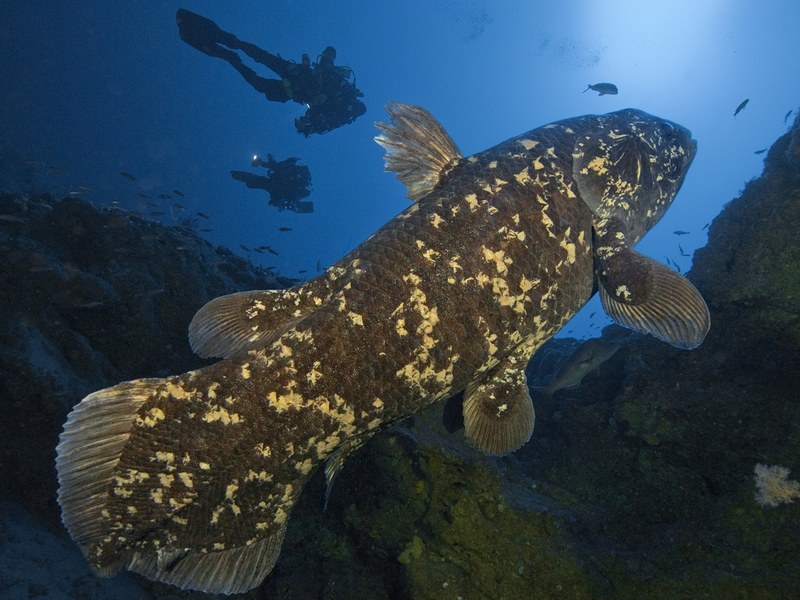
Introduction
The coelacanth (genus Latimeria) is a group of ancient lobe-finned fish that holds a unique place in the history of biology as a ‘living fossil’—a surviving member of a lineage thought to have been extinct for 66 million years until its dramatic rediscovery in 1938. Comprising two extant species—the West Indian Ocean coelacanth (Latimeria chalumnae) and the Indonesian coelacanth (Latimeria menadoensis)—the coelacanth belongs to the order Coelacanthiformes and the larger class Sarcopterygii, the lobe-finned fishes, which also gave rise to all tetrapods (four-limbed vertebrates including humans). The coelacanth’s discovery is considered one of the most remarkable zoological events of the twentieth century, demonstrating that lineages thought lost to deep time can survive in isolated refugia.
Physical Characteristics
Coelacanths are large, robust fish reaching 1.2–2 metres (4–6.5 feet) in length and weighing 30–90 kilograms (65–200 pounds). Their body is covered in a distinctive armour of heavy,阶梯状 (ladder-like) cosmoid scales—thick, bony, enamel-like scales found in no other living fish. The most taxonomically significant feature is their fleshy, limb-like paired fins (pectoral and pelvic), which articulate with the body through a single bony element, mirroring the structure of tetrapod limbs and providing strong evidence of the evolutionary link between fish and land vertebrates.
The tail fin is distinctive: it bears a third lobe extending beyond the midline, a three-lobed or ‘ protocercal’ configuration unique among living fish. The coelacanth also possesses a vestigial, gas-filled notochord (a flexible rod that in embryos develops into the spinal column), and an intracranial joint—a hinged joint in the skull that allows the front of the head to be raised, thought to aid in swallowing large prey. Their eyes are large and light-sensitive, adapted for the dark depths. Coloration is a deep blue-grey to brown with irregular white flecks that help the fish blend against rocky deep-sea substrates; the fleck pattern is unique to each individual, functioning as a natural identifier.
Habitat and Distribution
The West Indian Ocean coelacanth (L. chalumnae) is found in the western Indian Ocean, particularly around the Comoro Islands (Comoros), off the coasts of Kenya and Tanzania, in the Mozambique Channel, and off South Africa’s southern coast near the False Bay area at depths of 150–700 metres. The Indonesian coelacanth (L. menadoensis) was discovered in 1997 near Sulawesi and is found throughout the western Pacific, from the Philippines to New Caledonia. In both species, individuals shelter in underwater caves and lava tubes during daylight hours, emerging at night to hunt in the open water column of the deep mesopelagic zone.
The ocean depths inhabited by coelacanths are cold (typically 10–18 °C), dark, and under immense pressure. These environments are thermally stable but subject to strong currents in some areas. The species is extremely sensitive to temperature and has been documented making vertical movements in the water column in response to subtle thermal changes, occasionally ascending to shallower depths of 90–150 metres at night.
Behaviour and Diet
Coelacanths are slow-growing, long-lived fish with generation times estimated at 20–60 years. They are ambush predators, drifting passively in the deep water or resting in caves during the day, then moving into open water at night to hunt. Their diet consists primarily of fish, squid, and cuttlefish, with smaller fish and crustaceans making up the remainder. Their unique intracranial joint allows them to open their mouths wide to create strong suction, drawing prey into the buccal cavity before swallowing it whole.
Social structure is poorly understood, but coelacanths appear to be largely solitary, with individuals occasionally aggregating near caves or in areas of upwelling. Tracking studies have shown that individual fish occupy relatively small home ranges and return repeatedly to the same caves. Their swimming style is unique: they use a sinusoidal movement of their dorsal and anal fins to propel themselves, giving the impression of ‘walking’ through the water rather than conventional fish swimming. They are buoyant neutral, with a unique fatty organ that replaces the swim bladder found in most fish, allowing them to hover effortlessly at depth without expending energy on buoyancy control.
Evolutionary Significance
The coelacanth holds a singular place in vertebrate phylogeny. As a lobe-finned fish (Sarcopterygii), it is more closely related to tetrapods (amphibians, reptiles, birds, and mammals) than to any ray-finned fish. Fossil coelacanths first appear in the geological record in the Middle Devonian (approximately 390 million years ago) and were diverse and abundant through the Carboniferous and Permian periods. By the end of the Cretaceous (66 million years ago), the coelacanth fossil record shows a sharp decline, and the group was presumed extinct alongside the non-avian dinosaurs.
The discovery of a living coelacanth by South African museum curator Marjorie Courtenay-Latimer in 1938—a specimen pulled from a fishing trawler’s nets off the coast of East London, South Africa—was one of the most astonishing zoological finds in modern history. The fish was identified by ichthyologist J.L.B. Smith as a member of an ‘extinct’ group. Subsequent deep-sea exploration has revealed healthy populations in several locations, fundamentally reshaping scientific understanding of deep-sea biodiversity and the concept of ‘living fossils’—organisms that have survived with minimal apparent morphological change over tens of millions of years.
Conservation Status
The West Indian Ocean coelacanth (L. chalumnae) is classified as Critically Endangered by the IUCN, with population estimates suggesting fewer than 1,000 individuals in total. The Indonesian coelacanth (L. menadoensis) is classified as Vulnerable. Both species face significant threats from accidental bycatch in deepwater fisheries, particularly demersal trawl and longline fisheries that operate in the same depth ranges as coelacanth habitat. Their extremely slow growth rate, late sexual maturity (approximately 20 years), and low reproductive output make populations extremely vulnerable to even low levels of direct or indirect mortality.
Conservation measures include the creation of marine protected areas around known coelacanth aggregation sites, fishing restrictions in key habitat zones, and international trade controls under CITES Appendix I. Ongoing deep-sea surveys using remotely operated vehicles (ROVs) continue to expand knowledge of coelacanth distribution, behaviour, and population structure, providing the data needed for evidence-based conservation planning.