 By st20113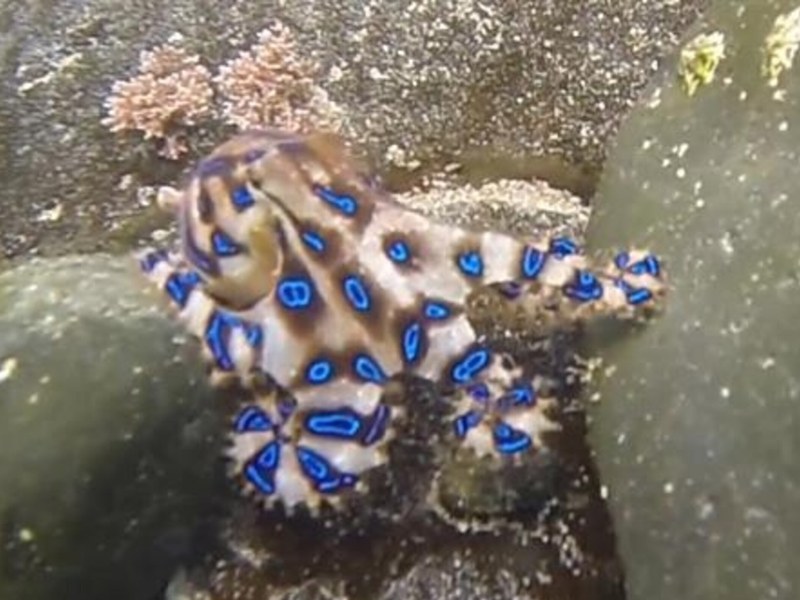
Introduction
The blue-ringed octopuses are a genus (Hapalochlaena) of four highly venomous octopus species inhabiting tide pools and shallow coral reefs across the Indo-Pacific region. Despite their small size—typically no larger than a golf ball—their bodies contain enough tetrodotoxin (TTX), a potent neurotoxin, to kill 26 adult humans within minutes. Their name derives from the vivid iridescent blue rings that appear across their body and arms as a dramatic warning display when the animal feels threatened. Found from Japan and Australia to the Philippines and the Indian Ocean, these octopuses are among the most dangerous venomous marine invertebrates in the world, though they are docile unless handled or cornered.
Physical Characteristics
Blue-ringed octopuses are among the smallest octopus species, with a mantle typically measuring 5–10 centimetres (2–4 inches) in length and a total span of 10–20 centimetres (4–8 inches) including the arms. Their soft, sac-like mantle is globular and lacks a rigid shell, as with all octopuses. Their eight sucker-lined arms are relatively short and equal in length. The base colouration is a dull yellowish-brown or sandy tone that provides effective camouflage against sandy and rocky reef substrates during relaxed states.
The spectacular blue rings—measuring up to several millimetres in diameter—are distributed across the mantle, head, and upper surfaces of the arms. These rings contain specialised pigment cells called chromatophores with reflective cells beneath, producing their characteristic iridescent, electric-blue glow. Unlike many warning colourations in terrestrial animals, the rings are absent or barely visible when the octopus is calm; they appear rapidly when the animal is disturbed, accompanied by slight skin texture changes. Each of the four species (H. lunulata, H. fasciata, H. maculosa, and H. nierstraszi) has a slightly different ring pattern and distribution.
Habitat and Distribution
The blue-ringed octopus inhabits shallow, warm marine environments across the Indo-Pacific, from southern Japan and the Philippines through Indonesia, Papua New Guinea, Australia (particularly the Great Barrier Reef and southern coasts), and west to Sri Lanka and the Indian Ocean islands. They are most commonly encountered in tidal pools, shallow reef flats, and coral rubble zones at depths of 0–50 metres, though they are occasionally found deeper. Their preference for very shallow, still-water environments brings them into frequent contact with human beachgoers, snorkellers, and waders.
Their habitat includes sandy bottoms, seagrass beds, rocky crevices, and particularly the intertidal zones of coral reefs where tidal pools create isolated pockets of water. They are largely nocturnal, spending daylight hours concealed in crevices, empty shells, or discarded objects, emerging at dusk to hunt small crustaceans including crabs, shrimp, and small fish.
Venom and Toxicity
The blue-ringed octopus produces tetrodotoxin (TTX), a powerful non-protein neurotoxin that blocks sodium channels in nerve cell membranes, preventing the transmission of nerve impulses and leading to progressive paralysis. TTX is produced by symbiotic bacteria within the octopus’s salivary glands and is secreted into prey through the beak during feeding. Unlike venom delivered through biting or stinging, TTX in the blue-ringed octopus is delivered through a bite followed by the transfer of venomous saliva into the wound.
A single bite delivers enough TTX to cause total body paralysis, including paralysis of the diaphragm and respiratory muscles, leading to suffocation within minutes in severe cases. There is no known antivenom; treatment consists entirely of supportive care, including artificial respiration (mouth-to-mouth or mechanical ventilation) until the toxin is metabolised and cleared by the body, which may take 24 hours or more. Paradoxically, the animal itself appears to be immune to its own toxin.
Human envenomation is extremely rare and almost always results from deliberate handling of the animal. Most incidents involve people picking up the octopus in tide pools, at which point the animal bites defensively. The bite is often described as painless or minimally painful initially, with symptoms developing within minutes and progressing rapidly to full paralysis and respiratory failure.
Behaviour and Life Cycle
Blue-ringed octopuses are solitary, cryptic predators. Their hunting strategy relies on stealth and a rapid, pouncing attack: the octopus approaches prey slowly using camouflage and jet propulsion, then lunges with its arms spread wide to engulf the victim before delivering the venomous bite. They are capable of changing both colour and texture of their skin using chromatophores and papillae to blend precisely with their surroundings.
Breeding occurs at any time during the warmer months. Males engage in a courtship display that may include flashing their blue rings, after which they mate by transferring a spermatophore into the female’s mantle cavity using a specialised arm called the hectocotylus. The female lays 50–100 eggs, which she broods vigilantly beneath or over her arms for approximately two months, during which she does not feed. After hatching, the planktonic paralarvae drift in the water column before settling to the bottom as miniature adults. Lifespan is short—typically 1.5 to 2 years.
Conservation Status
The blue-ringed octopus is not currently evaluated on the IUCN Red List due to insufficient data, but populations appear stable across their range. They face the same broad threats as other shallow-water marine organisms: coral reef degradation, pollution, ocean warming and acidification, and habitat destruction. Their small size, cryptic habits, and nocturnal nature make population monitoring difficult.
From a human safety perspective, education and awareness are the primary mitigation measures. Beachgoers and snorkellers in blue-ringed octopus territory are advised to avoid handling any small octopus encountered in tide pools. Signs warning of the species are posted at beaches in parts of Australia, and the animal is frequently featured in marine education curricula as an example of how beauty and extreme danger can coexist in nature.