 By st20113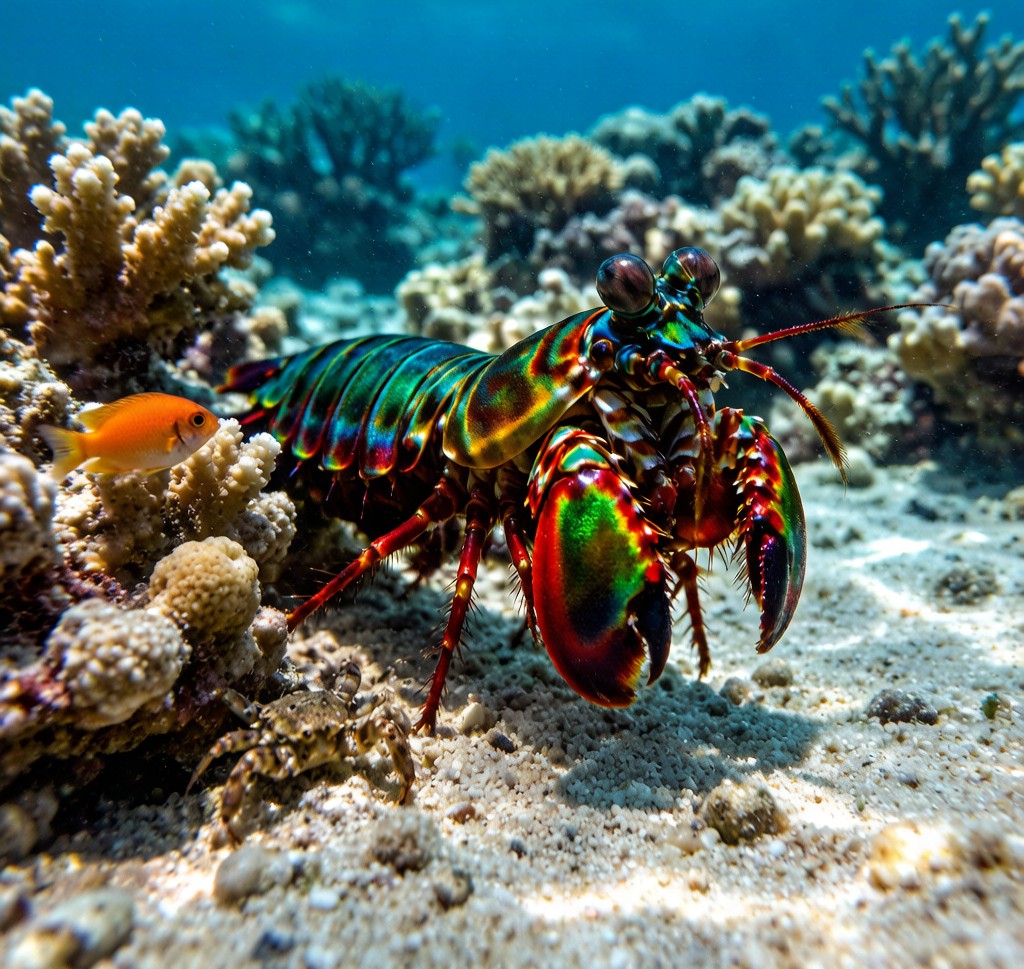
Overview
The Peacock Mantis Shrimp (Odontodactylus scyllarus) is one of the most spectacular animals on any coral reef – a small, aggressive crustacean that packs one of the most powerful punches in the animal kingdom. Found on coral reefs throughout the tropical Indo-Pacific region, from the Great Barrier Reef to the Philippines, Indonesia, Papua New Guinea, and the Hawaiian Islands, the Peacock Mantis Shrimp is famous for two things: its extraordinary beauty and its devastating strike. Growing to approximately 10 to 18 centimeters in length, the mantis shrimp’s body is covered in an iridescent coat of brilliant blue, green, and red that shimmers and changes with the light – one of the most striking color displays in the marine world.
The mantis shrimp’s second pereiopod legs are adapted into a pair of powerful, club-like weapons called dactyls, which fold back against the body like the pocket knife carried by a medieval knight. When a target – typically a hard-shelled prey item such as a crab, snail, or clam – comes within striking range, the mantis shrimp unleashes one of the fastest strikes in the animal kingdom. Its punch accelerates at over 100,000 meters per second squared, generating forces of up to 1,500 newtons – enough to shatter aquarium glass, smash a crab’s shell, and deliver a blow that has been compared to a .22 caliber bullet. The strike is so fast that it produces a flash of light (cavitation) and temperatures approaching the surface of the sun in the immediate vicinity of the impact.
Vision and Sensory World
The Peacock Mantis Shrimp possesses one of the most complex visual systems of any animal on Earth – a sensory capability that is fundamentally different from anything found in any other creature. While most animals with color vision have three types of color photoreceptor cells (cones), the mantis shrimp has sixteen: twelve for color detection across the visible spectrum and beyond into the ultraviolet and infrared, plus four for detecting different wavelengths of polarized light. This extraordinary visual range allows the mantis shrimp to see ultraviolet and infrared light, perceive polarized light patterns (which are invisible to most other animals), and detect colors with a precision that far exceeds human capability.
Most remarkably, the mantis shrimp’s color vision appears to work differently from that of other animals. Rather than comparing signals from different photoreceptor types the way humans and other animals do (a process called color mixing), the mantis shrimp appears to detect specific wavelengths directly – essentially using its color receptors as a rainbow spectrometer rather than a color mixer. Scientists are still debating whether this means the mantis shrimp actually “sees” color in the same way we do, or whether its visual system works on fundamentally different principles that process color information more directly. What is clear is that the mantis shrimp’s visual world is radically different from our own – a rich, multidimensional sensory landscape of colors, polarization patterns, and wavelengths that we can barely imagine.
Habitat and Behavior
The Peacock Mantis Shrimp lives in burrows excavated in coral rubble, sand, or soft limestone on shallow tropical reef flats and reef slopes at depths of 3 to 40 meters. Each mantis shrimp maintains a territory centered on its burrow – a tubular excavation with one or more chambers – from which it emerges to hunt and to court potential mates. The species is highly territorial and aggressive, and resident mantis shrimp will attack and drive off any intruder of comparable or smaller size, including other mantis shrimp. These fights can be violent and may result in serious injury or death. The burrow serves as a refuge from predators, a site for mating and egg-laying, and a base for hunting expeditions.
Despite its fearsome reputation, the Peacock Mantis Shrimp poses no danger to healthy humans – attacks on people are extremely rare and are almost always in self-defense when the shrimp is cornered or handled. However, a strike from a large mantis shrimp can cause painful injuries that require medical attention, and aquarium owners are warned to handle them with extreme caution. In home aquaria, mantis shrimp are sometimes introduced inadvertently on live rock, where they can become destructive predators that will attack and eat fish and invertebrates, and can even shatter aquarium glass with their powerful strikes.
Conservation
The Peacock Mantis Shrimp is not currently considered globally threatened and is listed as Least Concern on the IUCN Red List. However, the species faces increasing pressure from coral reef degradation and loss. Coral reefs – the mantis shrimp’s primary habitat – are among the most threatened marine ecosystems on Earth, with approximately 50 percent of the world’s coral reefs having been lost or severely degraded over the past three decades due to ocean warming, acidification, pollution, overfishing, and physical destruction. The Peacock Mantis Shrimp’s reliance on coral rubble and live coral for burrow construction makes it particularly vulnerable to reef degradation.
On a positive note, the Peacock Mantis Shrimp is one of the most popular animals in the marine aquarium trade, which has created an economic incentive for reef conservation in some areas. While harvesting mantis shrimp for the aquarium trade is generally sustainable (they are relatively long-lived and populations can recover), the collection of mantis shrimp from coral reefs may have localized impacts on population density. Conservation efforts focus on protecting coral reef habitats through marine protected areas, reducing ocean warming and acidification through climate action, and monitoring mantis shrimp populations as indicators of reef ecosystem health.