 By st20113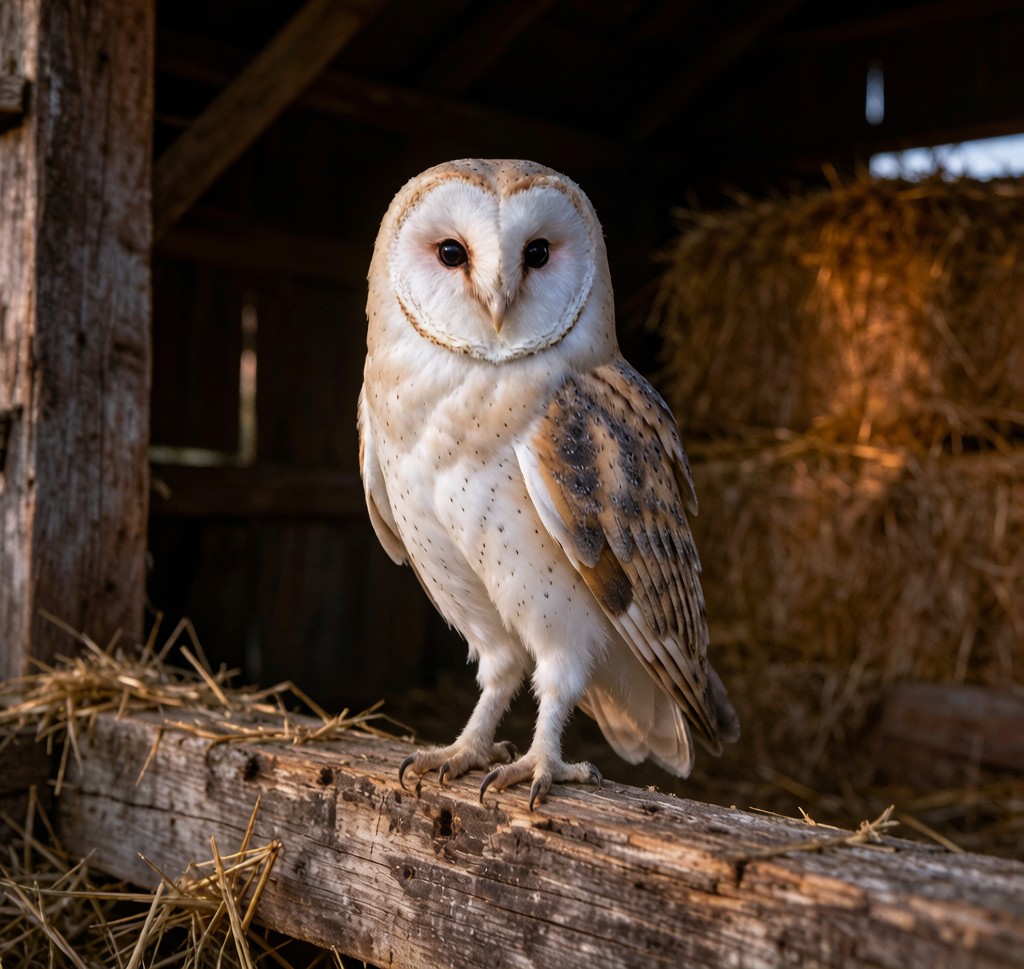
Overview
The Barn Owl (Tyto alba) is one of the most widespread and recognizable birds in the world – found on every continent except Antarctica, in an extraordinary diversity of habitats from farmland and grassland to deserts, marshes, and even urban environments. The Barn Owl is instantly recognizable by its distinctive heart-shaped face – a disk of pure white feathers that gives it an eerily human or ghostly appearance – and its pale, buff-colored upperparts mottled with grey and black. Unlike most other owls, the Barn Owl has long legs, a relatively slim body, and no ear tufts, giving it a streamlined, dove-like silhouette when seen in flight. It is a medium-sized owl, with a wingspan of approximately 80 to 95 centimeters and a body length of 33 to 39 centimeters.
The Barn Owl is perhaps the most globally distributed of all land birds, with at least 28 subspecies recognized across its vast range. Its success is attributable to its remarkable adaptability: the species can breed in an enormous variety of habitats, requires only small, dry cavities for nesting (often in old buildings, hollow trees, or cliff crevices), and feeds primarily on small mammals that are abundant in most environments. The Barn Owl is also known for its characteristic screech – a long, piercing, haunting scream – which is very different from the hooting call of many other owl species and has contributed to the bird’s association with ghosts and supernatural presences in folklore across the world.
Silent Flight and Hunting
The Barn Owl is one of the most stealthy hunters in the bird world, thanks to its extraordinary silent flight – a hunting adaptation so effective that prey animals are often unaware of the owl’s approach until the fatal strike. The Barn Owl’s feathers are uniquely modified for silent flight: the leading edge of each wing feather has a comb-like fringe that breaks up the turbulence that normally creates aerodynamic noise, while the soft, velvety surface of the upperparts absorbs the sound of air passing over the wings. The result is a bird that flies almost completely silently – a ghost moving through the night.
Barn Owls hunt almost exclusively at night, using a combination of exceptional low-light vision and ultra-sensitive hearing to locate prey in total darkness. Their facial disk – the heart-shaped arrangement of feathers around the eyes and ears – functions as a parabolic reflector, funnelling sound toward the owl’s highly asymmetrically placed ear openings. This allows a Barn Owl to pinpoint the location of a mouse rustling in grass with extraordinary precision, even when the mouse is hidden under leaf litter or snow. Once prey is located, the owl drops silently onto it from above, grasping it with sharp talons and killing it with a bite to the neck. The majority of a Barn Owl’s diet – typically 90 percent or more – consists of small mammals, particularly voles, mice, and rats, making the species one of the most economically valuable birds for agriculture.
Breeding and Nesting
Barn Owls are monogamous and typically form long-term pair bonds that may persist across multiple breeding seasons. The male attracts a female through aerial displays – circling above the nesting territory at night while giving a distinctive chattering call – and by offering food gifts. The pair selects a nest site – typically a dry, sheltered cavity such as an old barn, a church steeple, a hollow tree, or a cliff crevice – and the female lays 4 to 7 white eggs (sometimes up to 12) on the bare floor of the cavity. The eggs are incubated for approximately 30 to 34 days, with the female doing most of the incubation while the male provides food.
What makes Barn Owl breeding particularly notable is the species’ remarkable breeding flexibility: Barn Owls are one of the most opportunistic breeders of any bird, capable of breeding at any time of year when conditions are favorable. If prey is abundant, a pair may raise two or even three broods in a single year; in times of prey scarcity, breeding may not occur at all. This flexibility means that Barn Owl populations can respond rapidly to changes in prey availability – a critical adaptation for a predator that depends on small mammal populations that can fluctuate dramatically from year to year. However, it also means that Barn Owl populations are highly sensitive to factors that reduce prey availability, including agricultural intensification and the use of rodenticides.
Conservation
The Barn Owl is listed as Least Concern on the IUCN Red List, reflecting its large global population – estimated at approximately 4 to 10 million individuals – and its vast range. However, this masks significant population declines in many parts of the world, particularly in Western Europe and parts of North America, where agricultural intensification, the loss of traditional farm buildings, and the use of rodenticide poisons have caused local populations to crash. In the United Kingdom, for example, Barn Owl populations declined by approximately 70 percent between the 1930s and the 1980s due to changes in farming practice, though populations have partially recovered following targeted conservation programs.
Conservation efforts for the Barn Owl focus on maintaining and creating nesting habitat (particularly traditional barns and farm buildings), providing nest boxes in areas where natural cavities are scarce, reducing the use of rodenticide poisons that accumulate through the food chain and kill owls indirectly, and maintaining rough grassland and hedgerow habitat that supports the small mammal populations on which Barn Owls depend. The Barn Owl is one of the most popular species for nest box programs worldwide, and hundreds of thousands of artificial nest boxes have been erected in farmland areas to compensate for the loss of traditional nesting sites.