 By st20113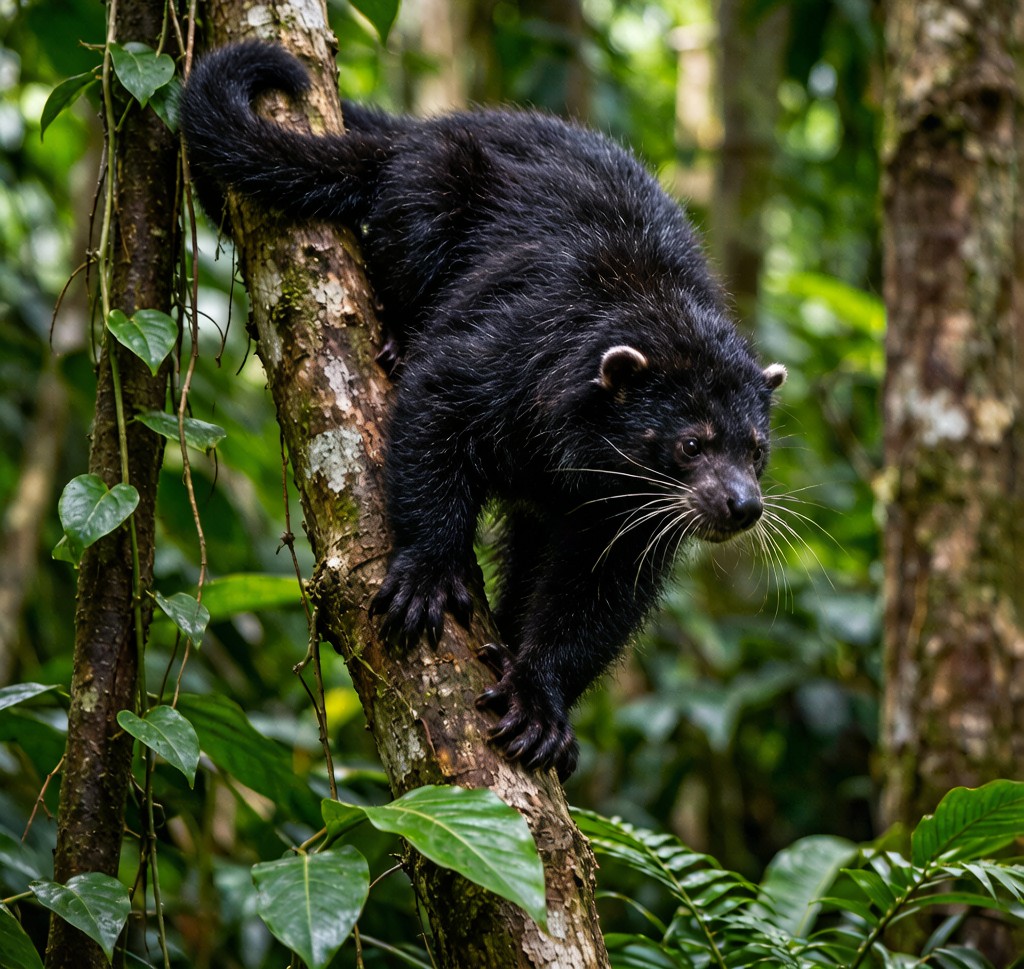
A Binturong (Arctictis binturong) climbing a tree in the Southeast Asian tropical rainforest, showing its prehensile tail and shaggy black fur
Overview
The Binturong (Arctictis binturong), also known as the bearcat – despite being neither bear nor cat but a member of the civet and mongoose family (Viverridae) – is one of the most unusual and least-known mammals of the Asian rainforest. Found from northeastern Pakistan and Bhutan through southern China to the islands of Borneo, Sumatra, and Java, the Binturong is one of the largest arboreal mammals in Asia, weighing 9 to 20 kilograms with a body length of 60 to 95 centimeters and an additional 55 to 95 centimeters of prehensile tail. Its distinctive shaggy, dark fur, small round ears, and long, semi-prehensile whiskers give it a uniquely tousled appearance – as if it has just emerged from a particularly vigorous windstorm.
The Binturong is one of only two carnivores with a fully prehensile tail – the other being the kinkajou of Central and South America. The Binturong’s tail can be used as a fifth limb, allowing it to grip branches and hang suspended while foraging. The species is also one of the few carnivores that can rotate its hind feet to grip a branch while descending a tree headfirst – a remarkable feat of biomechanical engineering that gives it unrivalled agility in the forest canopy. Despite its bulk, the Binturong is almost entirely arboreal and descends to the ground only rarely.
Habitat and Distribution
The Binturong occurs throughout South and Southeast Asia, from the Himalayan foothills of northeastern Pakistan, India, Nepal, and Bhutan, through mainland Southeast Asia (Myanmar, Thailand, Laos, Vietnam, Cambodia, and Malaysia), to the islands of Borneo, Sumatra, and Java. Within this vast range, the species inhabits primary and secondary tropical rainforest, with a preference for areas with dense canopy cover and abundant fruit. The Binturong is most common in lowland forest and is rarely found above 500 meters elevation, though it has been recorded up to 1,000 meters in some areas.
The Binturong is highly sensitive to forest disturbance and is rarely found in degraded or fragmented forest habitats. Like many large arboreal mammals, the Binturong requires continuous forest canopy for movement and is unable or unwilling to cross open ground between forest fragments. This makes the species particularly vulnerable to the ongoing deforestation and forest fragmentation that is the primary conservation challenge throughout its range. The loss of tropical rainforest across Southeast Asia has caused significant Binturong population declines in many areas.
Diet and Unusual Biology
The Binturong has an unusual diet for a carnivore – it is primarily frugivorous, with fruit constituting approximately 65 percent of its diet by weight. The species feeds on a wide variety of tropical fruits including figs, bananas, mangos, and other forest fruits, making it an important seed disperser in the Asian rainforest. In addition to fruit, the Binturong eats leaves, flowers, insects, small mammals, birds, fish, and carrion. Its diet is highly seasonal, reflecting the availability of different fruit species throughout the year.
The Binturong is one of very few carnivores that can ferment food using bacteria in its cecum, a trait more commonly associated with herbivores. This hindgut fermentation allows the Binturong to extract additional nutrients from fibrous plant material, supplementing its primarily fruit-based diet. Perhaps most remarkably, the Binturong produces a distinctive smell – described by researchers as resembling “buttered popcorn” – which comes from a gland at the base of its tail. This scent mark is used to communicate with other Binturongs and may serve as a territorial signal. The Binturong is primarily nocturnal, spending the daylight hours resting in tree hollows or dense canopy, and is active throughout the night foraging in the forest.
Conservation
The Binturong is listed as Vulnerable on the IUCN Red List, with populations declining throughout its range as a result of habitat loss, hunting, and the illegal wildlife trade. The species is widely hunted throughout its range for its meat, for use in traditional medicine, and for the illegal pet trade – baby Binturongs are reportedly taken from the wild and sold as exotic pets in several Southeast Asian countries. The pet trade is of particular concern because Binturongs do not fare well in captivity and the taking of infants from the wild reduces reproductive output of wild populations.
Conservation efforts focus on protecting large areas of tropical rainforest throughout the Binturong’s range, reducing hunting pressure through law enforcement and community engagement programs, and improving understanding of the species’ population status and distribution through camera trap surveys. The Binturong also plays an important role as a seed disperser of fig and other tropical fruit trees, and its conservation benefits the entire forest ecosystem. In some areas, Binturongs have been found to be relatively tolerant of disturbed forest and agricultural landscapes with scattered trees, offering some hope for the species’ persistence in human-modified landscapes if sufficient tree cover is maintained.
[…] several species in the genus Viverra, within the family Viverridae, a group that also includes the binturong and the smaller genet. Civets are Old World relatives of cats and mongooses, occupying an […]
[…] the genus Genetta, within the family Viverridae, a group related to the large-spotted civet and the binturong. Viverrids are Old World relatives of cats, and genets represent one of the most cat-like branches. […]