 By st20113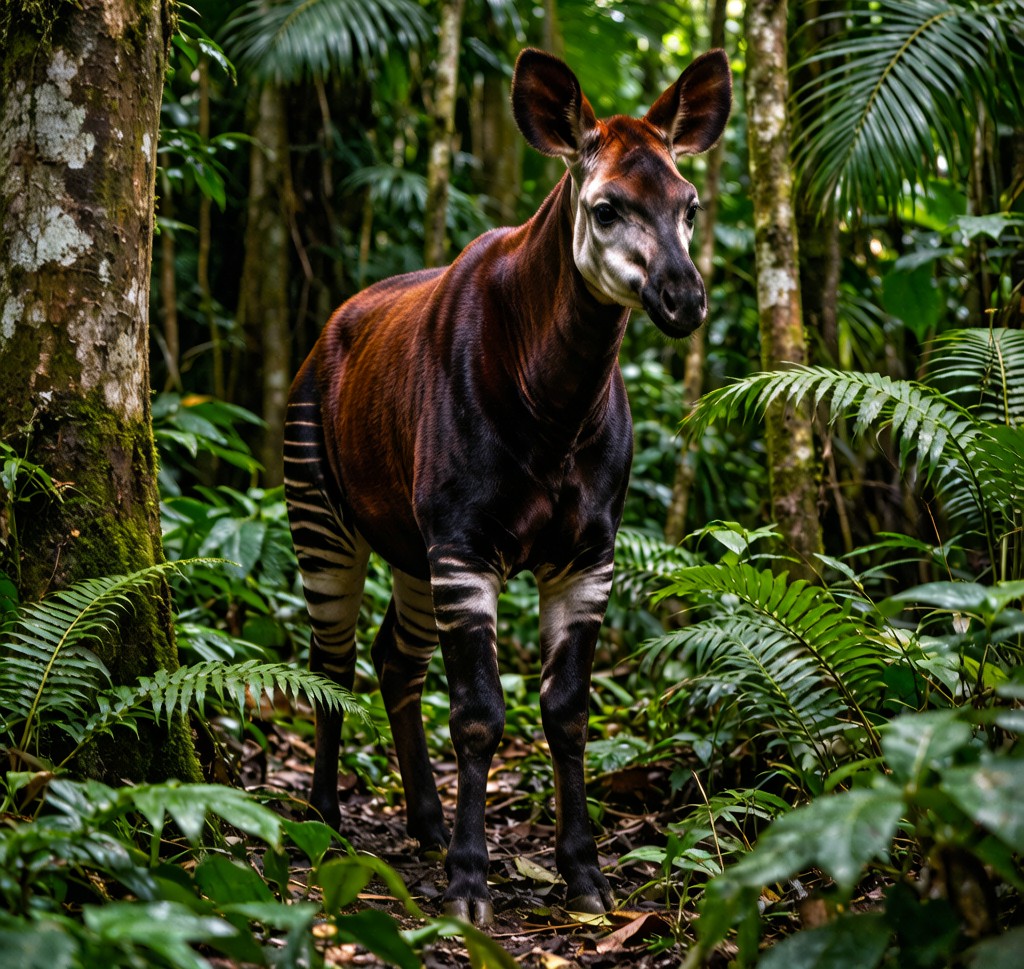
An Okapi (Okapia johnstoni) standing in the dense Ituri rainforest of the Democratic Republic of Congo, showing its zebra-like leg stripes
Overview
The Okapi (Okapia johnstoni) is one of the most remarkable zoological discoveries of the 20th century – an animal so elusive and so restricted in range that it remained entirely unknown to Western science until 1901. Found only in the dense rainforests of the northeastern Democratic Republic of Congo in Central Africa, the Okapi is a striking animal that looks like it could be the result of a cross between a giraffe and a zebra: its body and neck resemble a small, compact giraffe, while its legs and hindquarters are adorned with the zebra’s distinctive horizontal black-and-white stripes. The Okapi stands approximately 1.5 meters at the shoulder and weighs 200 to 350 kilograms, making it the second-largest forest mammal in Africa after the forest elephant.
Despite its giraffe-like appearance, the Okapi is the only living member of the family Giraffidae besides the giraffe itself, representing a remarkable evolutionary divergence between two dramatically different body plans. Both species share unique anatomical features, including a long, dark, velvety tongue that is long enough to clean the animal’s own eyelids and ears – a tongue that is approximately 30 to 36 centimeters long in the Okapi. The Okapi is a shy, solitary animal that is rarely seen even by the local Congolese people, earning it the local name of “forest elephant” or “Congo peacock” – a reference to its status as a prized and almost mythical animal.
Habitat and Distribution
The Okapi occurs only in the Ituri and adjacent forests of northeastern Democratic Republic of Congo, an area of approximately 400,000 square kilometers of lowland tropical rainforest. Within this range, the Okapi is strongly associated with areas of undisturbed primary rainforest with dense understory vegetation, particularly along riverbanks and in swampy forest areas. The species is absent from forest clearings, secondary growth, and human-modified landscapes.
The Ituri Forest – one of the largest blocks of tropical rainforest in Africa – is also home to forest elephants, forest buffaloes, 13 species of monkey, and one of the most diverse communities of forest birds in Africa. The Okapi is the flagship mammal of this ecosystem, and its conservation status has become a barometer for the health of the Ituri Forest. The forest faces multiple threats, including logging, artisanal and industrial mining (particularly for coltan, cobalt, and gold), civil conflict that has destabilized law enforcement, and hunting for bushmeat. The Okapi’s habitat has been particularly affected by the expansion of artisanal mining in recent years.
Behavior and Ecology
The Okapi is primarily diurnal and crepuscular – active during the day and around dawn and dusk – spending most of its active hours foraging in the forest understory. It is a browser that feeds on leaves, buds, and shoots of over 100 different plant species, as well as fruit, fungi, and occasionally small vertebrates. Its diet is highly seasonal, with the Okapi shifting from fruit and leaves in the wet season to bark and woody stems in the dry season when other food is scarce. Like giraffes, Okapis are ruminants with a four-chambered stomach that allows them to digest tough plant material.
Okapis are highly territorial and largely solitary outside of mating. Males maintain home ranges of approximately 12 to 13 square kilometers, while females use smaller areas of approximately 5 to 7 square kilometers. Individuals communicate using a variety of methods, including scent marking with urine and secretions from foot glands, and a characteristic “chimpanzee-like” cough vocalization that researchers have described as one of the most distinctive forest sounds. Okapi calves are born after a gestation of approximately 15 months – one of the longest of any ungulate – and are concealed in dense vegetation for the first few weeks of life, visiting the mother only for brief nursing sessions, a strategy that may reduce predation risk.
Conservation
The Okapi is listed as Endangered on the IUCN Red List, with populations declining as a result of multiple, overlapping threats. The primary threat is hunting for bushmeat, which has intensified dramatically as urban populations in eastern DRC have grown and demand for bushmeat has increased. The Okapi is also threatened by habitat destruction from logging and mining, particularly the expansion of artisanal mining for coltan, gold, and cobalt in the Ituri Forest. Civil conflict in the region has undermined conservation efforts and made it difficult to patrol and protect Okapi habitat.
The Okapi was first described to Western science by Sir Harry Johnston in 1901, based on specimens obtained from local Congolese communities near the Congo River. The species has been central to the establishment and operation of the Okapi Wildlife Reserve – a UNESCO World Heritage Site in the Ituri Forest – which remains one of the most important conservation areas for the species. Conservation efforts focus on strengthening law enforcement against hunting and illegal mining in the reserve, supporting community-based conservation programs with local Congolese communities, and continuing scientific research into Okapi ecology and population status through camera traps and field surveys. The Okapi’s cultural importance in Congolese communities – reflected in its depiction in masks and carvings in the courts of the Mangbetu kingdom – adds cultural value to its conservation.
[…] nearest living relatives are elephants and sea cows. It shares its rocky home with animals like the Okapi. That pairing surprises most […]