 By st20113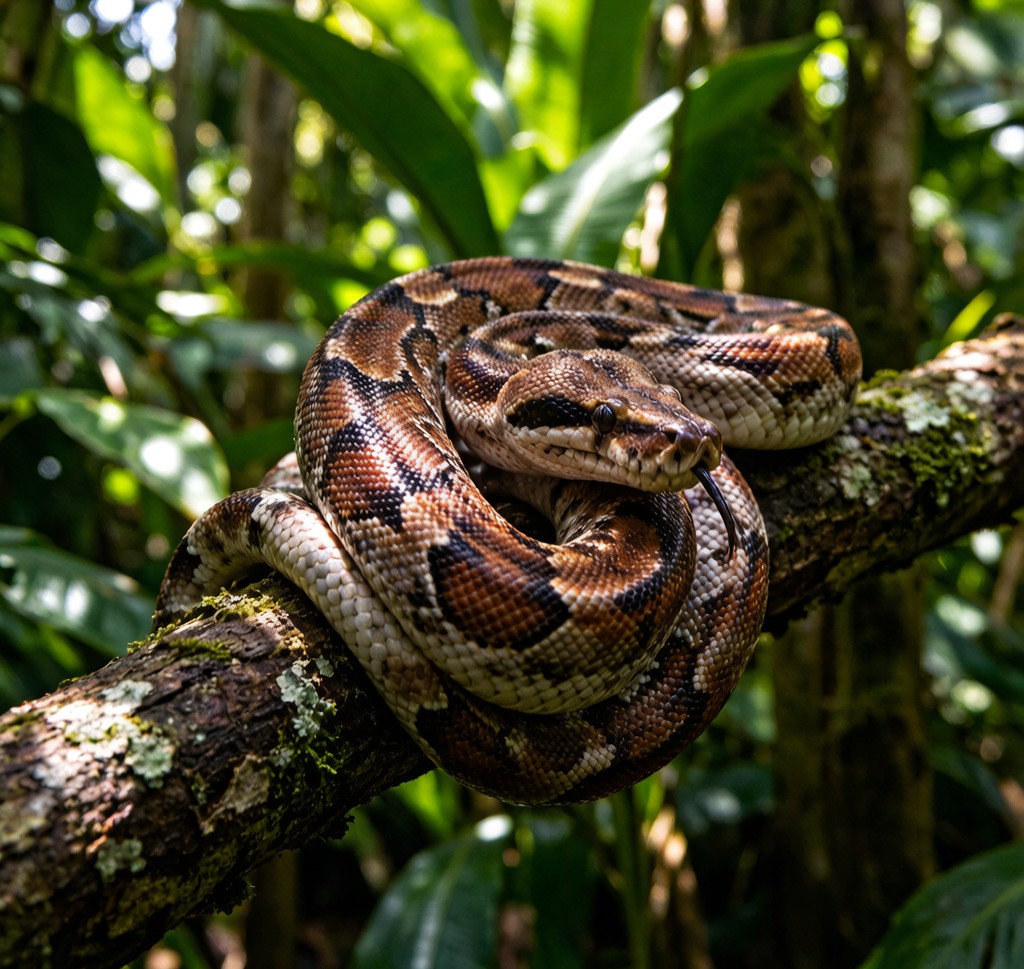
A Boa Constrictor (Boa constrictor) coiled around a branch in the tropical rainforest, showing its characteristic saddle pattern
Overview
The Boa Constrictor (Boa constrictor) is one of the largest and most well-known non-venomous snakes in the Americas. Ranging from Argentina north through Central America to southern Mexico, and also found on islands including Trinidad and Tobago and Hoga in the Lesser Antilles, the Boa Constrictor is an ambush predator that uses its powerful body to squeeze and kill prey before swallowing it whole. Its striking pattern of dark dorsal saddles, its impressive size, and its popularity in the exotic pet trade have made this snake one of the most recognizable reptiles in the world.
Boa Constrictors are large, heavy-bodied snakes. Males are typically smaller than females, with adults averaging 1.5 to 2.5 meters in length, though females in some populations can reach 3 to 4 meters and weigh over 30 kilograms. The longest confirmed specimen measured 5.5 meters. Their body is adorned with distinctive oval or irregular dark brown to reddish-brown saddles with black edges, set against a lighter tan, gray, or cream background. These patterns provide excellent camouflage in the dappled light of forest environments.
Habitat and Distribution
The Boa Constrictor occupies a vast geographic range across tropical Central and South America, from 27 degrees south latitude in Argentina to southern Mexico. Within this range, the species exploits an extraordinary diversity of habitats, from tropical rainforest and cloud forest to dry deciduous forest, thorn scrub, semi-desert margins, and even agricultural landscapes. They are most abundant in primary forest, where their cryptic coloration provides optimal camouflage.
Boa Constrictors are excellent climbers and swimmers, and they utilize both terrestrial and arboreal strata within their habitat. Juvenile and smaller individuals spend significant time in trees, while larger adults are more often found on the ground. They are primarily nocturnal and crepuscular, though they can be active during the day in cooler seasons. During the day, they shelter in hollow logs, animal burrows, rocky crevices, and the buttresses of large trees.
Diet and Hunting
The Boa Constrictor is an obligate carnivore and an ambush predator. It feeds on a wide variety of prey appropriate to its size – small juveniles take lizards and rodents, while adults target mammals including opossums, agoutis, pacas, capybaras, and monkeys, as well as birds and occasionally caiman. The snake uses a sit-and-wait strategy, coiling motionless near game trails or water sources, then striking with remarkable speed when prey comes within range.
The killing method – often mischaracterized as suffocation – involves the snake coiling its muscular body around the prey and applying pressure with each exhalation of the prey’s breath. This pressure prevents the prey’s heart from beating and causes circulatory collapse within seconds to minutes. The snake then swallows the prey head-first, using its recurved teeth and highly flexible jaws to accommodate prey up to several times the snake’s own head diameter. Digestion can take several days to over a week, during which time the snake remains largely inactive.
Reproduction
Boa Constrictors are ovoviviparous – eggs develop and hatch inside the mother’s body, with females giving birth to live young. Litters typically number 20 to 50 neonates, though some very large females have been recorded producing over 60 babies at once. Newborn boas measure approximately 40 to 50 centimeters at birth and are immediately independent, capable of climbing, swimming, and hunting small prey. They exhibit a particularly vivid coloration as juveniles, which fades somewhat as they mature.
Boa Constrictors reach sexual maturity at approximately 3 to 4 years of age for males and 4 to 5 years for females. Males engage in ritualized combat contests during the breeding season, intertwining their bodies and competing to force each other’s head to the ground. The victorious male has mating rights with any receptive females in the vicinity. Females do not feed during the latter stages of pregnancy, as the distended body reduces mobility, and may go without food for several months before giving birth.
Conservation and Human Interaction
In the wild, Boa Constrictors face predation from jaguars, cougars, large raptors, and crocodilians, particularly as juveniles. However, the greatest threats come from humans. Boa Constrictors are hunted for their skin (used in leather production), for their meat, and for the illegal pet trade. In some regions, they are killed by farmers who view them as threats to poultry and small livestock. Forest clearance destroys their habitat and exposes them to increased human contact.
Despite these pressures, the Boa Constrictor remains one of the more widespread and adaptable large snakes in the Americas, and the IUCN lists it as Not Globally Threatened. However, several island subspecies and isolated populations have been severely impacted by overharvesting and habitat loss. The species is protected under Appendix II of CITES, which regulates international trade, and is listed in the national red data books of several range countries.
species was described by Carl Linnaeus in 1758. As boas, anacondas are more closely related to the boa constrictor than to pythons, from which they differ in giving birth to live young and in possessing small